


MCPA 750 Herbicide: A Complete Guide
Table of Contents

Thistles in your pasture. Capeweed smothering a paddock after a wet winter. Wild radish coming up through a winter cereal just when you needed a clean crop establishment. These are all common problems that MCPA 750 was built to solve, and in Australian broadacre farming, it is one of the most relied-upon selective herbicides on the market.
MCPA 750 is not new. It has been used in Australian agriculture since the 1940s and has a well-established track record across many situations. But longevity alone doesn’t explain why it’s such a staple in the spray programs of cereal growers, graziers, turf managers, and groundskeepers nationwide. It persists because it provides broad, reliable control of over 80 broadleaf weed species while leaving grasses and grass-based crops essentially unharmed.
This guide covers what MCPA 750 is, how it works, where and when to use it, and who should use it, followed by some practical tips from our team that will help you elicit a clean paddock rather than just an average result.
What is MCPA 750?
MCPA 750 is a selective liquid herbicide containing 750 g/L of the active ingredient MCPA (2-methyl-4-chlorophenoxyacetic acid), present as the dimethylamine salt. It belongs to the phenoxy group of herbicides and is classified as a Group I herbicide under the Australian herbicide mode of action classification system, which groups it alongside other herbicides that disrupt plant cell growth.
The active ingredient MCPA mimics the action of natural plant growth hormones called auxins. When a susceptible broadleaf plant absorbs it, it causes uncontrolled, unsustainable cell division and growth. Stems twist and curl, leaves distort and wither, and the plant’s vascular system breaks down. The result is plant death, typically within days to a few weeks depending on weed species, size, and seasonal conditions.
Importantly, grasses and grass-based crops do not respond to MCPA in the same way as broadleaf plants. This is why MCPA is so valuable: it kills broadleaf weeds while leaving the grasses growing around them unaffected, provided it is applied correctly and within the crop’s registered growth window.
How does MCPA 750 herbicide work?
MCPA 750 is systemic and post-emergent, which means it must be applied to weeds that have already emerged from the ground and, once absorbed, will move through the plant rather than simply burning the tissue it contacts. Uptake occurs through the foliage and, though to a lesser extent, the roots. From there, the product is translocated through the plant’s vascular system to the growing points in the shoots and roots where the active ingredient accumulates and disrupts normal auxin balance.
This systemic translocation is what makes MCPA 750 so effective at controlling perennial weeds and annuals. For annuals, spraying young plants whilst still actively growing gives the fastest and most reliable kill. For perennials like nodding thistle and horehound, MCPA is most effective when applied just before the bud stage, when the plant is moving carbohydrates to its roots. This helps the herbicide to translocate deep into the plant rather than remaining near the spray point.
Which weeds does MCPA 750 control?
MCPA 750 is registered to control over 80 broadleaf weed species commonly found in Australian agricultural and turf contexts. Additionally, the Grains Research and Development Corporation (GRDC) notes that Group I herbicides like MCPA are important tools in managing broadleaf resistance in northern Australian farming systems, where they provide an alternative mode of action to glyphosate in fallow weed programs.
Here are some of the most relevant weed species controlled by MCPA for land managers and farmers to consider.
Thistles
MCPA 750 is a preferred product for thistle control in Australia, with strong activity against the following types of thistle:
- Artichoke thistle (Cynara cardunculus)
- Nodding thistle (Carduus nutans)
- Saffron thistle (Carthamus lanatus)
- Scotch thistle (Onopordum acanthium)
- Slender thistle (Carduus pycnocephalus)
- Soldier thistle (Picnomon acarna)
- Spear thistle (Cirsium vulgare)
- Star thistle (Centaurea calcitrapa)
- Variegated thistle (Silybum marianum)
Capeweed
A major problem weed across southern Australia, capeweed is well controlled by MCPA 750, particularly when it is targeted as young rosettes. Product labels for MCPA 750 warn that capeweed may become more palatable to stock after spraying and can be poisonous in some circumstances, so a 7-day withholding period applies.
Paterson’s curse
Paterson’s curse is controlled by MCPA 750, but label directions on the relevant herbicide products carry specific warnings: avoid grazing with young or breeding stock, do not graze horses or pigs after spraying, and preferably use stock destined for slaughter. This weed can cause nitrate poisoning in some situations after herbicides are applied.
Broadleaf weeds in crops or pastures
MCPA 70 can also be used on the following broadleaf weeds found in crops or pastures:
- Bathurst burr (Xanthium spinosum)
- Bindweed (Convolvulus arvensis)
- Charlock (wild mustard or field mustard) [Sinapis arvensis]
- Docks (Rumex spp.)
- Doublegee (Rumex hypogaeus)
- Fat hen (Chenopodium album)
- Fumitory (Fumaria spp.)
- Horehound (Marrubium vulgare)
- Noogoora burr (Xanthium strumarium)
- Plantains (Plantago spp.)
- Skeleton weed (Chondrilla juncea)
- Sorrel (Rumex acetosa)
- Wild radish (Raphanus raphanistrum)
- Wild turnip (Brassica tournefortii)
These and many more weed species can be found on the registered weed list for MCPA 750.
Turf weeds
MCPA 750 also controls common broadleaf weeds in lawns and sports turf, including dandelion, flatweed (catsear), plantain, and clover, when used at appropriate rates. Note that clovers are not completely tolerant and some species will be damaged or killed, which is relevant for producers managing mixed grass-clover pastures.
Where can MCPA 750 herbicide be used?
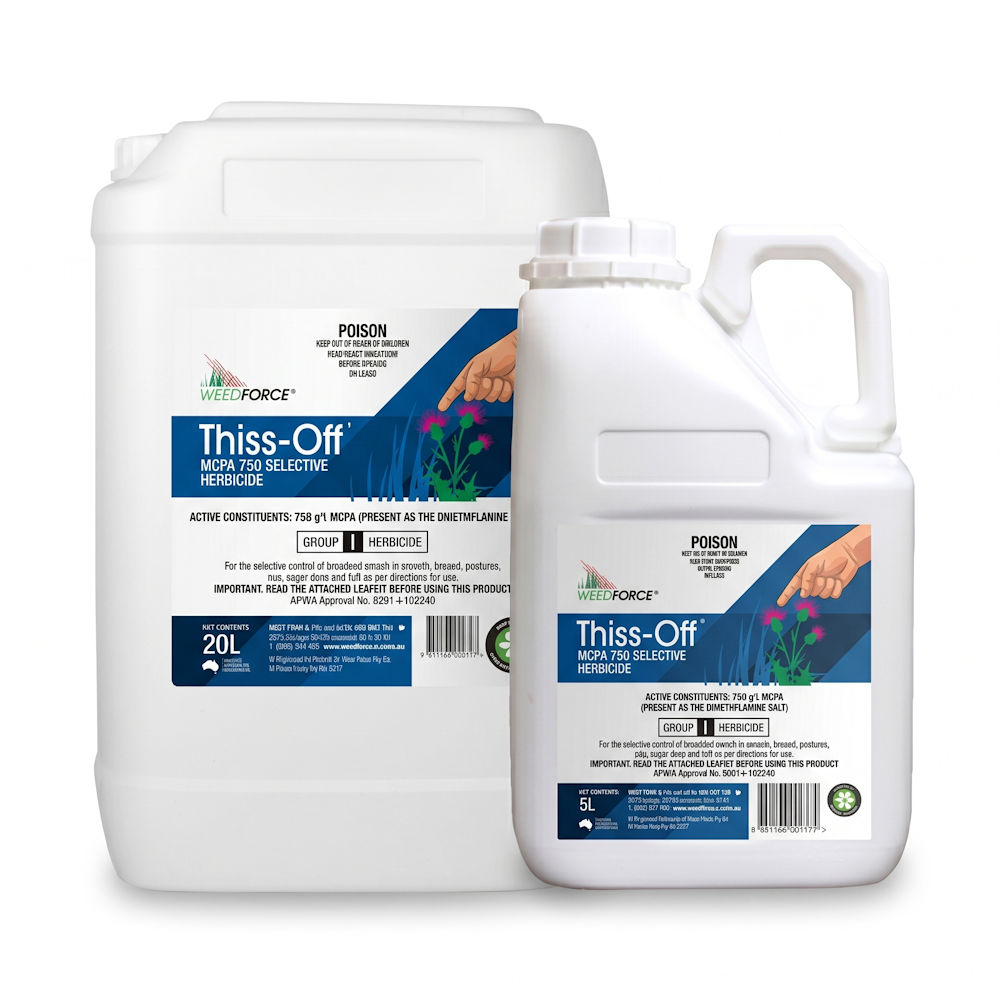
Registered use situations for MCPA 750 cover a wide range of Australian farming and land management contexts. Products like Conquest MCPA 750, Nufarm MCPA Amine 750, and Weed Force Thiss-Off Thistle and Broadleaf Herbicide – all available from Specialist Sales – have largely the same registered use patterns as follows.
Broadacre cereals
MCPA 750 is registered for use in wheat, barley, oats, triticale, and cereal rye. The critical timing window for most cereals is from the 3-leaf stage through the flag leaf emergence (Zadoks Growth Scale 13-37), with rates that increase as the crop grows. Do not spray at or after flag leaf emergence.
The lower rate applies in early growth stages, and the higher rate is permitted once the crop has established several leaves and can tolerate the product better. Application within the correct window is not just best practice – applying outside the registered growth stage can cause crop damage and reduced yield.
Pastures and grass seed crops
Pasture and grass seed crop use is arguably the most common MCPA 750 application for Australian graziers. It is ideal for controlling thistles and other broadleaf weeds in established grass-based pastures, including ryegrass, phalaris, cocksfoot, and other similar perennial pastures.
MCPA is widely preferred over 2,4-D amine in pastures where legumes are present as it is somewhat less damaging to clovers and medics. However, legume damage is still possible, particularly at higher rates or when used on smaller plants.
MCPA 750 is also suited to the spray-graze technique, where weeds are sprayed and stock are introduced 7 to 10 days later at high stocking rates (at least five times higher than normal) to graze off the dying weeds before they can regenerate. This approach can significantly reduce weed seed set and improve pasture recovery after treatment.
Other broadacre crops
MCPA 750 is also registered for use in the following contexts:
- Linseed and flax in Victoria and Tasmania only, when the drop is 8 to 20cm high
- Field peas for control of prickly lettuce and charlock
- Sugar cane for bellvine, billygoat weed, morning glory, Noongoora burr, and related weeds
- Rice, applied 45 or more days after cereal sowing with water level management required
Each crop will have specific directions on the relevant MCPA 750 product label that must be followed to ensure crop safety.
Turf (lawns and sports fields)
Finally, MCPA 750 is registered for broadleaf weed control in established turf including couch, Kikuyu, buffalo, ryegrass, and fescue-based lawns and playing fields. The key restriction for turf use is that buffalo grass is more easily damaged than other grass species, so it’s important to exercise care when selecting rates and timing applications. Do not spray newly laid turf until it is well established (at least two months old), and do not mow for two days before application.
Registered uses, timing, and general rates
Who is MCPA 750 herbicide for?
MCPA 750 has a broad user base across Australian primary industries and land management:
-
- Broadacre grain growers use it as an in-crop broadleaf herbicide in winter cereals, typically tank-mixed with bromoxynil or other compatible actives to extend the weed spectrum.
- Mixed-enterprise farmers and graziers use it to manage thistle pressure in pastures, especially in high-rainfall zones where nodding and variegated thistles are persistent problems.
- Cropping farmers in northern Australia use MCPA 750 as a Group I herbicide in tank mixes with glyphosate during fallow weed management to provide a different mode of action that slows resistance development. This is consistent with GDRC guidance on resistance management in broadleaf weeds.
- Turf managers and groundskeepers at sports fields, racetracks, golf courses, and public parks use it to manage broadleaf weed pressures in grass-based turf.
- Hobby farmers and large rural property owners use it to manage capeweed, thistles, and other persistent broadleaf weeds in and around grazing areas.
Key features and benefits of MCPA 750
MCPA 750 herbicide offers a wide range of benefits to users:
- Broad-spectrum broadleaf control: Over 80 weed species are listed on registered product labels, covering the majority of major species encountered in Australian cereal, pasture, and turf situations.
- Grass-safe selectivity: MCPA 750 does not damage grass crops or grass-based pastures when applied within the registered timing window and at label rates.
- Systemic translocation: This herbicide type moves throughout the plant to provide more reliable control of perennial weeds compared to contact-only herbicides.
- 2-hour rainfastness: Once absorbed, MCPA 750 herbicide is not washed off by rainfall after just two hours, providing users with confidence in variable conditions.
- Varied compatibility: MCPA 750 tank-mixes well with bromoxynil, dicamba, diflufenican, and various other registered herbicides, which allows growers to expand the weed spectrum or increase efficacy in a single pass.
- Effectiveness where legumes are undersown: In cereal crops or pastures with legume content, MCPA is less damaging to clovers and medics than 2,4-D amine or ester.
- Cost-efficacy at scale: MCPA 750 is often available in larger pack sizes, making it economical for bigger operations where broad coverage is required.
Tips for getting the best results from MCPA 750
Spray when weeds are actively growing
MCPA 750 relies on uptake and translocation through actively growing plant tissue, so target annual weeds when they are young and growing. Perennials like thistles are most susceptible just before the bud stage, when the plant is directing energy to its roots. This allows the herbicide to move deeper into the plant.
Extreme cold, extreme heat, or drought will significantly reduce efficacy by impacting growth. The best results come from applications made when the soil moisture is adequate, temperatures are moderate, and the weather is mild and settled.
Respect the crop’s growth stage window
For cereal crops, applying outside the registered growth window is one of the most common causes of crop damage and reduced efficacy. Do not spray before the crop has reached the minimum leaf stage, and do not spray at or after flag leaf emergence. For newly released varieties, check with your agronomist before spraying, as some may be more sensitive to phenoxy herbicides than established varieties.
Avoid spray drift
MCPA 750 can seriously damage susceptible broadleaf crops, horticultural plantings, and trees if spray drifts off target. Cotton, tobacco, tomatoes, vines, fruit trees, vegetables, oilseed crops, and ornamentals are all highly sensitive to drift, and native trees like kurrajongs, belahs, and eucalypts can also be damaged. To minimise drift, do not spray in high winds, use appropriate nozzles, and consider application timing to avoid periods of wind or temperature inversion.
Tank mix appropriately
When tank mixing with other products, half-fill the spray tank with clean water before adding MCPA 750. Add the required amount of product while agitating, then top up with the remaining water and maintain agitation throughout. MCPA 750 mixes readily with water and is compatible with most commonly used herbicide tank-mix partners.
Always check compatibility before mixing with insecticides – some products can be degraded by alkaline hydrolysis in the presence of phenoxy herbicides.
Tank mix compatibility overview
Manage stock carefully after spraying
Once MCPA 750 has been applied to cereals and pastures, observe the 7-day withholding period for grazing and cutting stock food. Be aware that dying weeds – particularly capeweed, Paterson’s curse, and variegated thistle – can become more palatable to stock after spraying, and in some circumstances, consuming these plants in large quantities can cause stock losses from poisoning. Introduce stock carefully after the withholding period and monitor grazing behaviour.
Withholding period overview
Special considerations for turf
Apply MCPA 750 herbicide to turf when weeds are actively growing and conditions are suitable. Do not mow for two days before spraying on established turf, and wait at least two months before applying MCPA 750 on newly laid turf.
Buffalo grass is more sensitive than other common turf species. Use the appropriate lower rate for buffalo and watch for temporary yellowing, which should resolve as the grass recovers.
For lawns containing clover, be aware that MCPA will damage or kill clover at most registered rate. If clover retention is a priority, MCPA is not the appropriate product.
What MCPA 750 won’t do
MCPA 750 is a selective broadleaf herbicide and does not control grass weeds like ryegrass, summer grasses, or barley grass. For mixed grass and broadleaf weed infestations, you will need to tank mix MCPA with an appropriate grass herbicide, or make a separate application.
It is also not registered for use in broadleaf crops such as canola, soybeans, or chickpeas as a post-emergent herbicide. These crops are susceptible to MCPA and would be damaged or killed by in-crop application. For weed control in broadleaf crops, seek out an alternative registered option.
As a Group I herbicide, MCPA 750 carries a herbicide resistance risk. The GRDC’s guidance on post-emergent herbicide resistance in Australian farming systems notes that Group I herbicides have helped slow broadleaf resistance development in northern grain systems by providing a non-glyphosate mode of action. To protect this efficacy, rotate modes of action where possible and avoid applying Group I herbicides exclusively for multiple consecutive seasons on the same paddock.
Discover MCPA 750 herbicide at Specialist Sales
Specialist Sales stocks a range of MCPA 750 herbicides from reputable Australian and international brands. All products share the same active ingredient – 750g/L MCPA as the dimethylamine salt – and cover the same broad registered use pattern.
MCPA 750 has earned its place in Australian farming and turf management over more than 80 years of use. It is not the newest herbicide on the market, but it remains one of the most versatile, cost-effective, and reliable tools available for broadleaf weed control across cereals, pastures, and turf. When used at the right time, in the right situation, and in accordance with label instructions, it consistently delivers the clean results that producers and managers need.
If you need help selecting the right MCPA 750 product for your situation, advice on tank mix partners, or guidance on application rates for your specific weed or crop, get in touch with our team of experts.
Always read and follow the product label before use. Check that the product is registered for your specific crop, weed, and state. Rates, critical comments, and growth-stage windows vary by product and situation.
The information in this article is general in nature and does not constitute specific agronomic advice. Consult your local agronomist for guidance tailored to your property and farming system. Specialist Sales’ liability is limited; please review our Terms and Conditions for more information.
About the author