



7 Mistakes Farmers Make When Spraying Woody Weeds (and How to Fix Them)
Table of Contents
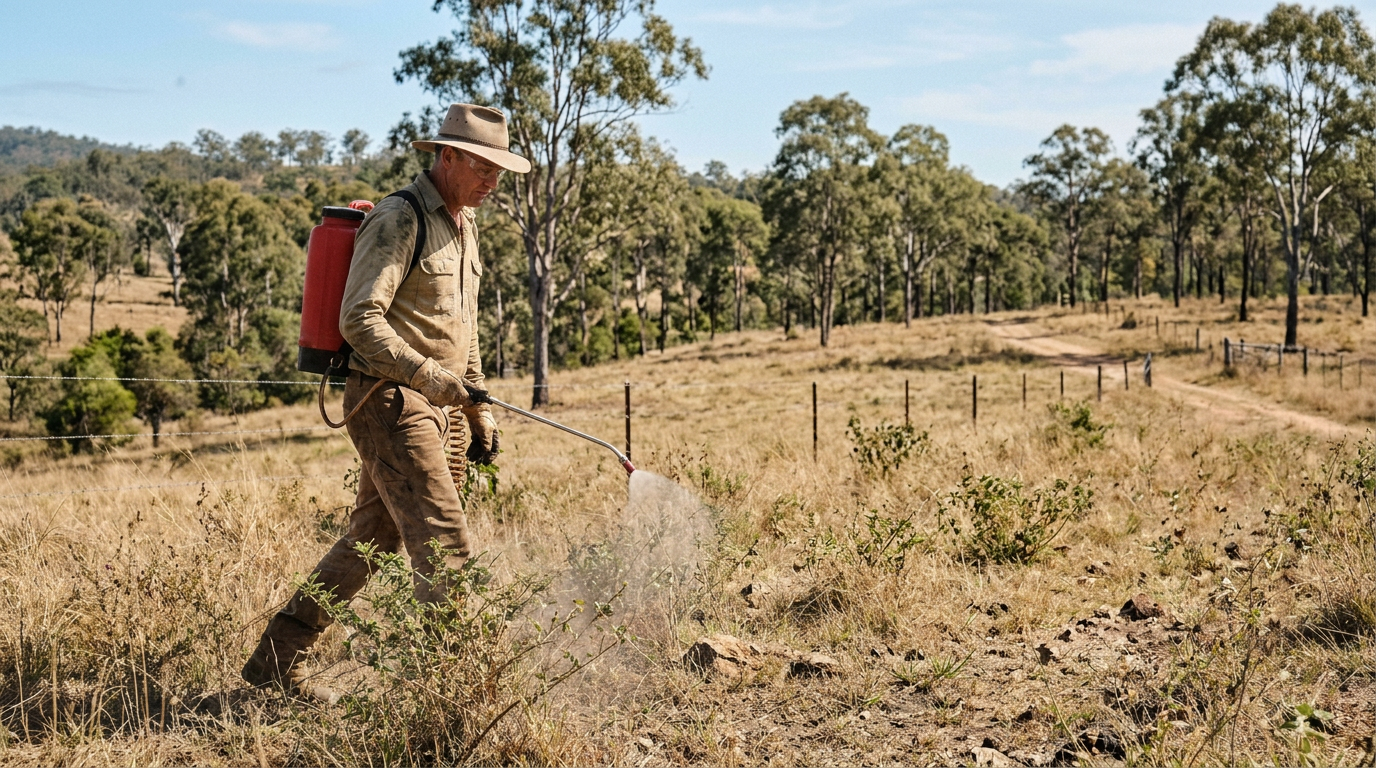
Woody weeds cost Australian agricultural producers an estimated $4.34 billion a year in control expenditure and lost production, and common species like lantana, prickly acacia, and brigalow regrowth are among the biggest culprits.
On grazing country in particular, an unchecked woody weed infestation doesn’t just sit there looking untidy. It competes with pasture for water and nutrients, shades out desirable grasses, hampers mustering, and can affect a paddock’s carrying capacity year after year until it’s addressed properly.
The frustrating part for most producers is that they’re putting in the work — buying the right herbicides, hooking up boom sprays or hand guns, and putting in full days in the paddock, only to treat the same patch of scrub 12 months later. For all the diesel, chemical, and labour that goes into these control programs, poor results are still surprisingly common.
In most cases, the problem isn’t the product, but rather how and when it’s applied. A herbicide that’s perfectly effective on the shelf can fail completely if mixed or administered incorrectly.
Over decades of experience in the Australian agriculture industry, we’ve seen farmers and land managers make a whole host of simple-to-fix mistakes when spraying woody weeds. Here are the seven most common with tips to rectify them for better results.
1. Spraying weeds that aren’t actively growing
Spraying inactive weeds is the single-biggest cause of failed woody weed control in Australia. Systemic herbicides can only work if the plant is actively growing, or in technical terms, translocating — moving water and nutrients (and with it, the herbicide) from the leaves down to the root system.
Products that use triclopyr, picloram, and aminopyralid, the active ingredients behind herbicides like Grazon Extra, Hatchet Extra, and Woody Extra, depend entirely on this process to reach the root system.
If the plant is under stress from drought, waterlogging, cold snaps, poor nutrition, disease, or an earlier round of herbicide, translocation slows or stops, and the weed reshoots even though it appeared ‘sprayed’ at the time.
To fix this, wait for a solid rain event and spray once plants are visibly in full leaf and growing strongly. Timing your application accordingly helps you work with your herbicide, not against it.
2. Selecting the wrong herbicide
Many woody weeds look nearly identical in their juvenile stages, and a herbicide that performs well on lantana can give poor results on prickly acacia or mesquite. Choosing a product without specifically addressing the target weed — whether you’re guided by price, convenience, or a deceptive plant appearance — is one of the most expensive mistakes a producer can make.
If you’re not certain what you’re dealing with, Business Queensland’s weed identification tools can help confirm the species before you spray. Alternatively, you may be able to send a sample to your state’s herbarium (e.g., the Queensland Herbarium) for identification. Our guide to the top 10 woody weeds in Australia also offers a starting point when narrowing down what may be growing on your property before receiving formal confirmation.
Once you know the species, match it to a herbicide that is actually registered for its control.
Selecting from popular herbicides
This table compares the main triclopyr, picloram, and aminopyralid liquid herbicides on the market. This combination of actives is extremely effective and often registered for a wide variety of weeds, depending on concentrations and individual product labels.
| Product | Active ingredients | Best for | Application method |
| Grazon Extra | Triclopyr @ 300g/L
Picloram @ 100g/L Aminopyralid @ 8g/L |
Broad-spectrum foliar control of hard-to-kill woody and broadleaf weeds | Foliar spray
Aerial registered |
| Hatchet Extra | Triclopyr @ 300g/L
Picloram @ 100g/L Aminopyralid @ 8g/L |
Tough environmental weeds, noxious woody weeds, or herbaceous weeds with residual soil activity | Foliar spray
Aerial registered |
| Woody Extra | Triclopyr @ 300g/L
Picloram @ 100g/L Aminopyralid @ 8g/L |
Difficult-to-kill perennial woody weeds with deep root systems | Foliar spray |
If you’re seeking a granular product, Tebulex 200GR is a viable alternative. Its active is tebuthiuron at 200g/kg and, and it is ideal for treating brigalow, tea tree regrowth, and mimosa pigra on grazing land. The granular formulation can be applied via aerial, ground, or hand-spreading methods.
When purchasing any herbicide, check the current label for your target species and state. If you need support selecting the right option for your situation, reach out to the helpful Specialist Sales team.
3. Ignoring spray water quality
Many farmers don’t realise the water coming out of their bore or dam could be working against them before the herbicide even reaches the paddock.
A study backed by the Grains Research and Development Corporation (GRDC) surveyed 180 bores across central-western New South Wales. It found 78% of samples were more alkaline than desired, and 80% recorded higher-than-ideal bicarbonate levels. Both of these findings are extremely relevant to bores across Queensland and New South Wales.
Hard water is damaging to herbicides, particularly glyphosate-based products. Calcium and magnesium in high concentrations bind to the herbicide molecule, reducing how much active ingredient can actually be absorbed by the plant.
The below table lists the ideal ranges for various water parameters as specified by the GRDC.
| Water quality parameter | Ideal range |
| Salinity | Less than 1,000 ppm |
| Bicarbonates | Less than 150 ppm |
| Hardness | 250-300 ppm |
| Total dissolved solids | Less than 2,000 ppm |
To address this, test your water for pH, hardness, bicarbonates, and salinity before the season starts. If levels are outside the ideal range, dissolve ammonium sulfate (AMS) in the tank before adding herbicides. This is one of the most widely used, cost-effective tank-mixed corrections in Australian spray programs.
4. Spraying at the wrong time of year
Timing a spray program around convenience, rather than plant condition, can lead to disappointing results. Foliar sprays need good leaf cover and active growth with no leaf fall to work. Spraying during a drought, in the dormant season, or straight after a cut, burn, or bulldozer pass wastes herbicide on a plant that isn’t ready to absorb it.
In situations where weeds have already been mechanically cleared or burnt, or where the site has had previous chemical treatments, it’s best to hold off until regrowth reaches roughly 1 metre before spraying again. In Queensland and northern NSW, this generally means late spring to summer, once follow-up rain has spurred growth forward.
As a general rule for most species, the active growing season is your best application window.
5. Poor spray coverage and the wrong application method
Woody weeds don’t behave in the same way as broadacre annual grasses or broadleaf weeds, and coverage requirements when spraying reflect this.
For foliar application, the NSW Department of Primary Industries (DPI) notes that thorough wetting of all leaf surfaces is essential, and that foliar spraying is inherently prone to drift and off-target damage. This means that nozzle selection and boom height matter in addition to spray volume.
Additionally, not every site suits a foliar spray. Matching your method to the terrain and infestation is almost as important as choosing the right active ingredient.
Use this information to guide your application method selection:
| Method | Best for | Application considerations |
| Foliar spraying | Actively growing shrubs and infestations under 6m tall | High coverage need
Most prone to drift Keep boom height low Avoid windy conditions |
| Basal bark application | Thin-barked saplings
Regrowth Multi-stemmed shrubs Steep or inaccessible ground |
Minimal drift
Oil-based mix is applied to the lower trunk |
| Cut-stump application | Individual mature trees
Selective removal |
No drift
Herbicide is applied directly to the freshly cut surface |
| Granular application | Large-scale brigalow, tea tree, and mixed infestations
Steep terrain or sensitive non-target vegetation nearby |
No spray drift
Activated by rainfall and absorbed through the root zone |
Some of the most successful programs combine application methods — for example, a large-scale foliar or granular pass to knock back the bulk of an infestation, followed by cut-stump or basal bark application on missed plants or regrowth.
6. Cutting or burning too soon after spraying
Patience after a spray program isn’t optional. In fact, if you read it thoroughly, you’ll note it’s stated on the label. By slashing, burning, or pushing over sprayed woody weeds too early, you’re stopping the herbicide from translocating into the root system. This dramatically increases the likelihood of reshooting.
To avoid this, don’t burn, cut, or mechanically clear treated woody weeds for at least six months after spraying. Simply treat, leave it alone, monitor, and reassess at this key interval before following up with mechanical work. Reshooting from an incompletely killed root system is one of the most common reasons farmers end up in repetitive spray cycles on the same patch of ground.
7. Skipping a penetrant
Even a perfectly timed spray on an actively growing plant can underperform if the herbicide never gets into the leaf. Many of the toughest woody weeds, such as lantana, prickly acacia, and other species with waxy, hairy, or thick-cuticled foliage, are built to shed liquid. That protective layer is great for the plant’s survival but bad news for spray coverage, as it stops herbicide droplets from spreading out and penetrating into the plant tissue underneath.
This is where a penetrant adjuvant earns its place in a tank mix. It takes just a small amount to make a real difference, so you get strong results without adding much to your overall spray cost.
Organosilicone penetrants work by dramatically reducing the surface tension of the spray solution, letting it spread thinly across and push through a waxy or hairy cuticle that would otherwise cause the droplet to bead up and roll off. Because they’re more penetrative than a standard wetter, they’re particularly suited to hard-to-kill species, thick-leaved regrowth, and situations where herbicide resistance is already a concern.
It helps to know which adjuvant is doing which job, since wetters, spray oils, and penetrants aren’t interchangeable. Here’s a handy reference:
| Adjuvant type | How it works | Best suited to |
| Non-ionic surfactant (wetter) | Reduces surface tension so the spray spreads and sticks evenly | Dense foliage where coverage is the main issue |
| Spray oil | Softens the waxy cuticle to aid entry
Offers strong rainfastness but weaker spreading |
Rainfast protection on lighter weed burdens |
| Organosilicone penetrant | Lowers surface tension the most
Spreads and pushes through waxy and/or hairy cuticles |
Waxy, hairy, or thick-leaved woody weeds
Plants showing resistance |
Specialist Sales stocks a range of penetrant adjuvants, including Consume Penetrant, EuroChem Penetrant Adjuvant, and PCT Reactor Penetrant, all of which are worth adding to the mix for species with waxy, thick, or hairy foliage. As always, check your herbicide label for adjuvant compatibility and recommended rates before adding to a tank mix.
Getting it right, season after season
Correct identification, spraying on active growth, treating your water, and matching the application method to the site are the foundations of a woody weed program that actually delivers lasting results. We offer a range of woody weed herbicides, including those listed above, plus the AMS and water treatment products needed to get the most out of every tank mix.
If you’re not sure where to start, get in touch with our team for advice tailored to your region and target species.
Frequently asked questions
How long after spraying woody weeds can I burn or slash them?
It is important to wait at least six months after herbicide application. Cutting or burning sooner interrupts translocation to the root system and significantly increases the chance of reshooting.
What’s the best time of year to spray woody weeds?
Generally, the best time to spray woody weeds in Australia is in late spring through to summer, once there’s been good follow-up rain and plants are visibly in full leaf and actively growing. Avoid spraying during drought, dormancy, or leaf fall.
Does hard bore water really affect herbicide performance?
Yes. Calcium and magnesium in hard water bind to herbicides like glyphosate-based products and reduce how much of the active ingredient the plant absorbs. Testing your water and adding ammonium sulfate where needed is a low-cost fix.
How do I identify a woody weed before treating it?
Business Queensland’s online weed identification tools can help, or you can send a sample to a herbarium like the Queensland Herbarium. Correct identification matters because susceptibility to different active ingredients varies significantly by species.
Can I use a granular herbicide instead of a foliar spray?
Yes, depending on the context. For large-scale areas with recurrent regrowth where you want to treat but not harm pastures, a granular product like Tebulex 200GR can be a better fit than foliar spraying, since this product avoids spray drift entirely.
About the author