Soil Wetting Agents Explained: What They Do and What They Fix
Table of Contents

Soil wetting agents, also called soil surfactants, help water soak into soil that has become water repellent. Instead of beading on the surface, running off, or channelling straight past the roots, water moves into the soil and spreads evenly through the root zone. That fixes some of the most frustrating problems turf managers, growers and home gardeners face: brown dry patches that won’t green up, wilting despite regular watering, wasted irrigation, and in some cases, soggy soil that won’t drain.
This guide explains what soil wetting agents do, how to tell if your soil needs one, and exactly what each of the five wetting agents we stock is designed to fix – so you can choose the right one for your turf, lawn, nursery or irrigated crop.
Soil wetting agents at a glance
| Quick fact | Detail |
|---|---|
| What they do | Help water enter water-repellent soil, then spread and stay in the root zone |
| What they fix | Localised dry patch, runoff, uneven wetting, wilting despite watering, poor irrigation efficiency and, for one product, waterlogging |
| Formats | Liquid concentrates (sprayed or injected through irrigation) and granules (spread) |
| Where they’re used | Golf courses, sports fields, home lawns, landscapes, nurseries, irrigated crops, orchards and vineyards |
| Best timing | Before summer stress – most preventative programs start in spring |
| Withholding period | Not applicable for any of the five products below when used as directed |
Table 1: Soil wetting agent quick facts — Specialist Sales
What is water-repellent soil?
Water-repellent (or hydrophobic) soil is soil that temporarily resists wetting, which restricts the water available to plants. That’s how the Grains Research and Development Corporation (GRDC) defines it. Professor David Henry of Murdoch University, who leads a GRDC-funded project on the problem, notes that repellence varies across a paddock and from season to season, making it hard to manage.
According to GRDC’s Diagnosing Sandy Soil Constraints fact sheet, repellence forms when waxes from decayed organic material coat the grains of soil. Sands are more prone because their larger particles have less surface area to coat. In our experience, the same thing shows up in sand-based turf rootzones such as golf greens, and in potting mixes that have been allowed to dry out. Water sits on top or finds a few channels down rather than wetting the whole profile, and the problem is most obvious when the soil is dry.
What are the signs your soil is water repellent?
- Irregular brown or straw-coloured patches in turf (known as localised dry spot, or LDS) that persist even with regular irrigation.
- Water beading or pooling on the surface, then running off to low spots.
- Turf or plants wilting soon after watering.
- Moist soil on top but dry soil a few centimetres down when you dig a small hole.
- Water running straight down the side of pots instead of soaking into the mix.
- Patchy crop or pasture establishment and staggered weed germination.
How can I test my soil for water repellence?
GRDC recommends a simple water droplet test, best done on dry soil in late summer or early autumn. Using an eyedropper, place three large droplets on the soil surface from about 20–30 mm high, repeat three times at each site, and time how long the drops take to soak in.
| Time for droplet to soak in | Water repellence rating |
|---|---|
| Less than 5 seconds | Not repellent |
| 5–60 seconds | Mild |
| 60–240 seconds | Moderate |
| More than 4 minutes | Severe |
Table 2: Water droplet test ratings for water repellence — Specialist Sales
Source: GRDC, Diagnosing Sandy Soil Constraints: Water Repellence and pH (2022).
How do soil wetting agents work?
Soil wetting agents are made from surfactants, molecules with one end attracted to water and one end that isn’t. Many modern wetters use block co-polymer surfactants. The water-hating end anchors itself to the water-repellent soil particle, while the water-loving end reaches into the pore space and draws water onto the particle’s surface. The result is soil that wets evenly again.
Most products are designed to do one or more of four jobs. GRDC’s soil wetter fact sheet notes that modern soil wetting agents are typically surfactant blends that combine penetrant properties (getting water in) with humectant properties (holding water there).
| Job | What it fixes | Products that focus on it |
|---|---|---|
| Penetration | Water sitting on top or running off | IrriGate, Hydraflo 2, H2Pro TriSmart, HydroForce Recharge |
| Spreading | Wet and dry spots side by side; roots missing out | H2Pro TriSmart |
| Retention and residual | Soil drying out quickly between waterings | H2Pro TriSmart, HydroForce Recharge, HydroForce Extend |
| Drainage | Waterlogged soil | Hydraflo 2 |
Table 3: The three jobs of a soil wetting agent — Specialist Sales
One important point: wetting agents manage the symptom, not the soil itself. GRDC’s ten-year review of water-repellent soils research in Western Australia found wetting agents are a low-cost option but need to be applied every year, whereas longer-term fixes like strategic deep tillage change the soil. For turf, lawns and gardens, that means planning a regular program rather than a single application.
What does each soil wetting agent fix?
Image alt text: Decision guide matching common soil water problems to the right soil wetting agent.
1. IrriGate Soil Surfactant
IrriGate Soil Surfactant from Sipcam Pacific Australia contains 200 g/L blended ethylene, propylene and glucose co-polymers, plus 98 g/L available carbon. It is a soil surfactant designed to work with irrigation water and rainfall in both permanent and seasonal crops.
What it fixes: poor infiltration and penetration of irrigation water and rainfall into the soil, so water reaches the root zone instead of sitting on the surface. You can inject it through irrigation systems or apply it with a conventional sprayer, and the label says it will not burn foliage.
Best for: centre pivot and lateral operations, orchards, vineyards and vegetables, as well as turf, sports fields, garden beds, pot plants and transplants.
2. Hydraflo 2 Granular Soil Wetting Agent fix?
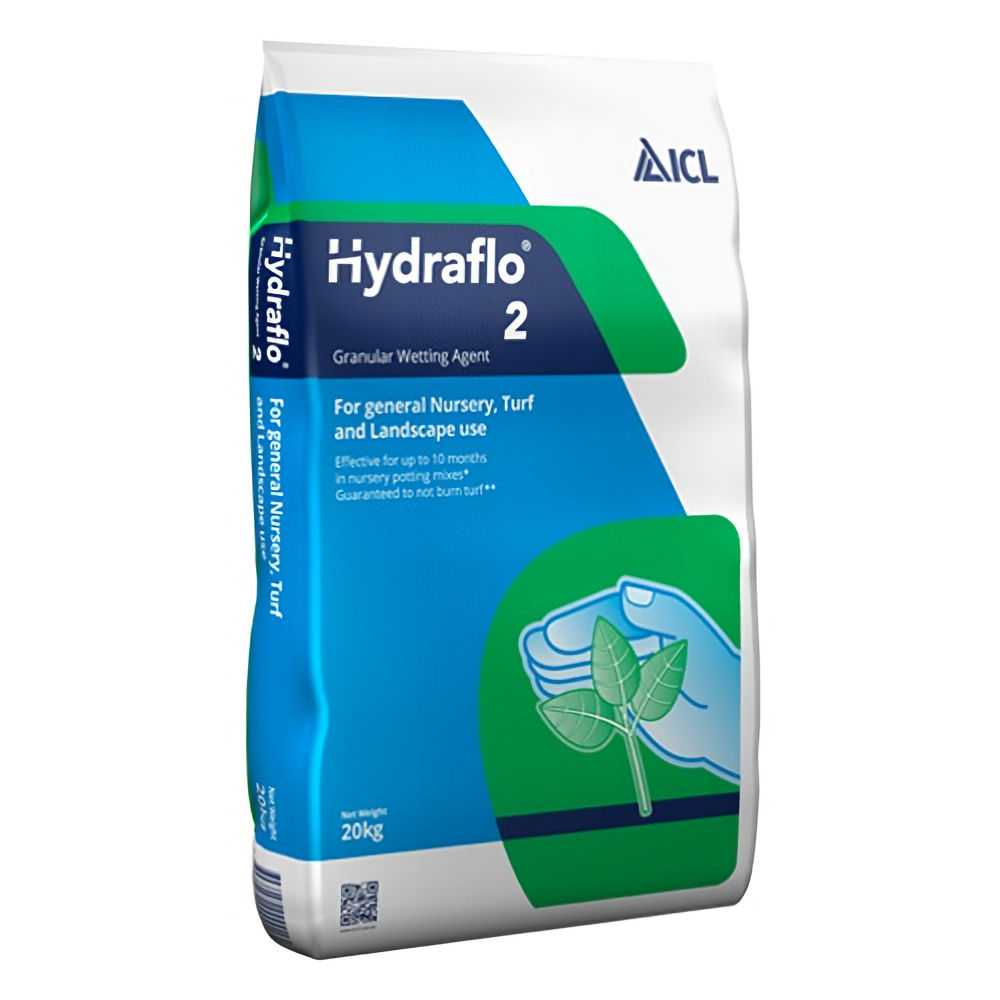
Hydraflo 2 from ICL is a granular wetting agent containing 15% non-ionic surfactants on an inert carrier. ICL says it delivers immediate action as a topdress and keeps working over a longer period once incorporated into soils and potting mixes.
What it fixes: dry, water-repellent soil and potting mix that won’t rewet, and – unusually for a wetting agent – waterlogged soil, by encouraging free drainage. ICL also states it inhibits the growth of moss, algae and soil-borne pathogens. In nursery mixes, ICL’s technical guide recommends higher rates where up to 10 months between applications is needed.
Best for: turf, landscapes, nurseries and greenhouses, and anyone who would rather spread granules than mix a liquid. ICL describes it as safe for use on all ornamental plants, including turfgrasses, and the SDS classifies it as non-hazardous and not a scheduled poison.
3. H2Pro TriSmart Turf Wetting Agent
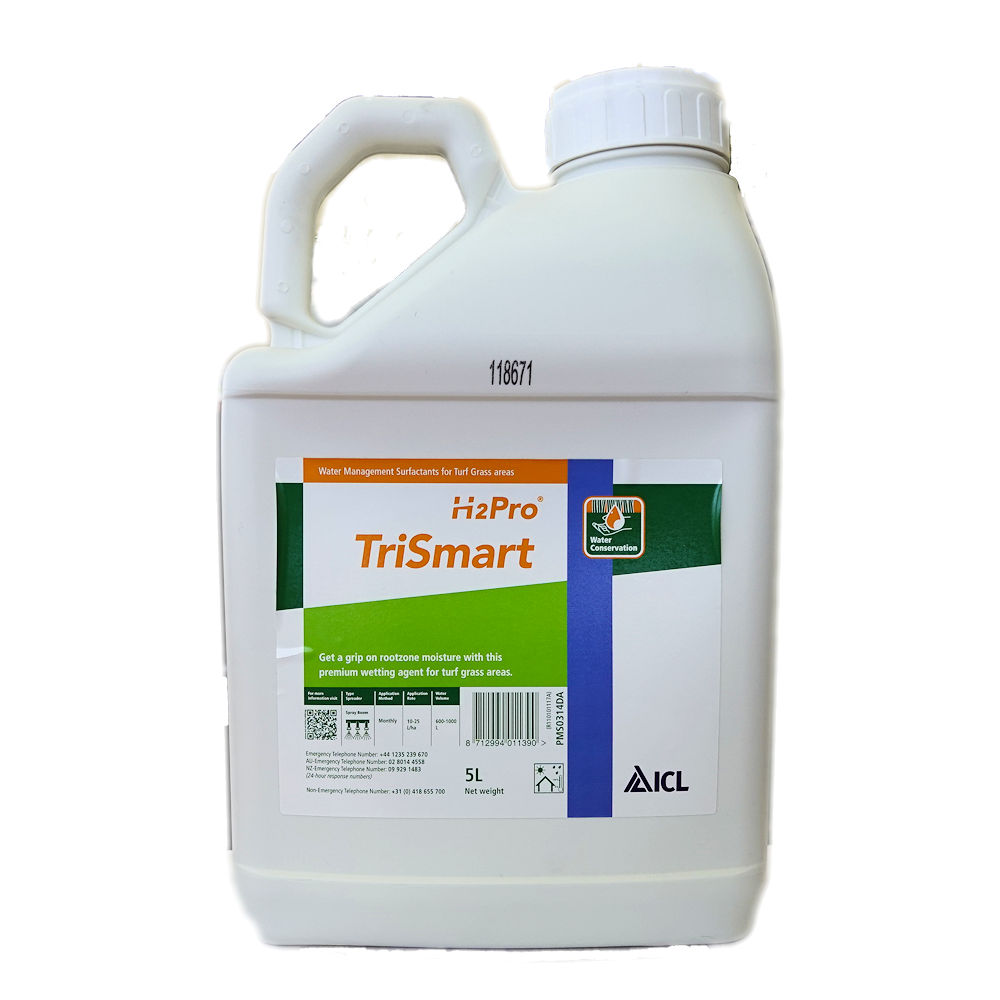
H2Pro TriSmart is a liquid from ICL built on three water management technologies: a penetrant surfactant that gets water in, co-formulant humectants that spread it through the rootzone, and two block polymer surfactants that retain it in the soil.
What it fixes: soil hydrophobicity and localised dry patch, uneven moisture across a surface, and poor water-holding in free-draining sandy rootzones. It also helps cut irrigation: in a water conservation trial carried out by STRI Australia, turf treated with TriSmart and watered at only 60% of evapotranspiration (ET) replacement was compared with untreated turf receiving 100% – and the treated turf held its quality on less water.
Best for: golf greens, tees, fairways, surrounds, collars and approaches, stadium pitches and lawns. Each application lasts about four weeks depending on conditions, so it suits a monthly program through the warmer months.
4. HydroForce Recharge
HydroForce Recharge from Indigo Speciality Products is manufactured and developed in Australia. It contains 80% non-ionic surfactants – an APG surfactant that improves water penetration, plus a block co-polymer surfactant that overcomes dry patch, improves rewetting and offers residual activity and moisture retention, and 5–10% L-form amino acids.
What it fixes: localised dry spot that has already appeared (it has a curative label rate), as well as preventing it. Indigo says the amino acid package helps maintain and restore damaged plants in summer and improves plant response in tough growing conditions, which makes Recharge a strong option for turf that is already stressed.
Best for: golf courses, sports fields, racetracks, stadiums, lawns, garden beds and general horticulture.
5. HydroForce Extend
HydroForce Extend, also from Indigo Speciality Products, is a 100% non-ionic EO/PO block co-polymer surfactant. Indigo says the molecule’s complex structure and mass mean microbial breakdown takes several months, which is what gives it long residual activity. In a six-month greenhouse study on hydrophobic soil reported in Indigo’s technical sheet, water soaked into Extend-treated soil faster than untreated soil at every monthly assessment.
What it fixes: recurring localised dry spots over a long season and high irrigation demand; Indigo says it reduces irrigation requirements by increasing the rate and depth of water penetration. It can also be used curatively at higher rates.
Best for: turf managers who want long-term prevention with fewer applications. Indigo describes it as safe for warm- and cool-season turf.
How do the five soil wetting agents compare?
| Product | Format | Active ingredient | Main problem it fixes | How often to apply |
|---|---|---|---|---|
| IrriGate | Liquid | 200 g/L EO/PO and glucose co-polymers | Poor infiltration of irrigation water and rain | Turf: every 4–6 weeks after the first application |
| Hydraflo 2 | Granule | 15% non-ionic surfactants | Dry, repellent soil and waterlogging | Turf: season-long or bi-monthly rates; nursery mixes up to 10 months |
| H2Pro TriSmart | Liquid | Three-technology surfactant blend | Prevents dry patches; even moisture in sand | Monthly (lasts about 4 weeks) |
| HydroForce Recharge | Liquid | 80% non-ionic surfactants + 5–10% amino acids | Curing and preventing dry spots; stressed turf | Every 4 weeks (low rate) to every 2–3 months (high rate) |
| HydroForce Extend | Liquid | 100% EO/PO block co-polymer | Long-term dry spot prevention | Long residual; repeat at your chosen interval |
Table 4: Soil wetting agents compared — Specialist Sales
What application rates should I use?
The table below summarises the main label rates. It’s simplified for quick reference – always check the full label for your situation.
| Product | Situation | Rate | Key notes |
|---|---|---|---|
| IrriGate | Irrigation injection or conventional sprayer | 2.5–10 L/ha | Irrigation or rain should follow spraying |
| IrriGate | Turf and amenity | 10 L/ha, then 5 L/ha every 4–6 weeks | Boom spray or through irrigation |
| IrriGate | Garden beds and pots | 30 mL per 10 L watering can | At planting, then every 8–10 weeks |
| IrriGate | Transplants | 1 L per 1,000 L transplant water | With the first watering |
| Hydraflo 2 | Turf – season-long | 20–25 g/m² | Water in with 4–6 mm |
| Hydraflo 2 | Turf – bi-monthly | 10–15 g/m² | Water in with 4–6 mm |
| Hydraflo 2 | Nursery potting mixes | From 1 kg/m³ (propagation mixes 0.3 kg/m³) | Incorporate evenly before potting |
| H2Pro TriSmart | Full program | 10 L/ha (100 mL/100 m²) monthly | In 600–1,000 L water/ha |
| H2Pro TriSmart | Late start | 25 L/ha, then 10 L/ha monthly | In 600–1,000 L water/ha |
| HydroForce Recharge | Preventative | 20–50 L/ha (200–500 mL/100 m²) | At least 800 L water/ha; 20 L/ha every 4 weeks, or 50 L/ha every 2–3 months |
| HydroForce Recharge | Curative | 40–50 L/ha | At least 1,000 L water/ha; fortnightly until recovery |
| HydroForce Extend | Preventative – greens and tees | 20–40 L/ha | At least 400 L water/ha |
| HydroForce Extend | Preventative – sports fields and fairways | 25–50 L/ha | At least 400 L water/ha |
| HydroForce Extend | Curative | 40–50 L/ha | At least 400 L water/ha |
| Recharge and Extend | Garden beds/horticulture | 15 mL per 10 L (up to 5 m²) / 150 mL per 100 L | Water in well after application |
Table 5: Soil wetting agent application rates — Specialist Sales
How do I set up a soil wetting program?
- Confirm the problem. Run the water droplet test above on dry soil, and dig a small hole in a dry patch. If the soil stays dry below a wet surface, or drops take more than five seconds to soak in, the soil is likely water-repellent.
- Decide on prevention or cure. If you’re ahead of the problem, choose a preventative product and rate. If dry patches are already showing, start with a curative rate (HydroForce Recharge or Extend) or a late-start rate (H2Pro TriSmart).
- Start before summer. In our experience, preventative programs work best when they begin in spring, before hot, dry conditions set in.
- Calibrate and apply. Use the label rate and water volume, and calibrate your sprayer or spreader before you start.
- Water it in. Irrigation after application moves the product into the root zone. For Hydraflo 2 on turf, water in with 4–6 mm.
- Repeat on schedule. Reapply at the label interval through the warmer months, and switch to curative rates if dry patches appear.
What should I know before applying a wetting agent?
- Test before tank mixing. The HydroForce labels advise against tank mixing unless a jar test and strip test show the combination is physically compatible, effective, and non-injurious under your conditions.
- Watch for foam. The HydroForce labels note a defoamer may be needed, such as Foam Stop Defoaming Agent.
- Trial first. ICL recommends trialling Hydraflo 2 and H2Pro TriSmart on a small scale before changing rates or application methods.
- Protect your eyes. IrriGate is classified as causing serious eye damage – wear goggles and elbow-length PVC gloves when using it.
- Don’t confuse soil wetters with spray wetters. Spray adjuvants help herbicides work on the leaf; soil wetting agents work in the soil. Read more in our guide to using wetting agents with herbicides.
Key takeaways
- Soil wetting agents help water penetrate water-repellent soil, spread through the root zone, and stay there.
- They fix localised dry patches, runoff, uneven wetting and wilting – and Hydraflo 2 also encourages drainage of waterlogged soil.
- For irrigated crops, orchards, vineyards and vegetables, IrriGate goes through your irrigation system.
- For prevention on turf, choose H2Pro TriSmart (monthly) or HydroForce Extend (long residual).
- For turf already showing dry spots or stress, use HydroForce Recharge at curative rates.
- Wetting agents need to be reapplied – plan a program through the warmer months.
Where can I buy soil wetting agents?
All five products are available online at Specialist Sales with free shipping. Browse the full soil conditioners and wetters range.
| Product | Brand | Pack size | Shop now |
|---|---|---|---|
| IrriGate Soil Surfactant | Sipcam | 20 L | View product |
| Hydraflo 2 Granular Soil Wetting Agent | ICL | 20 kg | View product |
| H2Pro TriSmart Turf Wetting Agent | ICL | 5 L | View product |
| HydroForce Recharge | Indigo Speciality Products | 20 L | View product |
| HydroForce Extend | Indigo Speciality Products | 20 L | View product |
Table 6: Where to buy soil wetting agents — Specialist Sales
Need larger quantities? See our bulk orders page or contact our team.
Frequently asked questions about soil wetting agents
Can I use a soil wetting agent on my vegetable garden?
IrriGate lists vegetables as an ideal use. The HydroForce Extend label covers general horticulture around the base of plants and trees but makes no statement about vegetables, so contact the manufacturer if you’re unsure.
Will a soil wetting agent burn my lawn?
The IrriGate label states it will not burn foliage, ICL describes Hydraflo 2 as safe on all ornamental plants including turfgrasses, and Indigo describes both HydroForce products as non-burn formulations. For any product, stick to label rates and water volumes, and trial a small area first.
How long does a soil wetting agent last?
It depends on the product and rate. H2Pro TriSmart lasts about four weeks; HydroForce Recharge is reapplied every four weeks to three months, depending on rate; Hydraflo 2 offers season-long and bi-monthly turf rates; and HydroForce Extend provides residual activity over several months.
Do I need to water in a soil wetting agent?
It’s recommended. Watering in moves the product into the root zone. IrriGate directions say irrigation or rain should follow spraying; Hydraflo 2 should be watered in with 4–6 mm on turf; and HydroForce labels recommend irrigation to ensure effectiveness.
Is there a withholding period?
No. A withholding period is not applicable for any of these five products when used as directed.
Can a wetting agent fix waterlogged soil?
Hydraflo 2 is designed to encourage free drainage in waterlogged soils and help dry soils rewet.
Getting the most from your soil wetting agent
The right soil wetting agent depends on the problem you’re trying to fix. To prevent dry patches on turf, a regular spring program of H2Pro TriSmart or HydroForce Extend keeps water moving evenly. If dry spots and wilting have already set in, HydroForce Recharge helps rewet the soil and support recovery. For granular convenience and better drainage, Hydraflo 2 does both jobs, and for irrigated crops, IrriGate goes straight through your system. Pairing a wetting agent with a good feeding program makes every drop and every granule count – see our guide to fertilising your lawn.
Not sure which suits your soil? Our knowledgeable team is happy to help.
This information and product advice is general in nature and is not intended as advice or a recommendation for any specific use or circumstance. Always read and follow the product label before use, and seek specialist advice for your situation. Specialist Sales’ liability is limited; please review our Terms and Conditions for more information.
About the author