



Description
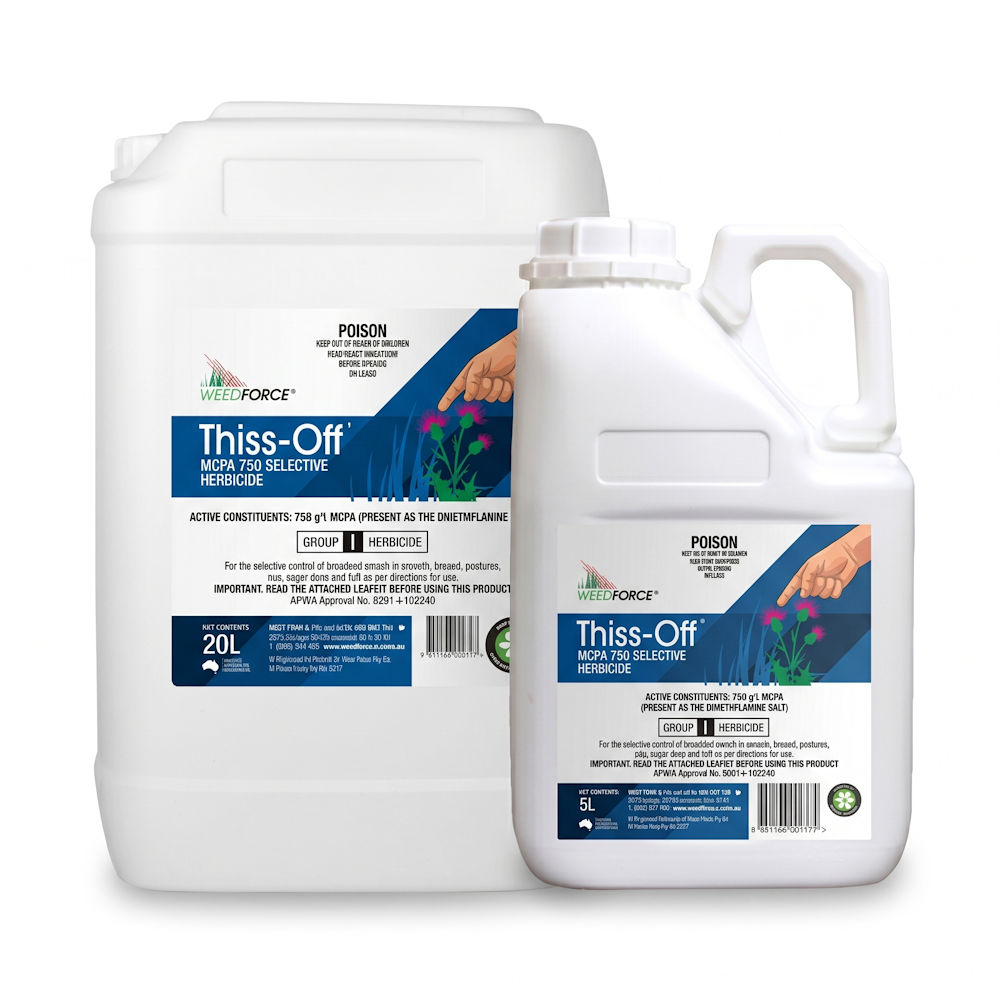
Weed Force Thiss-Off Thistle & Broadleaf Herbicide — MCPA 750 Selective Control
Weed Force Thiss-Off Thistle & Broadleaf Herbicide contains 750 g/L MCPA present as the dimethylamine salt. WeedForce Pty Ltd registered Thiss-Off as a Group 4 phenoxy herbicide. As such, it disrupts plant cell growth in susceptible broadleaf species while leaving established grasses intact. Moreover, the product delivers selective post-emergent control across cereals, pastures, turf, sugar cane, and non-crop areas throughout Australia. It mixes readily with water and suits boom spray, aerial, and knapsack application.
MCPA acts on plant auxin pathways, giving Thiss-Off selective activity across multiple broadleaf species. Rates and timing vary by state and crop situation. In grain-growing situations, growers can apply Thiss-Off during tillering within state-specific windows. Additionally, Thiss-Off suits established grass-based pastures, so producers can target broadleaf weeds without damaging the grass base.
Thistle Control Across Pastures and Cropping Systems
In pastures, Thiss-Off targets a broad range of thistle species. These include saffron, spear, variegated, artichoke, nodding, slender, soldier, and scotch/cotton thistles. Registered rates range from 460 mL to 2.7 L per hectare, depending on species and state. As a result, producers can address multiple thistle species with one product in a single pass. Thiss-Off also controls capeweed, Paterson’s curse, dandelion, docks, field bindweed, fat hen, Bathurst burr, and noogoora burr.
In cereals, Thiss-Off works in wheat, barley, oats, and triticale within state-specific growth windows. Generally, growers apply it from the 5-leaf stage through to late tillering. Furthermore, Thiss-Off supports tank mixing with diuron, clopyralid, bromoxynil, dicamba, metsulfuron-methyl, and diflufenican. This lets growers broaden the weed spectrum in a single operation.
Registered Across Multiple Crops and Situations
Beyond cereals and pastures, Thiss-Off holds registration in several other situations. Queensland growers use it as a directed inter-row spray to control broadleaf weeds in sugar cane. For oilseed poppies in Tasmania, aerial application targets spear thistle. New South Wales growers apply it to rice by aircraft during the early tillering stage. For turf, Thiss-Off applies to established turf at rates from 330 mL to 1.8 L per hectare. Buffalo grass requires extra care due to its higher susceptibility to MCPA.
Frequently Asked Questions
Q. Can I use Weed Force Thiss-Off in wheat during tillering?
A. Yes. In most states, Thiss-Off applies from the 5-leaf stage through to late tillering. State-specific windows apply — for example, in WA the window extends from the 5-leaf stage to flag leaf emergence (Zadoks 15–37). Refer to the Directions for Use table for your state and ensure weeds are at the correct growth stage before application.
Q. How long before stock can graze after spraying pastures?
A. The withholding period for cereals and pastures is 7 days. Do not graze or cut for stock for 7 days after application. In WA pastures, observe at least 7 days after spraying before reintroducing stock.
Q. Can Thiss-Off be applied by aircraft?
A. Yes. Aerial application is registered at 10–90 litres of water per hectare. Oilseed poppies in Tasmania are registered specifically for aerial application at 30–40 L/ha.
Q. Does Thiss-Off control skeleton weed?
A. Yes, in South Australia. Thiss-Off controls skeleton weed at 960 mL–1.35 L per hectare, applied to rosettes from 5–15 cm diameter when the crop is between the 5-leaf and late tillering growth stages. This treatment substantially reduces seed set in the following season.
Q. Is Thiss-Off safe to use near legumes?
A. Use with care. MCPA is preferred over 2,4-D amine or ester where legumes are undersown, but damage can still occur depending on species, variety, and growing conditions. Do not spray cereal crops undersown with lucerne. In pastures with clover present, do not exceed 575 mL/ha in Soldier Thistle situations in SA.
Q. How does Weed Force Thiss-Off compare to Nufarm MCPA 750 and Sabakem MCPA 750?
A. All three contain the same active constituent, 750 g/L MCPA present as the dimethylamine salt, so weed control performance is equivalent. The real difference is pack size: Thiss-Off comes in 5L and 20L, Nufarm MCPA Amine 750 extends to 110L and 1000L for broadacre buyers, and Sabakem MCPA 750 is only sold in 20L and 1000L, with no 5L option. The choice comes down to pack size and registrant preference, not efficacy.








What others are saying
There are no contributions yet.