
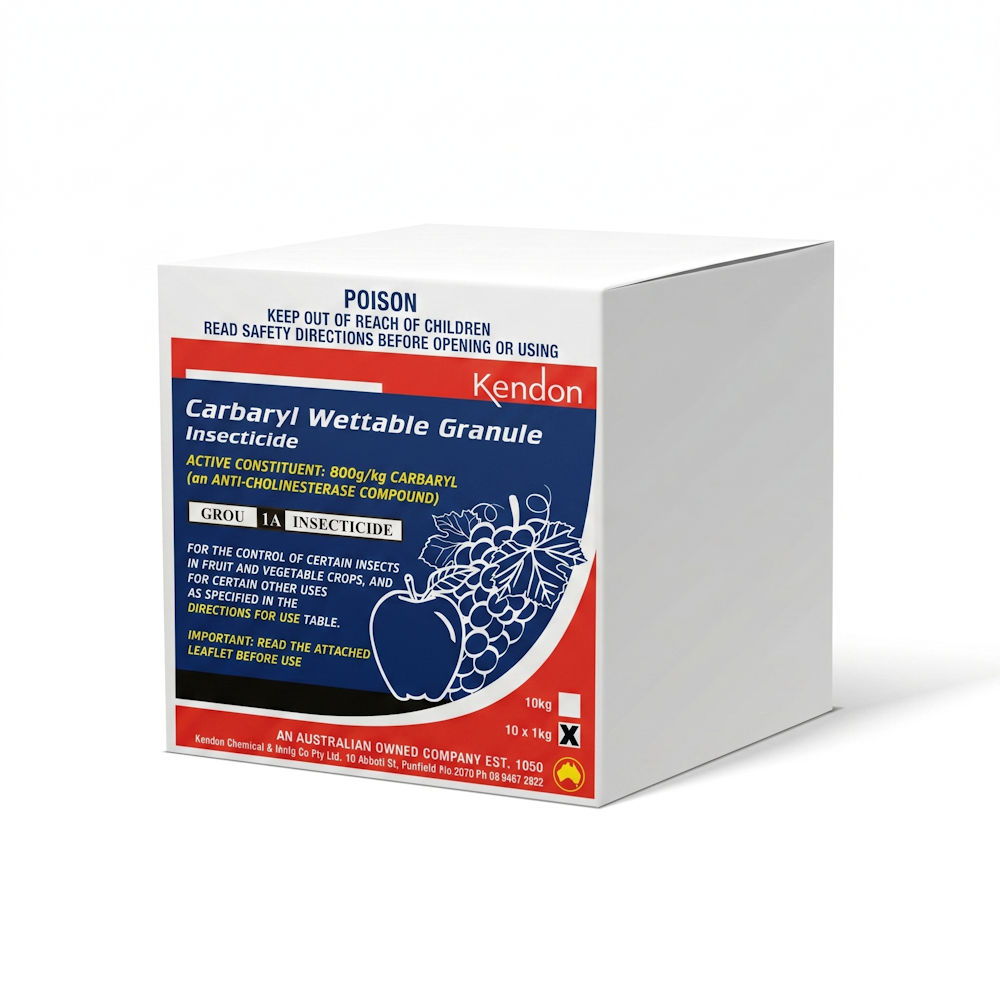
Kendon Carbaryl Wettable Granule Insecticide

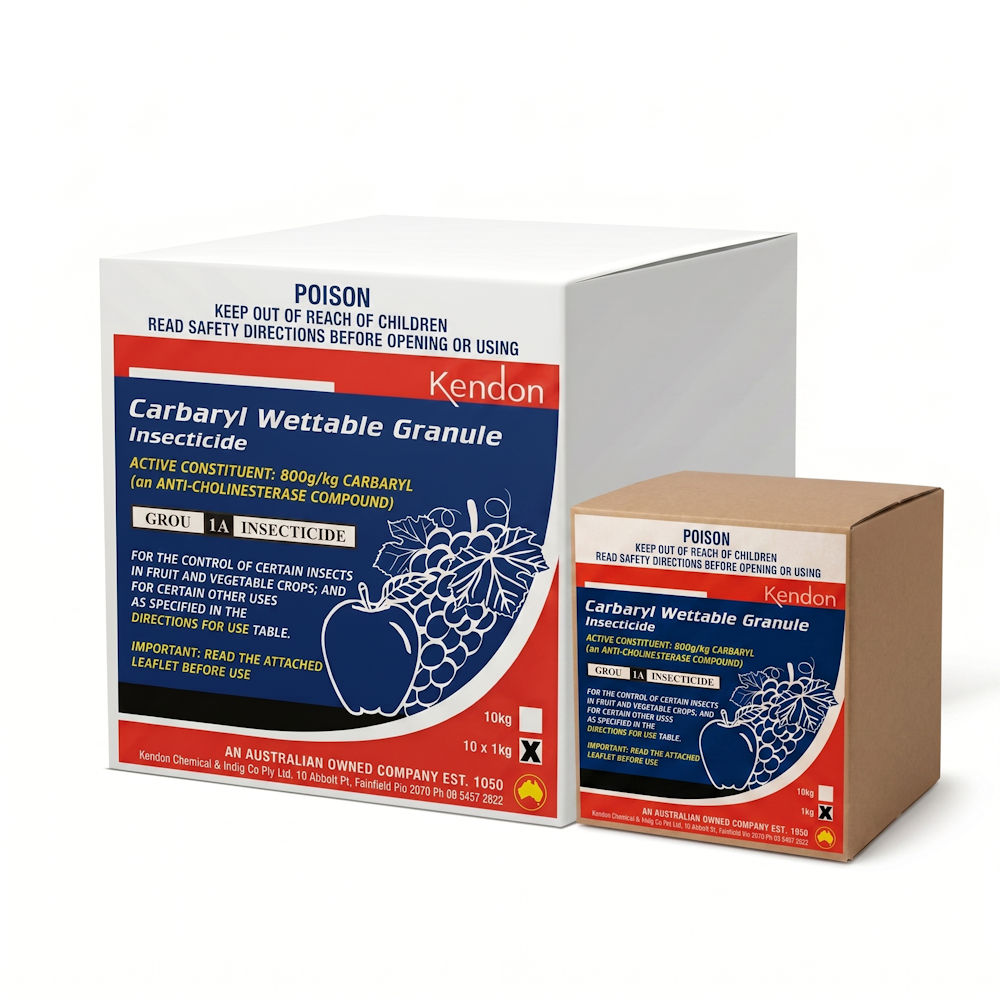
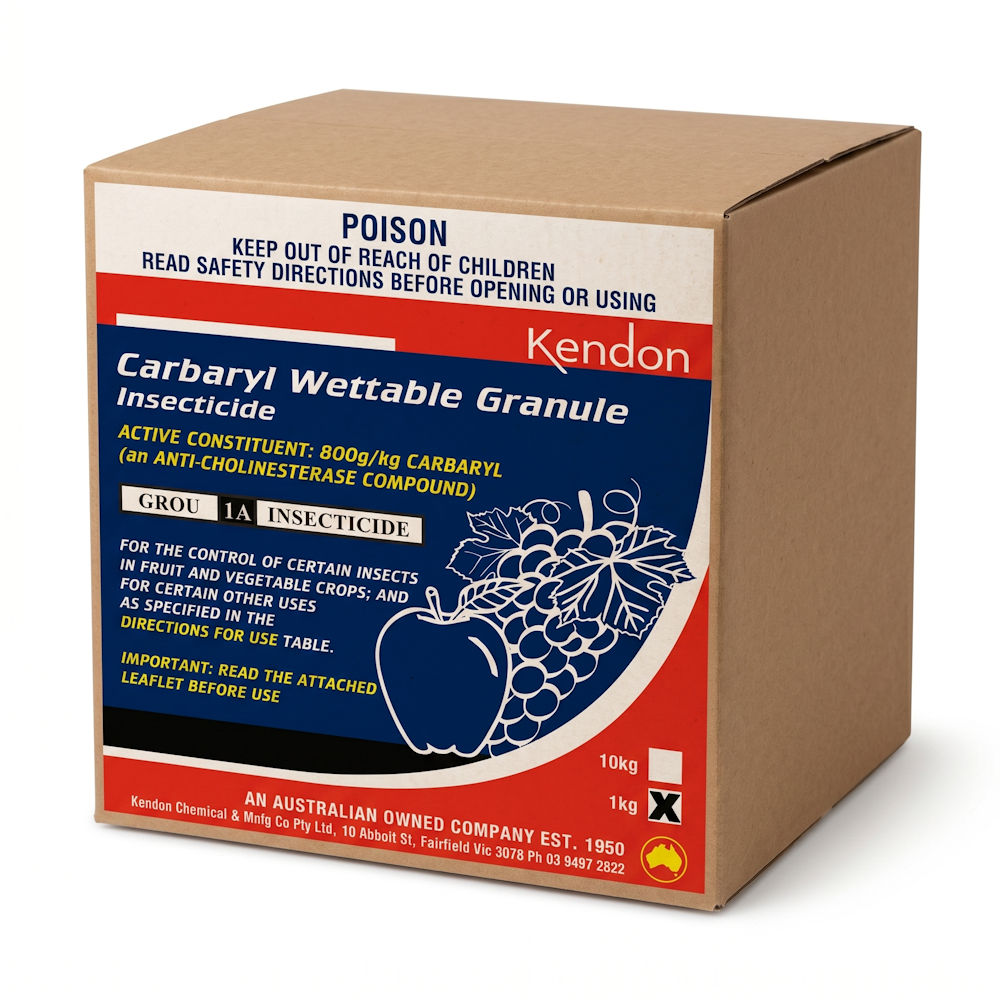
Kendon Carbaryl Wettable Granule Insecticide is a Group 1A contact and stomach insecticide containing 800 g/kg carbaryl.

It controls a wide range of chewing and sucking insects in fruit, vegetables, field crops, pastures and listed ornamentals. Orchardists also use it to thin apples and pears at fruit set. The wettable granule format mixes cleanly and suits dilute or concentrated spraying. As a result, mixed cropping operations gain one product for many pest jobs.

Pack Sizes: 1 kg and 10kg (10 x 1 kg packs). Registrant: Kendon Plant Care Pty Ltd (APVMA #: 68322/58104)

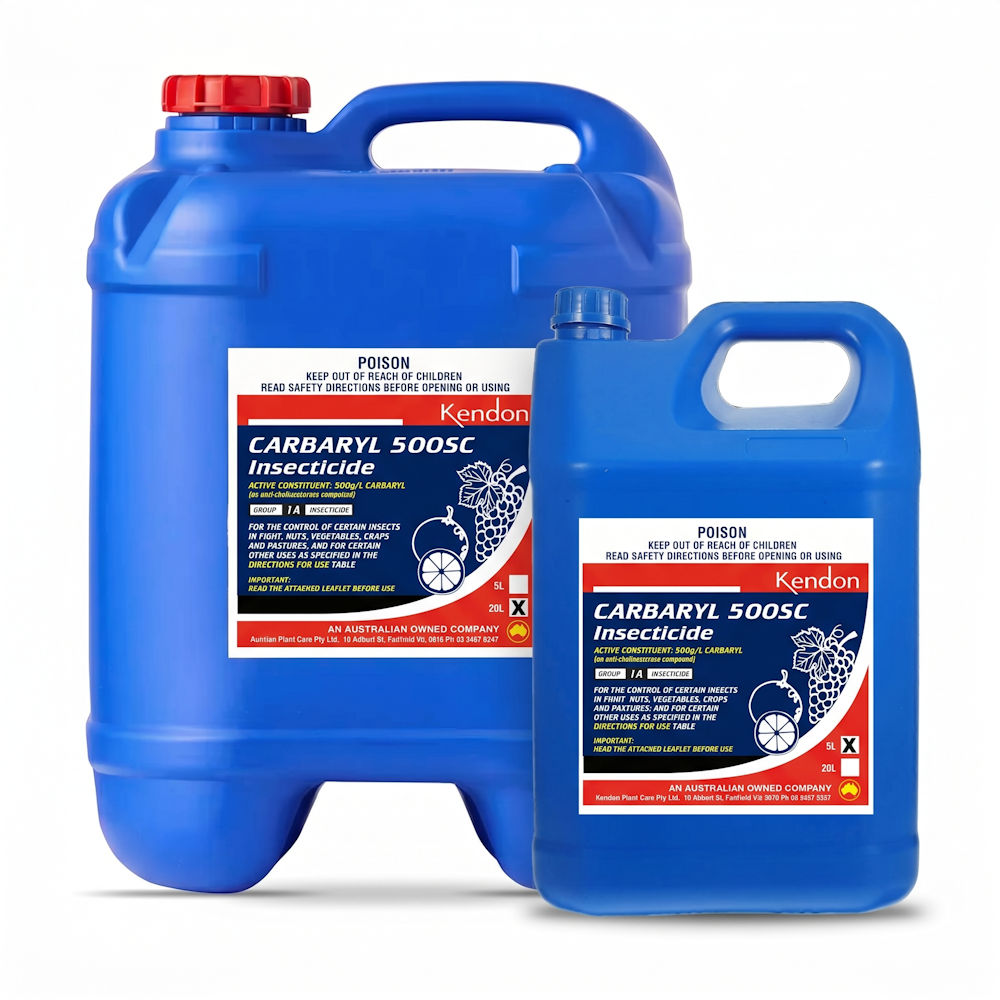
Similar or comparable to Kendon Carbaryl 500 SC Insecticide and Bugmaster Flowable Insecticide (AgNova)

Click For Technical Info & Tips For Use
0 out of 5 (0 customers reviews)

QuantityDiscountStatus
2 or more$89.00 eachAvailable
2 or more$430.00 eachAvailable
-
+

Free & Fast Shipping

Not able to be delivered to a PO box Live remotely? Please ensure a courier can reach your address. Click here for shipping info or give us a call.

This item is dangerous and requires a courier! Ensure a courier can reach your address.
Don’t worry, shipping is STILL FREE!
Click here for shipping info or give us a call.

Ordering multiple large items? They will be shipped on a skid or pallet to ensure that your items arrive safely and securely. The delivery truck will need to be unloaded with a forklift. If you do not have a forklift, please provide an address where a forklift is present.

This item is large and requires a courier! Ensure a courier can reach your address.
Don’t worry, shipping is STILL FREE!
Click here for shipping info or give us a call.

Ordering multiple large items? They will be shipped on a skid or pallet to ensure that your items arrive safely and securely. The delivery truck will need to be unloaded with a forklift. If you do not have a forklift, please provide an address where a forklift is present.

Kendon Carbaryl Wettable Granule Insecticide CARBARYL-800WG Kendon

Description

Kendon Carbaryl Wettable Granule Insecticide controls chewing and sucking insects across fruit, vegetables, field crops and pastures. The active constituent is 800 g/kg carbaryl, a Group 1A anti-cholinesterase compound. Growers apply it at the first sign of pest activity. Because it acts by contact and ingestion, it suits orchard, vine and broadacre situations. In addition, the wettable granule format mixes cleanly in hard or soft water.

Kendon Plant Care Pty Ltd manufactures this insecticide in Australia. The product carries APVMA approval number 68322/58104. It targets pests such as codling moth, light brown apple moth, locusts and weevils. Therefore, it gives mixed orchard and farm operations one product for several jobs. However, users must follow the label crop and rate table closely.

Kendon Carbaryl Wettable Granule Insecticide for fruit, vegetable and field crops

This Group 1A insecticide works on contact and through ingestion. As a result, insects that chew foliage or feed on sap pick up a lethal dose. Carbaryl also thins fruit on apples and pears when applied at the right stage. Growers value that dual role during the early fruit set window. In addition, the product mixes with several oils and fungicides for broader programmes.


Frequently Asked Questions

Q. What does Kendon Carbaryl Wettable Granule Insecticide control?

A. It controls many chewing and sucking insects. Targets include codling moth, light brown apple moth and locusts. The label lists each crop and pest.

Q. What is the active constituent?

A. The active constituent is 800 g/kg carbaryl. It belongs to insecticide Group 1A. Carbaryl is an anti-cholinesterase compound.

Q. Can I use it in the home garden?

A. No. The label clearly states: Do not use this product in the home garden. Kendon registered this granule for commercial growers only. For lawns, Kendon Carbaryl 500 SC is registered to treat lawn grubs and crown mealybug. Home gardeners can also choose Yates Success Ultra Insect Control, Eco-Neem Botanical Insecticide or Eco-Oil. Always check the label registration before you spray.

Q. How soon can I harvest after spraying?

A. The withholding period depends on the crop. For example, pome fruit needs 11 weeks. Avocados and citrus need three days. Check the label for each crop.

Q. Does it harm bees?

A. Yes, carbaryl is dangerous to bees. Do not spray plants in flower while bees forage. This protects local pollinators.

Crop Insecticide Product Range

Features & Benefits

  • Contains 800 g/kg carbaryl, a proven Group 1A anti-cholinesterase active.
  • Controls a broad range of chewing and sucking insects across many crops.
  • Works by both contact and ingestion for reliable knockdown.
  • Wettable granule format mixes cleanly in hard or soft water.
  • Suits dilute and concentrate spraying in tree and vine crops.
  • It thins apples and pears when applied at the correct fruit set stage.
  • Compatible with several oils, fungicides and other partners for broader programmes.
  • Australian-owned manufacturer with APVMA registration 68322/58104.

Share your thoughts!

0 out of 5 stars

0 reviews

Let us know what you think...

What others are saying

There are no contributions yet.

×

Welcome back

Existing account holders please login below via Email or Google Account or Click here to register your NEW FREE ACCOUNT.

Already Registered? Sign in with your email
Register for an account

Secure Checkout

You can shop with Specialist Sales online store with confidence. We have partnered with PayPal, Master and Visa Card which is provided by Braintree. Braintree payment technology accepts credit cards and electronic payments safely and securely for our customers.

Braintree transactions are processed using the 3D Secure framework to ensure your sensitive customer information and credit card processing is safe and secure. Similarly, PayPal also provides comprehensive buyer protection for your peace of mind.

Your information is safe

Specialist Sales adheres to strict industry standards for payment processing, using industry leading security protection measures including 128-bit Secure Sockets Layer (SSL) technology for secure Internet Protocol (IP) transactions, and compliance with the Payment Card Industry Data Security Standard (PCI DSS).

Continue as a Guest

Directions Of Use

Click here for Kendon Carbaryl Wettable Granule Insecticide directions for use.

General instructions: Fill the spray tank half full of water. Add Kendon Carbaryl Wettable Granule Insecticide and mix thoroughly. Then add the rest of the water and mix again. Maintain agitation while filling and spraying. Good pest control and fruit thinning need even, thorough coverage. Apply with appropriate equipment and enough water for full penetration.

Restraints:

  • Do not apply by air.
  • Do not make more than four applications per season to avocados.
  • Do not make more than three applications per season to mangoes.
  • Do not use this product in the home garden.

Table 1: Tree and vine crops

Crop Pest Rate Critical comments
Avocados (NSW & Qld) Monolepta beetle 130 g/100L Apply at the first sign of infestation and repeat as swarms re-infest.
Coconut (non-flowering, non-fruiting only) Palm leaf beetle 125 g/100L water or 1.4 kg/ha Apply at the first sign of pest activity and repeat as necessary.
Orange and Lemon Citrus leaf-eating weevil, Lightbrown apple moth 100–130 g/100L Apply at first sign and repeat at 2-week intervals. Use a higher rate under high pressure.
Orange and Lemon Fuller’s Rose weevil 100–130 g/100L Spray the lower parts of trees and the ground beneath when an attack is noticed.
Orange and Lemon White wax scale 90 g/100L + 1L Summer Oil Spray to run off. Two applications: early December, again late Jan to early Feb.
Orange and Lemon Bronze orange bug, Spined citrus bug 65 g/100L Apply at the first sign of activity and repeat as necessary.
Orange and Lemon Orange fruit borer, Yellow peach moth 130 g/100L Apply at the first sign of activity and repeat as necessary.
Orange and Lemon Pink wax scale 90 g/100L + 1L Summer Oil Apply at the first sign of activity and repeat as necessary.
Grapes (butt treatment only) Cutworms 130 g/100L Apply to the base of the vine.
Longans and Litchis (non-flowering, non-fruiting) Yellow peach moth, Macadamia nut borer, Monolepta beetles, Rhyparida beetles, Leaf roller, Red-shouldered leaf beetle 125 g/100L water Apply at first sign and repeat as necessary. Thorough foliage coverage needed.
Macadamias Macadamia nutborer 130 g/100L Four sprays at 2 to 3 weekly intervals during late Nov to Feb. Direct spray to nut clusters.
Macadamias Macadamia twig-girdler 130 g/100L Two sprays: one in spring, again in autumn. Do not spray flowers.
Mangoes Flatids, Pink wax scale 90 g/100L Apply in December.
Mangoes Fig leafhoppers 90 g/100L Apply when pests appear on fruit stalks (Oct to Nov).
Pome fruit (Apples, pears) Codling moth, Lightbrown apple moth, Pear leaf blister mite 130 g/100L Apply at the first sign in spring. Repeat at 3 to 4 week intervals. See label cultivar and bloom restrictions.
Pome fruit (Apples, pears) Pear and cherry slug 130 g/100L Apply at the first sign. Repeat at 3 to 4 week intervals.
Pome fruit (Apples, pears) Fruit thinning 100–130 g/100L Apply between 7 and 28 days after full bloom. Do not add wetting agents or spray in cold, wet conditions.
Stone fruit (Apricots, nectarines, peaches, plums, prunes; not cherries) Light brown apple moth, Oriental fruit moth, Native budworm 100–130 g/100L Apply at the first sign. Repeat at 2-week intervals. Use a higher rate under high pressure.
Stone fruit Fruit tree borer 180 g/100L Saturate damaged trunk and limb areas. Apply twice at 21-day intervals during winter.

Table 2: Fruit and vegetables

Crop Pest Rate Critical comments
Melons and other flowering cucurbits (to flowering only) Budworms (Heliothis spp), pumpkin beetle, 28-spotted ladybird 100–130 g/100L Apply at first sign and repeat as necessary.
Potatoes Potato moth 1.4 kg/ha Use enough water for thorough coverage. Start when moth activity is first seen and repeat as necessary.
Raspberry Light brown apple moth, Heliothis, Mealy bug, Rutherglen bug, weevils, Armyworm 125 g/100L water Apply at first sign and repeat as required.
Root vegetables (Beetroot, turnips/Swede only) Brown vegetable weevil 190 g/100L Apply at first sign and repeat as necessary.
Sweet Potato Sweet potato weevil 125 g/100L water or 1.4 kg/ha Apply at first sign and repeat as necessary.

Table 3: Field crops and pastures

Crop Pest Rate Action
Cereals (including maize and sorghum) Australian plague locust, wingless grasshopper, yellow-winged locust, migratory locust 700–900 g/ha Apply when pest appears and repeat as necessary. Use a higher rate under high pressure.
Duboisia Sandal-box hawk moth, Cluster caterpillar, Leaf-eating ladybirds, Australian plague locust, Grasshopper 130 g/100L Apply as necessary.
Lucerne Lucerne leaf roller 1.0–1.4 kg/ha Apply when pest appears and repeat as necessary.
Lucerne Native budworm, Leaf hopper 1.4 kg/ha Use enough water for adequate coverage.
Lucerne Lucerne flea 320 g/ha Apply 3 to 5 weeks after opening autumn rains and repeat as necessary.
Pastures, pasture seed crops Yellow-winged locust, migratory locust, Australian plague locust 750–875 g/ha Apply when pests first appear and repeat as necessary. Some tropical pasture legumes may show phytotoxicity.

Table 4: Ornamentals

Situation Pest Rate Critical comments
Elm Trees Elm leaf beetle 2.5 kg/100L Apply to the trunk in December when larvae are first seen. Repeat 4 to 6 weeks later if needed. Apply a half metre band at 1.5 m height or above.
Elm Trees Elm leaf beetle (small specimen trees) 125 g/100L Apply to foliage if large numbers of larvae threaten defoliation. Repeat when required.
Ornamentals Green vegetable bug, potato moth, European earwig, cabbage white butterfly, cabbage moth, native budworm, loopers, leaf-eating ladybird, pumpkin beetle 130 g/100L Apply at first sign and repeat as necessary. Test a small area first, as phytotoxicity and efficacy cannot be guaranteed across all ornamentals.

Rates are a general guide only. Before opening, carefully read the Kendon Carbaryl Wettable Granule Insecticide directions for use, precautionary and protection statements, storage and disposal, safety directions and first aid instructions. The product is designed for the particular purpose indicated on the label. Failure to use the product strictly as directed may be illegal and dangerous, and render the product ineffective.

Questions and answers from customers

There are no questions yet. Be the first to ask a question about this product.

Send me a notification for each new answer.

Disclaimer: This information and product advice is not intended to be advice or recommendations for any specific use or circumstance. You should seek specialist advice before using any product. Always follow the manufacturer’s guidelines. Specialist Sales liability is limited.

Host & Pest

Host Pest
Host & Pest
Apricot, Nectarine, Peach, Plum, Prune Fruit Tree Borer, Light Brown Apple Moth, Native Budworm Or Bollworm, Oriental Fruit Moth
Avocado Monolepta Beetle
Beetroot, Swede, Turnip Brown Vegetable Weevil
Cereal Crop Australian Plague Locust, Migratory Locust, Wingless Grasshopper, Yellow-Winged Locust
Coconut Palm Leaf Beetle
Cucurbit - Flowering, Melon Budworms, Pumpkin Beetle, Twenty-eight-Spotted Potato Ladybird
Duboisia Or Corkwood Australian Plague Locust, Cluster Caterpillar, Grasshopper, Leaf-Eating Ladybird - Epilachna Spp., Sandal-Box Hawk Moth
Elm Tree Elm Leaf Beetle
Grape Cutworm
Lemon, Orange Bronze Orange Bug, Citrus Leaf-Eating Weevil, Fuller's Rose Weevil, Light Brown Apple Moth, Orange Fruit Borer, Pink Scale, Spined Or Larger Horned Citrus Bug, White Scale, Yellow Peach Moth
Loganberry, Lychee Leaf Beetle, Leaf Rolling Moth - Adult & Larval, Macadamia Nutborer, Monolepta Beetle, Redshouldered Leaf Beetle, Yellow Peach Moth
Lucerne Leafhopper, Lucerne Flea, Lucerne Leafroller, Native Budworm Or Bollworm
Macadamia Macadamia Nutborer, Macadamia Twig Girdler
Mango Fig Leafhopper, Flatid, Pink Scale
Ornamental Cabbage Moth, Cabbage White Butterfly, European Earwig, Green Vegetable Bug, Leaf-Eating Beetle, Looper, Native Budworm Or Bollworm, Potato Moth, Pumpkin Beetle
Pasture, Pasture Seed Crop Australian Plague Locust, Migratory Locust, Yellow-Winged Locust
Pome Fruit Blister Mite, Codling Moth, Fruit Thinning, Light Brown Apple Moth, Pear And Cherry Slug
Potato Potato Moth
Raspberry Armyworm, Light Brown Apple Moth, Mealy Bug, Rutherglen Bug, Weevil
Sweet Potato Sweet Potato Weevil

Tips For Use

Mixing

  • Mix with hard or soft water. Fill the tank half full, add the granules, mix well, then add the rest of the water.
  • When tank mixing with spray oils, add the product after the oil is thoroughly mixed with water.
  • Maintain agitation while filling and spraying.

Compatibility

  • May be combined with any one of: copper oxychloride, dimethoate, sulphur, summer spray oil, thiram, zineb or ziram.
  • Do not mix with Lime Sulphur, Bordeaux mixture or other alkaline materials.
  • Test all mixtures before mixing commercial quantities.

Resistance management

  • This is a Group 1A insecticide. Repeated use of Group 1A products can select for resistant insects.
  • Rotate with insecticides from other groups where possible.

Application

  • Good control and fruit thinning need even, thorough coverage.
  • Adjust equipment settings and water volume to suit crop growth stage.
  • For tree and vine crops, the label sets out dilute and concentrate spraying methods.

Re-entry period

  • Do not enter treated areas until the product has dried, unless wearing cotton overalls and chemical-resistant gloves.
  • For hand harvesting after airblast and groundboom use, do not enter until Day 6, unless wearing the stated protective clothing.
  • Do not allow public entry until the product has dried.

Protection of livestock, wildlife and the environment

  • Dangerous to bees. Do not spray any plants in flower while bees are foraging.
  • Do not contaminate streams, rivers or waterways with the chemical or used containers.

Storage and disposal

  • Store in the closed, original container in a cool, well-ventilated area.
  • Do not store for prolonged periods in direct sunlight.
  • Triple or preferably pressure rinse containers before disposal, and add rinsings to the spray tank.

Safety Directions

  • The product is poisonous if absorbed through skin contact or swallowed.
  • It may irritate the eyes and skin. Avoid contact with eyes and skin.
  • Do not touch or rub your eyes, nose and mouth with your hands when handling granules.
  • When opening the container, preparing and using the spray, wear cotton overalls buttoned to the neck and wrist, a washable hat and elbow-length chemical-resistant gloves.
  • If the product gets on the skin or in the eyes, wash it out immediately with water.
  • After use and before eating, drinking or smoking, wash hands, arms and face thoroughly with soap and water.
  • After each day’s use, wash gloves and contaminated clothing.

First Aid

  • If poisoning occurs, contact a doctor or the Poisons Information Centre. Phone Australia 131 126.
  • For further information, refer to the Safety Data Sheet (SDS).

This information and product advice are not intended as advice or recommendations for any specific use or circumstance. You should seek specialist advice before using any product. Always follow the manufacturer’s guidelines. Specialist Sales liability is limited.

Withholding Period

Harvest

  • Coconuts (non-flowering, non-fruiting), Cucurbits (flowering), Grapes (butt treatment), Macadamia nuts, Longan and Litchi: withholding period not required when used as directed.
  • Avocados, oranges, lemons, beetroot, potatoes, sweet potatoes, turnips (swede): Do not harvest for 3 days after application.
  • Mangoes and Raspberries: Do not harvest for 7 days after application.
  • Cereals: Do not harvest for 14 days after application.
  • Stone fruit: Do not harvest for 5 weeks after application.
  • Pome fruit: Do not harvest for 11 weeks after application.

Grazing

  • Pasture: Do not graze or cut for stock food for 7 days after application.
  • Cereals and Lucerne: Do not graze or cut for stock food for 14 days after application.

SDS & Technical

Kendon Carbaryl Wettable Granule Insecticide Label (APVMA) Download Pdf
Kendon Carbaryl Wettable Granule Insecticide Label Download Pdf
Kendon Carbaryl Wettable Granule Insecticide SDS Download Pdf

Related Products