


Best Broadleaf Herbicides for Australian Lawns: Buffalo, Couch, Kikuyu
Table of Contents
Broadleaf weeds are one of the most persistent headaches for Australian homeowners trying to keep a thick, green, weed-free lawn: bindii in the grass before summer. Clover creeping through the couch. Oxalis popping up everywhere.
The sheer quantity of herbicides available to treat broadleaf weeds in lawns can seem overwhelming. The good news is that there are highly effective products to deal with them, but the catch is that not every herbicide is safe to use on every lawn type. Choosing the wrong one can be grave, causing damage to the grass you’re trying to protect, or even killing it.
Worse, Australian lawns aren’t uniform. A Sir Walter buffalo lawn on the Sunshine Coast will behave very differently to a couch fairway on the Darling Downs, and a herbicide that’s perfectly safe for one could wipe out the other. That’s why ‘best’ only takes on real meaning once you know your grass species. Before reaching for a bottle, it pays to identify your turf type and weeds.
To help you with your search, we’ve compiled a full breakdown of the best broadleaf herbicides for home lawns available at Specialist Sales, all matched to the most common Australian lawns.
Best Broadleaf Herbicides for Australian Home Lawns, by Grass Type
Of all the herbicides on the market, a few have emerged as the most popular and effective choices. This table compares the top herbicides for broadleaf weeds in lawns at Specialist Sales, with key information about where each can be used — and where they can’t.
| Herbicide brand | Active ingredients | Best for | Not safe for | Key weeds controlled | Pack sizes |
| Bow and Arrow Herbicide | Clopyralid, diflufenican, MCPA | Buffalo (most varieties), couch, Kikuyu | Bent grass, winter grass, golf or bowling greens | Bindii, capeweed, catsear, clover, cudweed, oxalis, plantain | 500mL, 10L |
| Kamba M Herbicide | Dicamba, MCPA | Couch, fescue, Kikuyu, ryegrass | Buffalo grass (all varieties) | 50+ species including dandelion, dock, pennywort, and thistles | 1L, 5L, 20L |
| Stadium Turf Selective Herbicide | Clopyralid, diflufenican, MCPA | Buffalo, carpet grass, couch, fescue, Kikuyu, paspalum, ryegrass | Bent grass, winter grass, golf or bowling greens | Bindii, capeweed, catsear, clover, cudweed, oxalis, plantain | 10L |
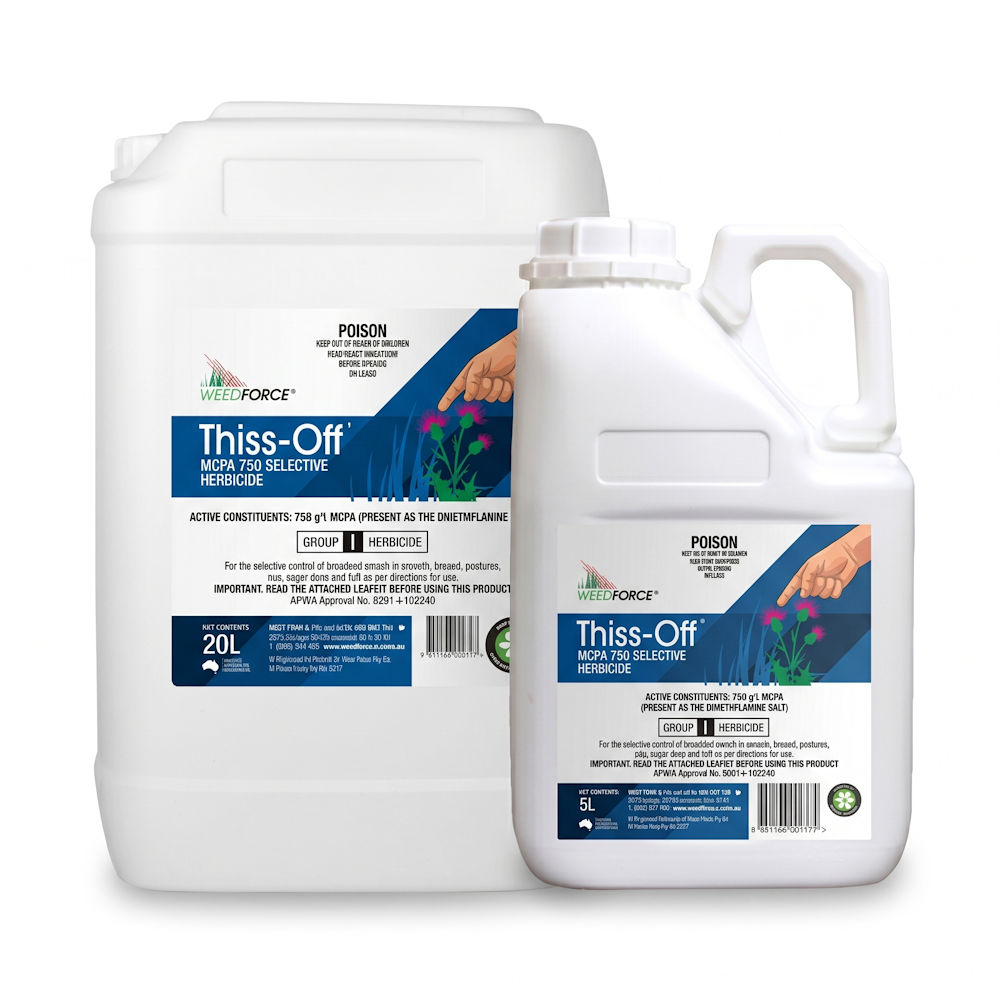
| Weed Force Thiss-Off Thistle & Broadleaf Herbicide (MCPA 750) | MCPA | Couch, Kikuyu, established pasture lawns | Newly sown or unestablished turf | Buttercup, capeweed, clover, dandelion, thistles | 5L, 20L |
| Monument Liquid Turf Herbicide | Trifloxysulfuron | Common couch, Durban grass, hybrid couch, Queensland blue couch, zoysia | Bent grass, buffalo, centipede, fescue, Kikuyu, paspalum, ryegrass | Bindii, catsear, chickweed, clover, curled dock, milk thistle, Mullumbimby couch, oxalis, plus nutgrass, winter grass | 100mL, 1L |
Common broadleaf weeds in Australian lawns: identification guide
Before choosing a herbicide, it helps to know exactly what you’re up against. Australia is home to more than 2,700 introduced and native weed species, but thankfully, just a small number of these are common in home lawns, making the identification and control processes simpler.
Most of the weeds we’ve listed below are winter-germinating annuals that flower in spring, which is why this is prime spraying season.
| Weed | Also known as | What it looks like |
| Bindii | Bindy-eye, jo-jo, onehunga | Low, ferny rosette that produces sharp, spiky seed heads |
| Capeweed | Cape daisy, cape dandelion, cape marigold | Flat rosette with grey-green, deeply lobed leaves and yellow daisy flowers |
| Catsear | Flatweed | Dandelion lookalike with hair, lobed leaves; low growth habit |
| Chickweed | n/a | Small, pointed oval leaves with tiny white star-shaped flowers; forms a dense mat |
| Clover | White clover | Trefoil (three-leaf) leaves with pink or white pom-pom flowers; spreads via runners |
| Creeping oxalis | Sourgrass | Clover-like leaflets with small yellow flowers; sour taste; spreads aggressively via seed pods that ‘explode’ |
| Cudweed | n/a | Woolly, grey-green leaves in a low mat; easy to miss until it flowers. |
| Pennywort | Dollarweed | Round, coin-shaped leaves on long stalks; thrives in damp or shaded turf |
| Plantain | Lamb’s tongue (plantain) | Broad, ribbed oval leaves in a rosette with tall, narrow seed spikes |
Matching a herbicide to your turf type
Your lawn’s grass species is the single largest factor in choosing a safe, effective herbicide. Get it wrong and you risk killing the turf you’re trying to protect, rather than just the weeds in it.
Buffalo lawns in particular need special care, since several popular products will damage or kill them outright, while couch and Kikuyu lawns offer a much wider range of safe options.
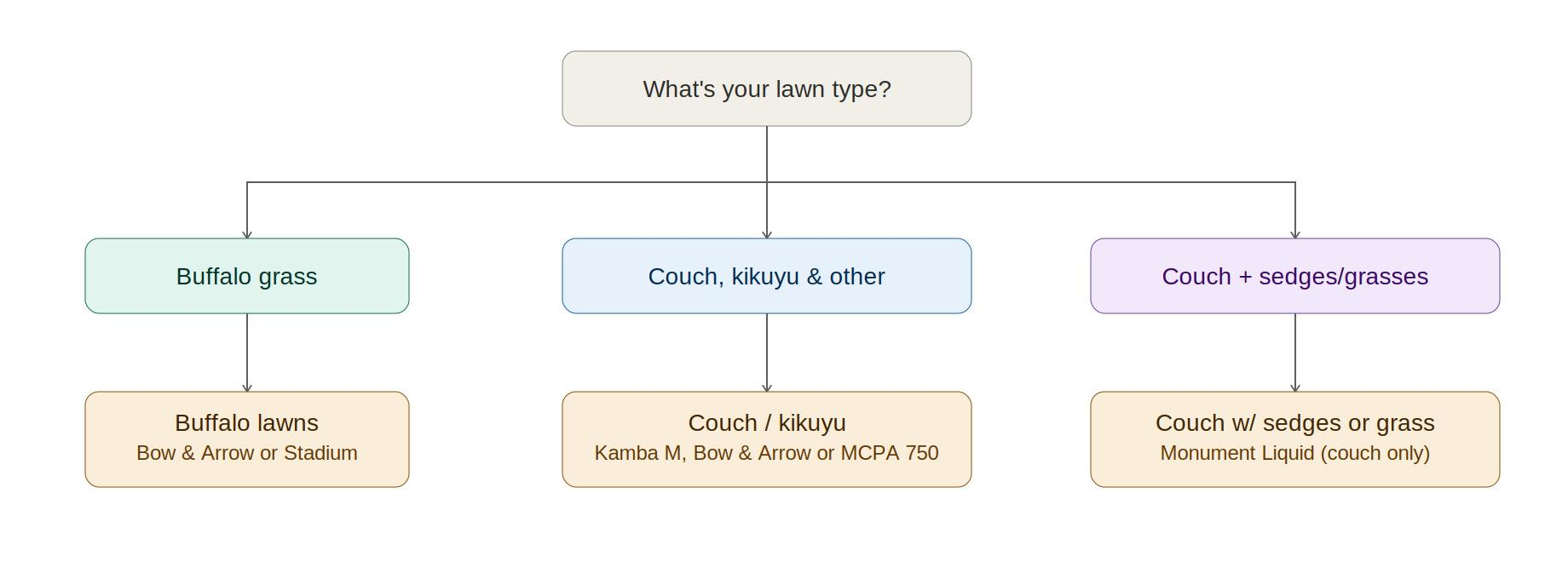
Use the guide below to find the right starting point for your lawn type, then read on for the full breakdown of each product.
1. Best all-rounder for most lawns: Bow and Arrow Herbicide
If there’s one broadleaf herbicide that consistently tops the list for Australian home lawns, it’s Bow and Arrow. It’s one of the most widely used broadleaf herbicides in the country and a long-standing favourite among turf professionals and lawn enthusiasts.
The reason for this is simple. It’s a three-way combination product that combines clopyralid, diflufenican, and MCPA; three actives that attack broadleaf weeds via different modes of action simultaneously, which also helps with resistance management. This makes it highly effective against a wide range of common lawn invaders, including bindii, capeweed, catsear (flatweed), clover, creeping oxalis, cudweed, and plantain.
Bow and Arrow is registered for use on most turf species, including couch, Kikuyu, and most buffalo varieties. There are a few limitations to keep in mind: don’t use it on bent grass or winter grass species, or on golf or bowling greens. Exercise caution when using it on Kikuyu, carpet grass, or Queensland blue couch, as it may cause transient discolouration. Some buffalo varieties (e.g., ST85) should be patch-tested first, as varietal sensitivity can vary.
This product is applied at a general rate of 5L per hectare, or roughly 50mL mixed into 2-5L of water for every 100m². Bow and Arrow is slower-acting than some single-active herbicides — full weed death can take up to six weeks — but the worthy trade-off is thorough, longer-lasting control with less regrowth.
| Bow and Arrow Herbicide | Features |
| Active ingredient | MCPA @ 300g/L, clopyralid @ 20g/L, diflufenican @ 15g/L |
| Best for | Buffalo (most varieties), couch, Kikuyu |
| Not safe for | Bent grass, winter grass, golf or bowling greens |
| Weeds controlled | Bindii, capeweed, catsear, clover, cudweed, oxalis, plantain, white clover, and other broadleaf weeds |
| Pack sizes | 500mL (treats up to 1,000m²), 10L |
| Alternative product | Surefire Multi Turf Herbicide |
2. Best for couch, Kikuyu, and difficult weeds: Kamba M Herbicide
For weed species that Bow and Arrow may not target — particularly pennywort and chickweed — Kamba M Herbicide steps in. Combining dicamba (80g/L) and MCPA (340g/L), this dual-active formulation targets over 50 broadleaf weed species, including bindii, capeweed, clover, dandelion, dock, oxalis, and thistles. It’s glyphosate-free and extremely versatile, making it a popular choice for homeowners, turf managers, greenkeepers, councils, and landscapers across Australia.
The critical caveat when using Kamba M is that buffalo grass is extremely sensitive to its active ingredients, and will suffer severe damage or death upon contact. Thus, never use this product on buffalo lawns.
If your lawn is couch or Kikuyu and you’re battling a stubborn or mixed weed population, Kamba M is one of the most cost-effective and broad-spectrum options available. A 5L pack treats up to roughly 7,500m², well beyond what most suburban blocks require.
| Kamba M Herbicide | Features |
| Active ingredient | Dicamba @ 80g/L, MCPA @ 340g/L |
| Best for | Couch, fescue, Kikuyu, ryegrass |
| Not safe for | Buffalo grass |
| Weeds controlled | 50+ broadleaf species including bindii, capeweed, clover, dandelion, dock, fleabane, lamb’s tongue (plantain), mallow, pennywort, thistles, and wild turnip |
| Pack sizes | 1L, 5L, 20L |
| Alternative product | Surefire Dicamba M Herbicide, Ozcrop Dicamba M Herbicide |
3. Best for tough, mature weeds across multiple lawn types: Stadium Turf Selective Herbicide
Stadium Turf Selective Herbicide is a professional-grade option that earns its place in a home lawn toolkit when weeds are well-established and single-active products haven’t delivered. It’s one of the broadest-spectrum broadleaf herbicides on the market, registered to control seven key weeds using a dual mode of action (Groups F and I) for improved performance and resistance management.
Its three-way formulation of clopyralid, diflufenican, and MCPA is similar in spectrum to Bow and Arrow, but Stadium is also registered for use on buffalo, fescue, paspalum, and ryegrass, making it a highly versatile option for mixed or unusual lawn types. A key feature is its low odour and Schedule 5 (Caution) classification, which combined, make it easy to use and comparatively safer for public or family-occupied environments.
As with Bow and Arrow, transient discolouration may occur on carpet grass, Kikuyu, and Queensland blue couch. Varietal differences in certain buffalo grasses (e.g., ST85) may produce more pronounced effects. It’s recommended that small areas be tested for turf safety before large-scale applications occur.
| Stadium Turf Selective Herbicide | Features |
| Active ingredient | Clopyralid @ 20g/L, diflufenican @ 15g/L, MCPA @ 300g/L |
| Best for | Buffalo (most varieties), carpet grass, common couch, fescue, Kikuyu, paspalum, Queensland blue couch, ryegrass |
| Not safe for | Bent grass, winter grass, golf or bowling greens |
| Weeds controlled | Bindii, capeweed, catsear, clover, creeping oxalis, cudweed, plantain |
| Pack sizes | 10L |
| Alternative product | Jolt Selective Herbicide |
4. Best budget option for simple infestations: Weed Force Thiss-Off Thistle & Broadleaf Herbicide (MCPA 750)
For homeowners dealing with a straightforward broadleaf weed problem — particularly buttercup, capeweed, clover, dandelion, or thistles — and not wanting to invest in a combination product, Weed Force Thiss-Off is a reliable and economical choice.
It’s a single-active selective herbicide containing 750g/L MCPA, which disrupts plant cell growth and causes the weed to die off. It’s rainfast in just two hours and compatible with a wide range of other herbicides for tank mixing.
This product is safe on most established grasses used in Australian lawns, but like all selective herbicides, it should only be applied once the lawn is properly established and mowed at least twice before spraying.
It won’t give you the multi-weed, broad-spectrum punch of a three-way combination product, but for targeted use against common single species, it gets the job done at a very reasonable price.
| Weed Force Thiss-Off Thistle & Broadleaf Herbicide | Features |
| Active ingredient | MCPA @ 750g/L |
| Best for | Couch, Kikuyu, established pasture lawns |
| Not safe for | Newly sown or unestablished turf |
| Weeds controlled | Buttercup, capeweed, clover, dandelion, thistles, and many other common broadleaf weeds |
| Pack sizes | 5L, 20L |
| Alternative product | Conquest MCPA 750 Herbicide, Nufarm MCPA Amine 750 Herbicide |
5. Best for fighting broadleaf weeds, sedges, and grasses in couch lawns: Monument Liquid Turf Herbicide
Monument Liquid Turf Herbicide is an effective choice for a different reason to the three-way combination products above: it’s not just a broadleaf herbicide. It’s a fully systemic, Group B herbicide that relies on 100g/L trifloxysulfuron-sodium, tackling broadleaf weeds, grassy weeds, and sedges in a single pass — which makes it the go-to option when a couch lawn has more than one weed problem at once.
It controls bindii, catsear, chickweed, clover, creeping oxalis, curled dock, and milk thistle on the broadleaf side, while also taking out Mullumbimby couch and nutgrass (both sedges) and ryegrass and winter grass (both grasses). It also suppresses Kikuyu and bahia grass seedheads when tank-mixed with a Primo growth regulator.
The consideration here is Monument’s much narrower turf safety window than the three-way products. Monument is registered only for common couch, Durban grass, hybrid couch, Queensland blue couch, and zoysia. It must not be applied to bentgrass, buffalo, centipede grass, fescue, Kikuyu, paspalum, or ryegrass turf, and off-label use on these species risks serious turf damage. Transient discolouration can still occur on Queensland blue couch and zoysia.
In the pros column, Monument is rainfast within just three hours, doesn’t need to be watered in, and is long-lasting. Most target weeds won’t need a follow-up treatment, except for Kikuyu suppression, which requires two applications 21 to 28 days apart for best results.
| Monument Liquid Turf Herbicide | Features |
| Active ingredient | Trifloxysulfuron @ 100g/L |
| Best for | Common couch, Durban grass, hybrid couch, Queensland blue couch, zoysia |
| Not safe for | Bent grass, buffalo, centipede grass, fescue, Kikuyu, paspalum, ryegrass |
| Weeds controlled | Bindii, burr medic, catsear, chickweed, clover, cotula, creeping oxalis, curled dock, milk thistle, Mullumbimby couch, nutgrass, ryegrass, winter grass; suppresses bahia grass and Kikuyu seedheads |
| Pack sizes | 100mL, 1L |
| Alternative product | Recondo 100WG Herbicide |
Which herbicides are safe on buffalo grass (and which will kill it)
Buffalo grass (including Sir Walter, Palmetto, and Sapphire varieties) is by far the most popular home lawn across Queensland and New South Wales. It deserves a special mention because several common herbicides are instantly out of the running when choosing a weed control product.
Dicamba-based products like Kamba M will damage or kill buffalo, so keep them well away from buffalo turf. Bromoxynil-based products for home use are also no longer available from Specialist Sales following the APVMA reclassification to Schedule 7 in February 2025.
For buffalo lawns, Bow and Arrow is ideal. Stadium Turf Selective Herbicide is also buffalo-registered, though a patch test is recommended on some varieties before large-scale application. Monument Liquid Turf Herbicide is not registered for buffalo grass at all and should be avoided entirely on such lawns.
If you’re unsure which product is right for your specific buffalo variety, the Specialist Sales team can help you work through the label requirements before you spray.
When to spray broadleaf herbicide in Australia: autumn to summer timing
As the final consideration before you spray, we’ll just say this — application timing matters. Here’s what is recommended for each season, tailored to the Australian environmental context.
| Season | What’s happening | Actions to take |
| Autumn (March to May) | Winter annual weeds are germinating | Consider a pre-emergent herbicide if weeds are a recurring problem |
| Winter (June to August) | Weeds are visible but slow-growing | Spraying can be effective, but results may take longer in cooler soil temperatures |
| Spring (September to November) | Peak active growth and flowering is occurring before seed set | Make use of the ideal window for post-emergent broadleaf herbicides by spraying before seed heads form |
| Summer (December to February) | Turf is actively growing; some weeds are dormant | Spraying is effective, but avoid doing so during heat stress or drought |
As a general rule, spray while both weeds and turf are actively growing, avoid application within four hours of expected rain, and don’t mow for three to four days either side of treatment to give the herbicide time to work.
Frequently asked questions
Can I use a broadleaf herbicide on a new lawn?
No. Selective herbicides like these should only be applied to established turf that has been mowed at least two to three times, which gives the grass a strong enough root system to tolerate chemicals.
How long before I can let my kids or pets back on the lawn?
As a general precaution, keep pets and children off treated areas until your chosen herbicide spray has completely dried, and ideally for 24 hours afterwards. Always check the specific product label, as re-entry periods can vary.
Why is my buffalo lawn turning yellow after spraying?
This is usually transient discolouration, which can occur with three-way herbicides like Bow and Arrow or Stadium on certain buffalo varieties. It typically resolves within a couple of weeks. If you’re concerned, patch-test a small area next time before treating the whole lawn.
Do I need to mow before or after spraying?
Avoid mowing for three to four days before and after application. Mowing removes the leaf surface area that is critical for absorption, and disturbs the plant while it’s trying to take up the chemical.
What if I’m dealing with a mix of weeds?
Bow and Arrow or Stadium, both three-way combination products, offer the broadest coverage for mixed broadleaf infestations. If pennywort or chickweed are part of the mix (and your lawn isn’t buffalo), Kamba M is the stronger option. If your couch lawn has broadleaf weeds mixed in with nutgrass, Mullumbimby couch, or winter grass, Monument Liquid Turf Herbicide is worth considering — just remember it can only be applied to couch and zoysia, and never buffalo.
The golden rule with any lawn herbicide is to read the label before you buy, not after. Grass type, weed species, and application timing are all listed on the product label, and all determine whether you get a clean, weed-free result or an expensive problem.
If you’re still not sure where to start, browse the full turf herbicide range at Specialist Sales, or contact our friendly team for advice.
About the author