



Strike cattle tick early and hard
Table of Contents

The single most effective thing you can do to control cattle tick is to start early.
A strategic, long-acting chemical treatment applied at the beginning of the tick season, before populations build on pasture and cattle, does far more good than the same treatment applied later once numbers have already climbed.
This guide covers why cattle tick is such a costly pest, how its life cycle works, when to start treatment in your region, how to build an integrated control program, and the current pour-on options available from Specialist Sales.
Why Cattle Tick Is Such a Costly Pest
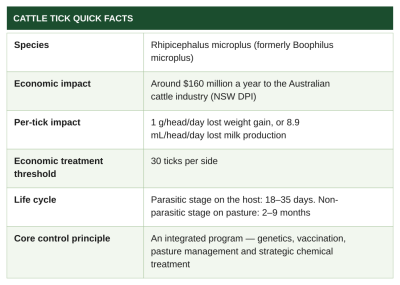
Cattle tick (Rhipicephalus microplus) is one of the most economically significant parasites in the Australian beef industry, costing the national cattle industry an estimated $160 million a year. Infestations cause losses through tick fever, anaemia, weakness, reduced appetite, weight loss, reduced fertility, and in severe cases, death.
The per-animal impact adds up quickly. Research has shown that just one tick can reduce weight gain by 1 g per head per day, or milk production by 8.9 mL per head per day. At an average burden of 50 ticks per head, that’s roughly 1.5 kg of lost live weight gain, or 13.4 litres of lost milk production, every 30 days.
Cattle tick also transmit tick fever (babesiosis and anaplasmosis), a serious and sometimes fatal blood disease, which is why control isn’t just about the tick itself, but about preventing the disease it carries.
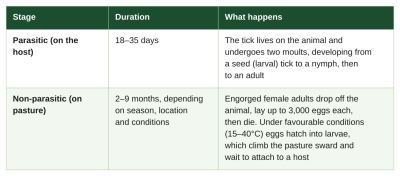
The Cattle Tick Life Cycle
Understanding the life cycle is the foundation of an effective control program; it tells you when treatment will have the most impact.
When To Start Treatment
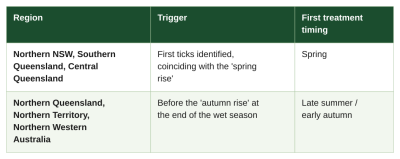
Start chemical treatment once tick infestations reach the economic threshold, generally accepted as 30 ticks per side. Timing then depends on your region and the seasonal tick ‘rise’:
Applied early as part of a strategic program, this long-acting treatment helps minimise tick build-up on both cattle and pasture, rather than just knocking down the numbers already there.
Building An Integrated Tick Control Program
Regardless of the level of Bos indicus content in your herd, effective cattle tick control relies on a combined approach rather than chemical treatment alone.
- Understand the tick life cycle so treatments are timed for maximum impact.
- Breed for tick resistance where herd genetics allow; Bos indicus content generally improves natural resistance.
- Vaccinate to increase immunity against tick fever, particularly for cattle moving into or through tick-endemic areas.
- Use strategic pasture management to help break the tick’s non-parasitic cycle on pasture.
- Apply effective chemical treatments strategically, starting at the economic threshold and timed to your regional tick rise.
How Dual-Active Tick Treatments Work
Products that combine ivermectin and fluazuron target the tick problem from two directions at once — knocking down ticks already on the animal, while also breaking the life cycle of ticks still to come from pasture.
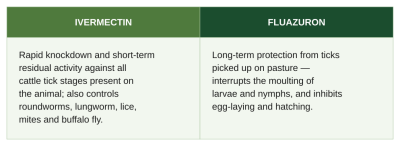
Two modes of action in a single product also help reduce the risk of resistance developing and prolong the useful life of the chemistry.
How long does protection last?
Protection length varies by livestock class. Independent Australian research by Craig Stevenson from Elanco Animal Health has shown that treating dry cattle with a dual-active pour-on can prevent re-infestation by seed ticks for up to 9 weeks, and the presence of fully engorged female ticks for up to 12 weeks. Protection may be reduced in lactating cows or rapidly growing young cattle. Calves suckling a treated cow do not need to be treated separately.
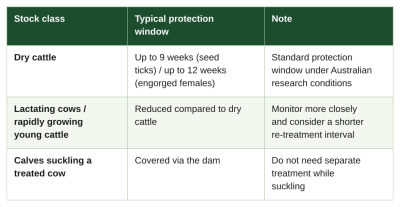
Most dual-active products have a minimum re-treatment interval of 42 days and a maximum of three treatments per tick season; always check the specific product label for exact intervals and limits.
Current Cattle Tick Control Products
Specialist Sales stocks both dual-active (fluazuron + ivermectin) and single-active pour-on options, so you can choose the right tool for your situation and rotate chemistries as part of a resistance management plan.
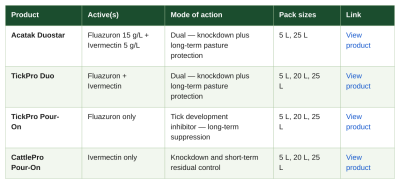
Product ranges and stock availability change over time — browse the full, current range at specialistsales.com.au before ordering.
Moxidectin-based options
Moxidectin-based injections and pour-ons are a separate class of long-acting tick treatment, and a useful rotation partner alongside the fluazuron-based products above. They’re available as both long-acting injections (applied to the back of the ear) and topical pour-ons, with tick protection windows that vary by format.
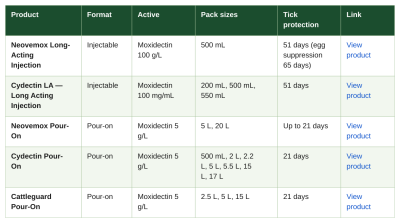
Product ranges and stock availability change over time — browse the full, current range at specialistsales.com.au before ordering.
Managing Resistance
Multi-resistant ticks are present in many geographic regions where cattle tick occurs. Relying on a single product or mode of action season after season increases the risk of resistance developing and reduces the long-term effectiveness of your control program.
- Ideally, alternate a dual-active product with an effective product using a different mode of action each season, for example, a fluazuron-based product one season and a moxidectin-based injection or pour-on the next.
- Conduct a tick resistance test on your property to help determine which products are still effective in your situation.
- Keep to label-directed re-treatment intervals and maximum treatments per season to help slow resistance development.
Frequently Asked Questions
What is the economic threshold for treating cattle tick?
Chemical treatment should generally begin once infestations reach 30 ticks per side. Waiting beyond this point allows populations to build more rapidly on both cattle and pasture.
When should I apply the first tick treatment of the season?
It depends on your region. In Northern NSW, Southern Queensland and Central Queensland, treat in spring once the first ticks appear alongside the ‘spring rise’. In Northern Queensland, the Northern Territory and Northern Western Australia, treat in late summer or early autumn, before the ‘autumn rise’ at the end of the wet season.
Do I need to treat calves that are still suckling?
No, calves suckling a cow treated with a dual-active pour-on do not need to be treated separately.
How do I know if resistance is a problem on my property?
A tick resistance test is the most reliable way to determine which chemistries are still effective on your property. If you’re seeing reduced efficacy from a product that has worked well in the past, it’s worth investigating before continuing to use it.
Final Thoughts
Cattle tick control works best as a strategic, early, integrated program rather than a reactive one. Understand the life cycle, treat at the economic threshold in line with your regional tick rise, combine chemical control with genetics, vaccination and pasture management, and rotate chemistries to protect the products you rely on.
If you’re not sure which tick treatment suits your herd and situation, the team at Specialist Sales is available to help.
This information and product advice is general in nature and is not intended as advice or a recommendation for any specific use or circumstance. Always read and follow the product label before use, and seek specialist or veterinary advice for your situation. Specialist Sales’ liability is limited; please review our Terms and Conditions.
About the author