



Description
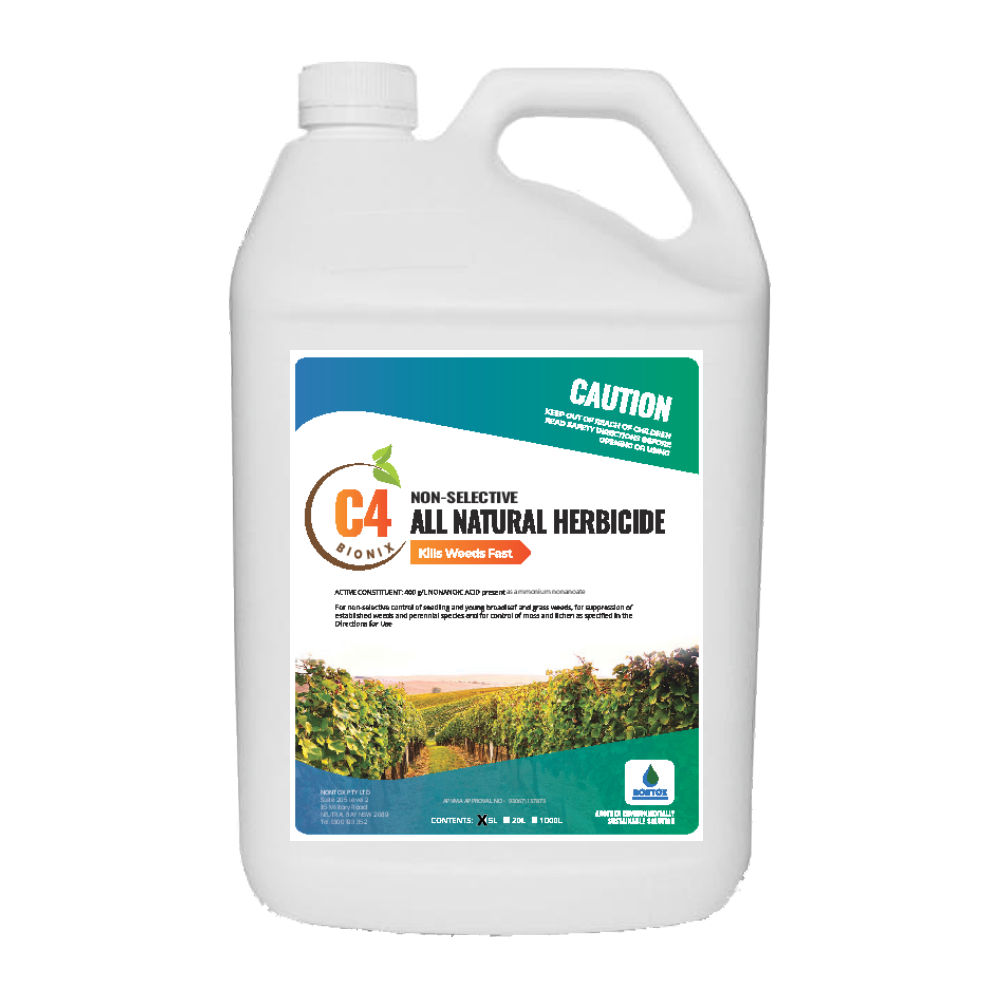
Bionix C4 Non-Selective All-Natural Herbicide
Bionix C4 is a plant-based, non-selective natural herbicide containing 400 g/L nonanoic acid present as ammonium nonanoate, delivering fast contact burndown of seedling and young broadleaf and grass weeds. Registered by the APVMA (Approval No. 93067/137873) in February 2024, this Nontox Pty Ltd product covers professional use across paths, fence lines, fallows, orchards, and vineyards. Its pH-neutral, soap-salt formulation provides a proven alternative where resistance to glyphosate and paraquat is a growing problem.
Bionix C4 penetrates plant cell walls and causes rapid dehydration and collapse. Because it is a contact-only product and does not translocate, it kills what it touches and does not migrate through the soil. Visible results appear within an hour, and full burndown is complete within 24 hours.
What Situations Is Bionix C4 Registered For?
| Situation | Examples |
|---|---|
| Infrastructure and amenity | Paths, driveways, roadsides, guideposts, powerlines, fence lines, aerodromes |
| Horticulture | Orchards, vineyards, nursery stock, protected cropping |
| Agriculture | Fallows |
| Public and commercial | Industrial areas, public utilities, public service areas |
| Turf (spot spraying) | Established lawns and turf |
Which Weeds Does Bionix C4 Control?
Bionix C4 controls seedling and young annual weeds, including:
- Clover, cobbler pegs, couch grass and crowsfoot grass
- False heather, fleabane, nutgrass and paspalum
- Plantain, slender celery, capeweed and chickweed
- Fat hen, lamb’s tongue, peppercress, potato weed and stinking roger
More advanced or established weeds may only be suppressed, so repeat applications are likely needed.
Is Bionix C4 Safe Around Crops?
Yes. Field trials at Piñata Pineapple Farms in Queensland confirmed a high level of crop safety when applied as directed. Bionix C4 also suits use as a harvest defoliant for pumpkins, potatoes, root vegetables, and cotton, where elimination of green leaves, weeds, and grasses is required before harvest.
Does Bionix C4 Work on Glyphosate-Resistant Weeds?
Yes. Bionix C4 offers an alternate mode of action against herbicide-resistant weed species. Comparative trials against Roundup Biactive (360 g/L glyphosate) and Slasher (525 g/L nonanoic acid) confirmed equivalent control on most species, including resistant fleabane in vineyard conditions at Mudgee. Note: not all resistant weed species have been tested.
Frequently asked questions;
Q: Both Bionix C4 and Slasher Organic Weedkiller (Yates) contain nonanoic acid as the active. What makes the Bionix C4 formulation different?
A: The key difference is the salt form. Bionix C4 uses ammonium nonanoate, which is nonanoic acid neutralised with ammonia. This salt form is water-soluble by nature, meaning it mixes readily into aqueous solutions without heavy reliance on added surfactants or organic solvents. Slasher uses free nonanoic acid (525 g/L), which is an oily fatty acid with low water solubility. To make it sprayable, manufacturers must force it into emulsifiable concentrates using high-surfactant approaches. Those added surfactants introduce high acidity, strong odour, corrosivity, and formulation complexity that Bionix C4 avoids entirely.
Q: Bionix C4 is pH neutral. Why does that matter compared to other nonanoic acid herbicides?
A: Free nonanoic acid is inherently acidic and corrosive. Products built on it require pH management and can damage spray equipment over time, particularly seals, pumps, and hoses. Bionix C4’s ammonium nonanoate formulation, combined with selected polar solvents, produces a pH-neutral product. This reduces corrosivity, extends equipment life, and makes the product safer and easier to handle under field conditions. It also lowers the risk of eye and skin irritation relative to concentrated free-acid formulations, which regulatory authorities, including the APVMA, flag as requiring tighter exposure controls.
Q: If the active is essentially the same compound, does Bionix C4 Natural Herbicide actually perform better in the field?
A: Comparable or better, depending on the situation. In Sunshine Coast Council trials, Bionix C4 delivered equivalent control to both Roundup Biactive (360 g/L glyphosate) and Slasher (525 g/L nonanoic acid) across most weed species. The ammonium nonanoate molecule has a split-polarity structure, meaning one end is water-loving, and one end is oil-loving. This causes it to sit at the water-air and water-oil interface, acting as its own surfactant on waxy and oily leaf surfaces. In practice, Bionix C4 self-wets on contact without the need for additional wetter in most situations, while free nonanoic acid products rely more heavily on added surfactants to achieve the same penetration. The result is a simpler, more consistent spray performance with lower acidity and a better handling profile.


What others are saying
There are no contributions yet.