



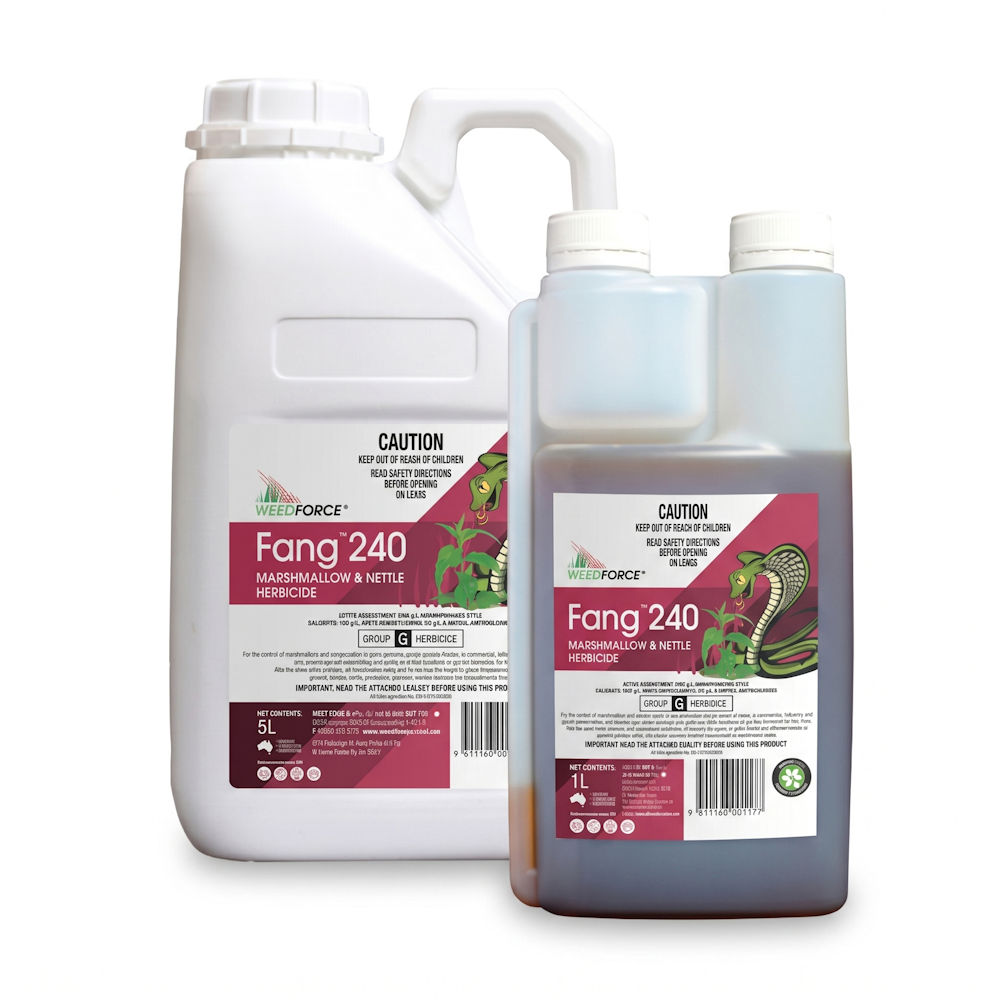
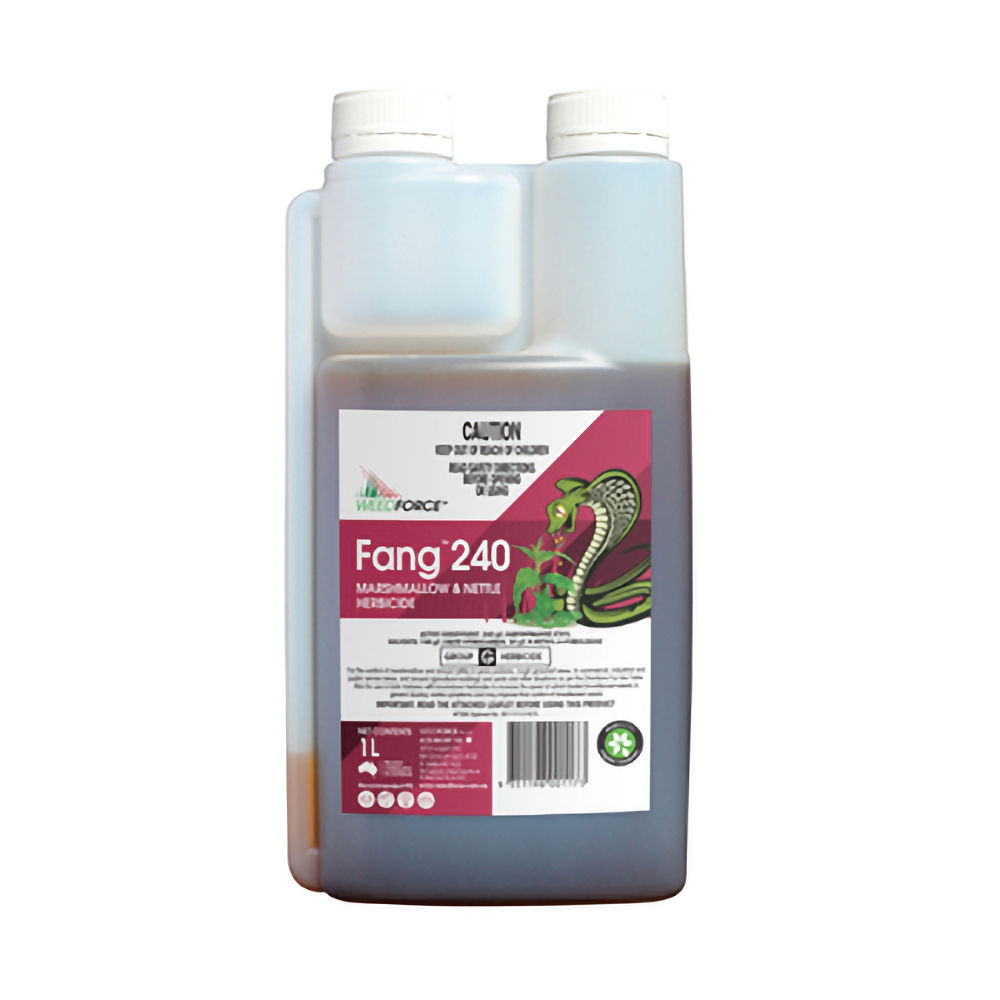
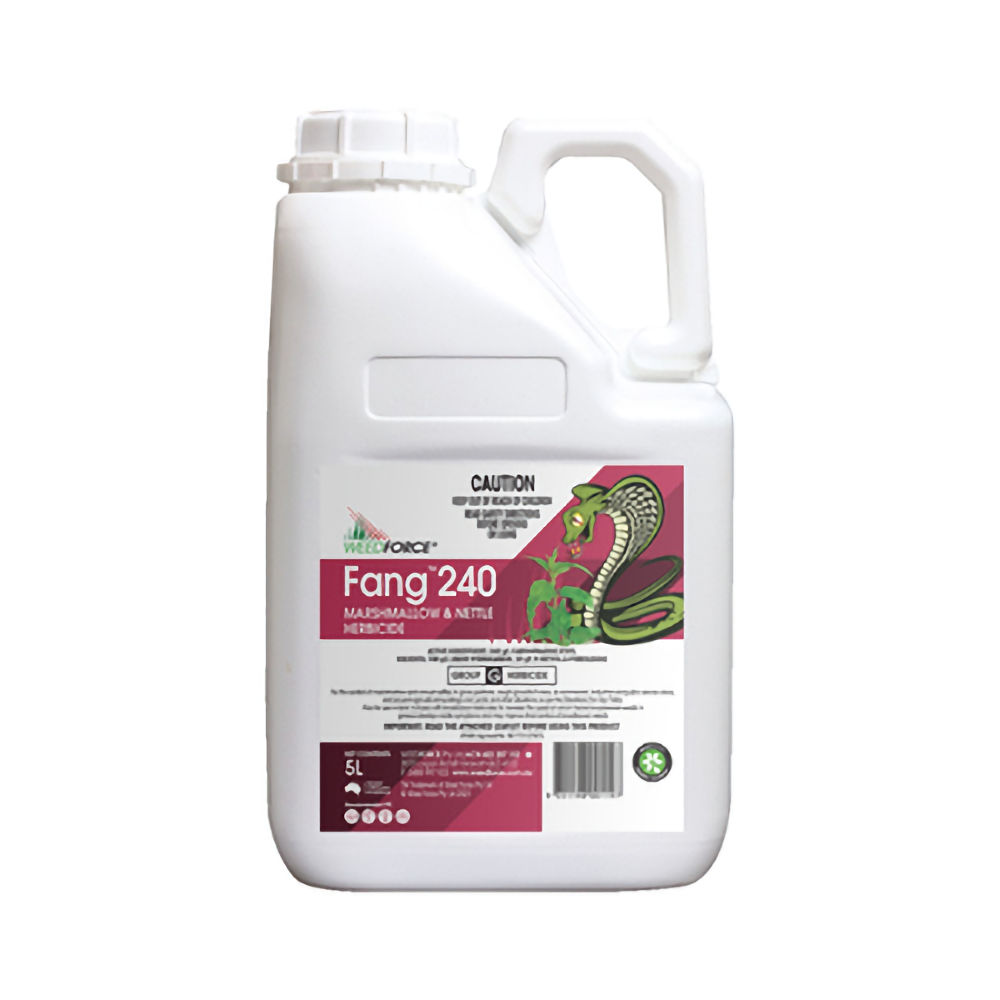
Description
Weed Force Fang 240 Marshmallow & Nettle Herbicide contains 240 g/L carfentrazone-ethyl, a Group 14 herbicide from Weedforce Pty Ltd. It controls marshmallow (Malva parviflora) and annual stinging nettles (Urtica urens) in grass pastures and rough turf areas across all Australian states. Because carfentrazone-ethyl disrupts plant cell membranes by inhibiting protoporphyrinogen oxidase, visible desiccation occurs within hours of application. As a result, susceptible weeds generally die within four days.
Fang 240 also functions as a tank-mix partner with knockdown herbicides, including glyphosate, paraquat, and glufosinate products. In this role, it broadens the weed spectrum before sowing winter or summer broadacre crops, or during fallow preparation. Target weeds include capeweed, chickweed, common storksbill, doublegee, Paterson’s curse, sub clover, wild radish, and Australian crassula. Weedforce Pty Ltd has also registered Fang 240 for commercial and industrial areas, around agricultural buildings and yards, and in grapevines, stone fruit, pome fruit, tree nuts, and tropical and sub-tropical fruit orchards.
Weed Force Fang 240 Marshmallow & Nettle Herbicide: How It Works
Carfentrazone-ethyl is a contact herbicide with no soil residual activity. Therefore, there are no crop plant-back or rotation restrictions after use. Subsequent weed germinations following application will not receive control, however, so good timing is critical. For best results, apply to small, actively growing weeds. Drought-stressed or hardened plants, particularly marshmallow sprayed in summer, respond poorly and may regrow after treatment.
Application in Grass Pastures and Rough Turf
In grass pastures, apply Fang 240 at 25 to 75 mL/ha by boom spray with a compatible adjuvant such as Hasten or 417 g/L paraffinic oil, or at 10 mL per 100 litres for spot-spray use. Apply only to seedlings at 2 to 10 leaf stage. Note that these rates may suppress the marshmallow only under some conditions. To improve marshmallow control, tank-mix with a 2,4-D product at label-recommended rates. Do not use Fang 240 in pastures where clover, lucerne, or medics are present, as the product will severely damage or kill these species.
Pre-Crop, Fallow, and Industrial Use
For pre-crop, fallow, and commercial or industrial situations, always apply Fang 240 as a tank mix with a knockdown herbicide at label rates. Use the lower rate of 25 mL/ha on younger plants growing under good conditions, and the higher rate of 75 mL/ha on older or stressed plants. Addition of a compatible adjuvant such as Hasten or Holdfast improves uptake when glyphosate is the tank-mix partner. Do not sow crops for at least one hour after application, and refer to the companion product label for any longer re-crop sowing intervals.
Frequently Asked Questions
Can Fang 240 be used in clover-based pastures?
No. Fang 240 will severely damage or kill clover, lucerne, and medics. It is not suitable for pastures where these species need to be maintained.
Does Fang 240 provide residual weed control?
No. Fang 240 is a contact herbicide with no soil residual activity. Subsequent weed germinations after application will not be controlled.
What is the withholding period for Fang 240 in grass pastures?
Do not graze treated areas or cut for stock food for 14 days after application.
Does Fang 240 require a wetting agent in grass pastures?
Yes. A compatible adjuvant, such as Hasten or 417 g/L paraffinic oil, is required when applying Fang 240 to grass pastures and rough turf areas.
Can Fang 240 be applied by aircraft?
Aerial application is not permitted except for cotton desiccation in Queensland, New South Wales, and Western Australia only.









What others are saying
There are no contributions yet.