How to treat sheep lice?
Table of Contents
Sheep body lice are one of the most costly parasites a wool producer can carry. In New South Wales alone, lice cost sheep producers about $123 million a year in treatment costs and lost production (NSW DPIRD). Lice can be eradicated, but only when every sheep is treated at the right time, with the right product, applied the right way.
Typically, the best time to treat sheep for lice is off-shears (within 24 hours of shearing) or in short wool (2 to 6 weeks after shearing). Traditional topical treatments applied in long wool (more than 6 weeks after shearing) usually reduce lice numbers but will not always eradicate them, so those sheep need to be treated again after their next shearing.
Until recently, that meant lice programs were planned around shearing. Pour-ons, dips, and jetting fluids all work on the outside of the sheep, and only off-shears and short-wool treatments could eradicate lice; long-wool jetting and backliners traditionally just held numbers down until the next shearing.
However, that all changed with the introduction of fluralaner, the active ingredient in Flexolt Oral Lice Treatment for Sheep. It is the only lice treatment with a label claim to eradicate lice at any wool length, because it does not depend on wool length at all (LiceBoss).
Fluralaner belongs to the isoxazoline chemical group, a new class of chemistry for sheep lice control with no known resistance in sheep lice populations. Instead of being poured on or jetted into the fleece, it is given as a low-volume oral drench. It is absorbed into the bloodstream and reaches lice at the skin surface, where they take it in as they feed. Because it works from the inside, it also controls lice strains that are resistant to synthetic pyrethroids and insect growth regulators.
For producers, that opens up options that simply were not available before:
- Treat when it suits you. Off-shears, pre-shearing, at crutching, pre-joining, at classing or pre-lambing (but not in the 4 weeks before lambing starts or during lambing).
- Treat every mob at once. You can treat sheep with different wool lengths on the same day, which helps on properties with split shearings.
- Treat lambs at foot. Lambs from 6 kg bodyweight can be drenched alongside their mothers.
- Treat new sheep on arrival. Treat introduced sheep regardless of wool length, once they have rehydrated and have good gut fill.
- Avoid weather and shearing problems. Rain before or after treatment does not affect the result; sheep are not wet down in cold weather as with dipping or jetting, and a poor shearing job does not reduce effectiveness.
Fluralaner has a wide safety margin (five times the maximum dose is well tolerated) and can be used in breeding rams and pregnant ewes, although safety during mating has not been established. It is short-acting rather than residual, so good biosecurity and keeping treated sheep away from untreated sheep still matters. Details are on the Flexolt product page and label.
This guide covers how to confirm you have lice, which treatment window you are in, how to apply off-shears and long wool treatments properly, and which products in our range suit each situation.
| Question | Answer |
|---|---|
| Which louse? | Sheep body louse (Bovicola ovis), the species behind most infestations |
| Best time to treat | Off-shears (0 to 24 hours after shearing) or short wool (2 to 6 weeks after shearing) |
| Long wool (over 6 weeks) | Topical treatments reduce numbers only; treat again after the next shearing |
| Any wool length | Oral fluralaner (Flexolt) is registered to eradicate lice regardless of wool length |
| Most common causes of failure | Missed sheep, under-dosing, poor shearing and resistance |
| When to check | Twice a year, at crutching and before shearing, plus any time you see rubbing |
Table 1: Sheep lice treatment quick facts — Specialist Sales
Sources: LiceBoss (AWI, MLA, UNE); PIRSA.
Key takeaways
|
How do you know if your sheep have lice?
Rubbing, biting at the fleece and pulled or tufted wool are the usual first signs. Because lice are hard to see in small numbers, a proper inspection is worth the time. PIRSA recommends the following method (PIRSA):
- Inspect sheep in a well-lit area, choosing animals that are rubbing or have pulled wool.
- Part a 10 cm length of wool and look closely near the skin for lice.
- Make 10 partings down the side of each sheep, plus any areas of pulled wool.
- Check as many sheep as you can.
A single louse means the mob is infested, so consider treatment. If you find a louse in every 10 cm parting, that indicates roughly 3,000 to 4,000 lice per sheep, and heavily infested sheep can carry more than 10,000. Check all mobs twice a year, ideally at crutching and before shearing, and always check sheep before you buy them or mix mobs.
When is the best time to treat sheep for lice?
Timing comes down to wool length. LiceBoss identifies off-shears (within 24 hours of shearing) and short wool (2 to 6 weeks after shearing) as the windows for eradication, with long wool treatments used for control only in most cases. (LiceBoss).
| Window | Timing | Goal | Typical method | Options at Specialist Sales |
|---|---|---|---|---|
| Off-shears | 0 to 24 hours after shearing (some labels allow up to 7 days) | Eradication | Backline pour-on | Spurt Off-Shears Pour-On, Extinosad Pour-On |
| Short wool | 2 to 6 weeks after shearing | Eradication | Plunge or shower dip | Extinosad Lice, Fly and Maggot Eliminator |
| Long wool | More than 6 weeks after shearing | Control only; re-treat after next shearing | Hand-jetting or long wool backline | Coopers Blowfly and Lice, Akula Concentrate, Extinosad Eliminator, Extinosad Pour-On |
| Any wool length | Any time, including lambs from 6 kg | Eradication (label claim) | Oral drench | Flexolt Oral Lice Treatment |
Table 2: Sheep lice treatment windows by wool length — Specialist Sales
Windows from LiceBoss. Always confirm the timing on the individual product label.
How do you treat sheep for lice off-shears?
Off-shears backline (pour-on) treatments account for about 80% of lice treatments applied in Australia. They are quick, need no re-muster, and treated sheep are easy to spot by the dye. But they only work if applied carefully (LiceBoss).
- Shear cleanly. Backliners will not spread properly on sheep that aren’t cleanly shorn or have dermo (lumpy wool). Those sheep need to be dipped, kept separate or culled.
- Stay inside the label window. Most products must go on within 24 hours of shearing.
- Dose to the heaviest sheep. Weigh a few of the biggest animals and set the dose to suit. If weights vary widely, draft into weight groups. Under-dosing is a leading cause of failure.
- Check your applicator. Use the applicator and nozzle the label specifies (drench guns are not suitable), and test a few doses into a measuring cup before you start.
- Follow the application pattern. Apply evenly from poll to tail exactly as the label diagram shows. A short or lopsided stripe leaves areas where lice survive.
- Keep treated sheep separate. Backliners can take 6 weeks or longer to kill all lice, so keep treated mobs away from untreated sheep during that time.
In our experience, the treatment itself is rarely the weak link. A handful of missed sheep, late shearing, or under-dosing lets lice back into a clean flock.
Can you dip sheep in short wool instead?
Yes. Plunge or shower dipping in short wool spreads the chemical more evenly over the sheep than a backline. Extinosad Lice, Fly and Maggot Eliminator is registered for plunge and shower dipping 2 to 6 weeks after shearing. Its label advises against dipping within 2 weeks of shearing or dipping sheep heavily infested with grass seed, and stresses thorough wetting to skin level.
What are your options for sheep in long wool?
If you find lice between shearings, you can treat in long wool, wait until shearing, or shear early. LiceBoss notes that early shearing is rarely the most cost-effective choice, and its Long Wool Tool can help you weigh up whether a long-wool treatment is worth the muster (LiceBoss).
Remember that long wool topical treatments only reduce lice numbers and limit wool damage. Whatever you do, plan to treat again after the next shearing.
How do you hand-jet sheep for lice?
Hand-jetting is hard work, and thoroughness drops as the operator tires, so set up properly before you start (NSW DPI):
- Apply at least 0.5 litres of jetting fluid per month of wool growth to adult sheep. Time how long it takes to deliver that volume into a container, and spend at least that long on each sheep.
- Run the pump at 700 kPa at the handpiece. An in-line pressure gauge at the wand is the easiest way to check.
- Wet the fleece to skin level along the backline, and add blows down each side of the neck and throat.
- Wear proper protective gear: waterproof pants, gumboots and gauntlets over overalls.
Jetting can leave higher residues in the wool, so check the wool harvest interval. Both Coopers Blowfly and Lice and Akula Concentrate must not be used less than 6 weeks before shearing. Both also protect against flystrike, which is useful heading into the warmer months; see our guide to blowfly strike in sheep.
Is there a long wool backline option?
Extinosad Pour-On is registered for long wool use at 50 mL per adult sheep (6 to 12 months after shearing), with nil meat and wool withholding periods for long wool application. As with any long wool topical, sheep should be treated again with an off-shears product at the next shearing.
What about oral treatment?
Flexolt Oral Lice Treatment for Sheep is the long wool option that also eradicates (see the introduction for how fluralaner works). A few label points to plan around: dose the mob to the heaviest sheep in each group, mark sheep as they are treated, do not re-treat within 54 days, and avoid treating ewes less than 4 weeks before lambing starts.
Which lice treatments suit off-shears and long wool?
| Product | Active (chemical group) | Method | Wool length | Key notes |
|---|---|---|---|---|
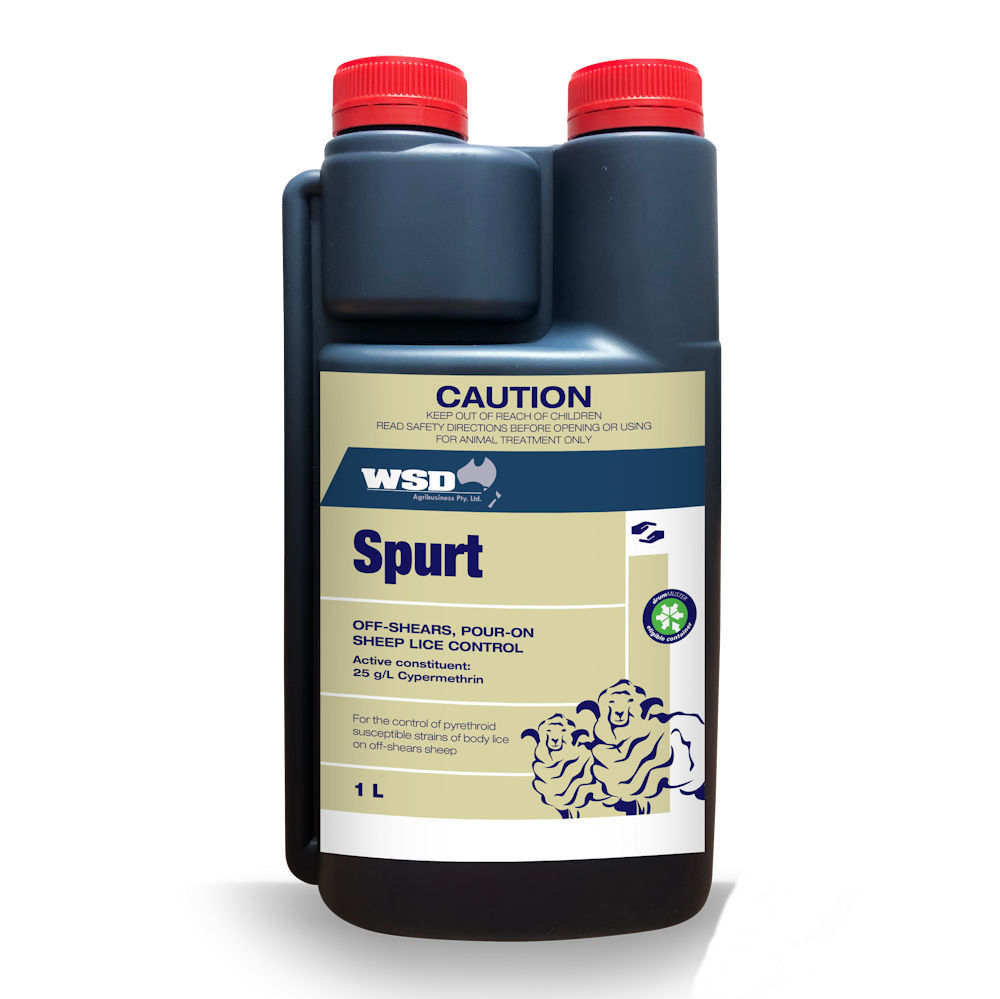
| Spurt Off-Shears Pour-On | Cypermethrin 25 g/L (synthetic pyrethroid) | Backline | Off-shears, within 24 hours | Pyrethroid-susceptible lice only. Not for ewes due to lamb within 6 weeks or with lambs at foot |
| Extinosad Pour-On | Spinosad 20 g/L (spinosyn) | Backline | Off-shears (up to 7 days), long wool, unshorn suckling lambs | Label claim against SP-resistant strains |
| Extinosad Lice, Fly and Maggot Eliminator | Spinosad 25 g/L (spinosyn) | Plunge/shower dip; hand-jetting | Short wool (dip); long wool (jetting) | Also treats and prevents flystrike |
| Coopers Blowfly and Lice | Ivermectin 16 g/L (macrocyclic lactone) | Hand-jetting | Long wool | Flystrike protection up to 12 weeks under low to moderate pressure |
| Akula Concentrate for Lice, Fly and Worms | Ivermectin 16 g/L (macrocyclic lactone) | Hand-jetting (lice) | Long wool | Can be used as an oral drench, or jetting fluid for treatment of blowfly strike and biting lice in long wooled sheep |
| Flexolt Oral Lice Treatment | Fluralaner 10 g/L (isoxazoline) | Oral drench | Any wool length | Eradication claim at any wool length. Lambs from 6 kg |
Table 3: Sheep lice treatments compared — Specialist Sales
Details from Specialist Sales product pages and labels, October 2026. Always read the full label before use.
What are the dose and mixing rates?
| Product | Situation | Rate |
|---|---|---|
| Flexolt | All sheep and lambs from 6 kg | 1.5 mL per 10 kg bodyweight (e.g. 7.5 mL for 41 to 50 kg) |
| Extinosad Pour-On | Off-shears (up to 7 days) | 15 mL (20 to 30 kg); 20 mL (31 to 40 kg); 25 mL (41 to 50 kg); 30 mL (51 to 60 kg); 35 mL (61 to 70 kg); 40 mL (71 to 80 kg); add 2.5 mL per 5 kg above 80 kg |
| Extinosad Pour-On | Unshorn suckling lambs | 5 mL (up to 9 kg); 7.5 mL (10 to 19 kg); 15 mL (20 to 29 kg) |
| Extinosad Pour-On | Long wool adults (6 to 12 months wool) | 50 mL per head |
| Extinosad Eliminator | Short wool plunge dip | 40 mL per 100 L initial charge; 60 mL per 100 L replenishment |
| Extinosad Eliminator | Short wool shower dip | 80 mL per 100 L initial charge; 160 mL per 100 L replenishment |
| Extinosad Eliminator | Long wool hand-jetting | 100 mL per 100 L water; 0.5 L fluid per month of wool (up to 5 L per sheep) |
| Coopers Blowfly and Lice and Akula | Long wool hand-jetting | 200 mL per 100 L water; 0.5 L fluid per month of wool growth |
Table 4: Sheep lice treatment dose and mixing rates — Specialist Sales
Rates from Specialist Sales product pages and current APVMA labels. Check the Spurt label for its dose table. Rates are a guide only; follow the label.
What are the withholding periods?
| Product | Meat WHP | Export slaughter interval (ESI) | Wool harvest interval (before shearing or crutching) |
|---|---|---|---|
| Flexolt | 14 days | 54 days | Nil |
| Extinosad Pour-On | 14 days (off-shears and lambs); nil (long wool) | 21 days (off-shears and lambs); 0 days (long wool) | Nil |
| Extinosad Eliminator | Nil | 0 days (long wool jetting); not established for short wool dipping | Nil |
| Coopers Blowfly and Lice | 7 days | 7 days | 6 weeks before shearing |
| Akula (jetting) | 7 days | 7 days | 6 weeks before shearing |
Table 5: Withholding periods for sheep lice treatments — Specialist Sales
Do not use any of these products on ewes producing milk for human consumption. Confirm current ESIs with the manufacturer or the APVMA before use.
What does a sheep lice treatment plan look like?
- Confirm lice. Use the 10-parting check on several sheep in each mob.
- Pick your window. Off-shears or short wool for eradication; long wool for control; oral if you need to treat regardless of wool length.
- Muster clean and fix fences. Find and treat every sheep, including rams, stragglers, and pets.
- Shear everything at once. Split shearings make eradication much harder. If you cannot avoid one, keep mobs separate.
- Weigh and calibrate. Dose to the heaviest sheep and check your applicator before you start.
- Treat and mark. Mark each treated sheep so you don’t miss any.
- Isolate. Keep treated sheep away from untreated or unknown-status sheep for the period on the label.
- Record and re-check. Note the product and chemical group, then check again at crutching and before the next shearing.
How do you avoid lice resistance?
Some sheep lice populations are resistant to synthetic pyrethroids and/or insect growth regulators. If lice are resistant to one product, they are resistant to every product in that chemical group. LiceBoss advises against using the same group again if lice were not eliminated, and recommends rotating groups if you treat every year. That said, most treatment failures still come down to incorrect application or under-dosing (LiceBoss).
How do you treat ewes with lambs at foot?
Never treat ewes and leave their lambs untreated, because lice on the lambs will move back to the ewes as the chemical wears off. Depending on the product, live lice can remain on treated ewes for 6 weeks or more, so avoid backlining ewes within 6 weeks of lambing unless you will also treat the lambs. Extinosad Pour-On has a dose for unshorn suckling lambs, and Flexolt can be used on lambs from 6 kg. LiceBoss also has a dedicated guide to lice control for ewes and lambs.
Lice treatments available at Specialist Sales
| Flexolt Oral Lice Treatment for Sheep
Active: Fluralaner 10 g/L Use: Oral; any wool length Pack sizes: 5 L, 20 L |
| Extinosad Pour-On for Sheep
Active: Spinosad 20 g/L Use: Backline; off-shears, long wool and suckling lambs Pack sizes: 5 L, 20 L |
| Spurt Off-Shears Pour-On Sheep Lice Control
Active: Cypermethrin 25 g/L Use: Backline; off-shears within 24 hours Pack sizes: 1 L, 5 L, 20 L |
| Extinosad Lice, Fly and Maggot Eliminator
Active: Spinosad 25 g/L Use: Short wool dip; long wool jetting Pack sizes: 250 mL, 1 L, 5 L |
| Coopers Blowfly and Lice
Active: Ivermectin 16 g/L Use: Long wool hand-jetting Pack sizes: 5 L |
| Akula Concentrate for Lice, Fly and Worms
Active: Ivermectin 16 g/L Use: Long wool hand-jetting (lice) Pack sizes: 1 L, 5 L |
Browse the full sheep lice control range, or if you are also planning your summer drench, read our guide to effective sheep drenching.
Frequently asked questions about sheep lice
Can I treat in long wool and skip treating at shearing?
Not with a topical product. Long-wool backline and jetting treatments reduce lice numbers but don’t eradicate them, so sheep need an off-shears or short-wool treatment after the next shearing. Oral fluralaner (Flexolt) is the exception, as it is registered to eradicate lice at any wool length.
How long after shearing can I apply a backline treatment?
Most off-shears backliners must be applied within 24 hours of shearing. Some labels allow longer; for example, Extinosad Pour-On can be applied up to 7 days off-shears. Always check the individual label.
Does an ivermectin drench kill sheep lice?
Not as an oral worm drench. Akula Concentrate and Coopers Blowfly and Lice control lice only when diluted and applied by hand-jetting to long wool sheep. Given orally, Akula is registered for internal parasites, nasal bot and itch mite, not lice.
How quickly do backline treatments work?
Backline products can take 6 weeks or longer to kill all lice, so you may still see live lice for a while after treatment. Keep treated sheep isolated during this period.
Getting sheep lice under control
Effective lice control depends on timing, thorough application, and treating every sheep. Treat off-shears or in short wool to eradicate; use long-wool treatments to protect the clip until shearing; and rotate chemical groups if lice return. If you are not sure which product suits your situation, our team is here to help.
This information is general in nature and is not intended as advice or a recommendation for any specific use or circumstance. Always read and follow the product label before use, and seek specialist advice for your situation. Specialist Sales’ liability is limited; please review our Terms and Conditions for more information.
About the author