



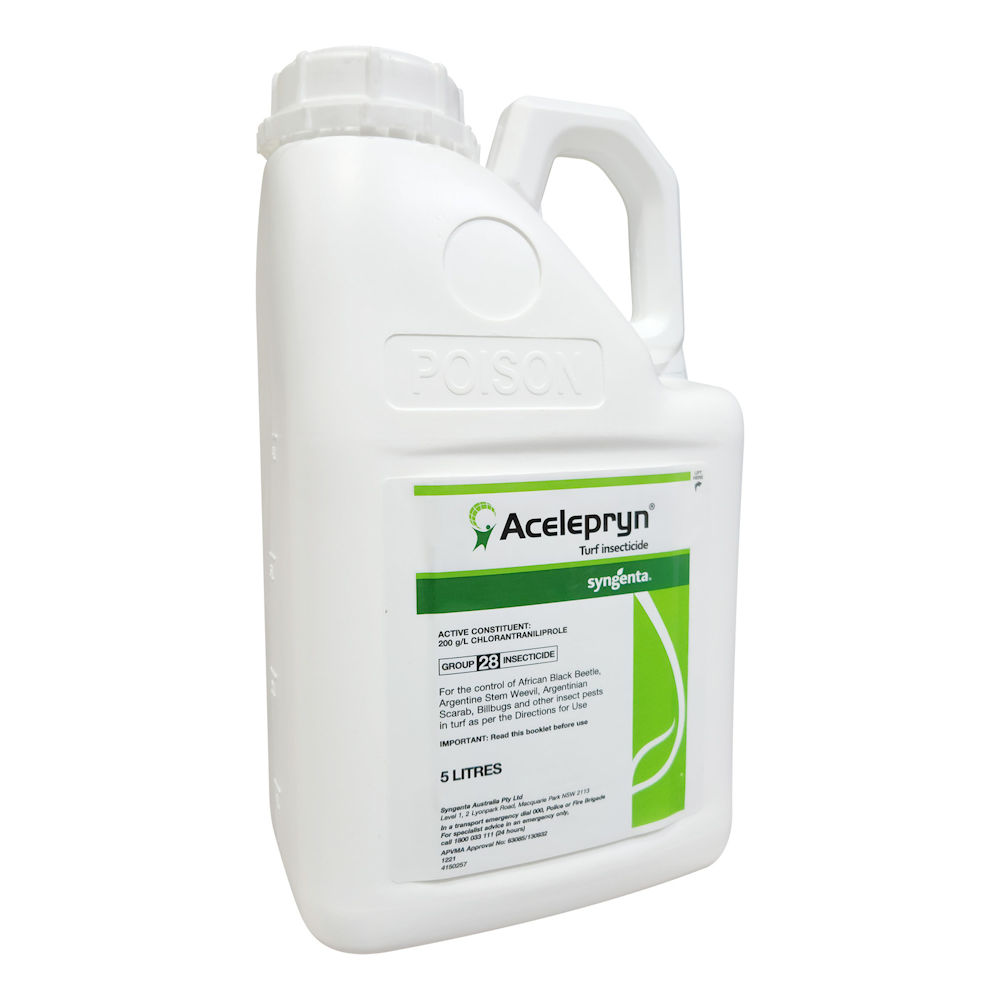
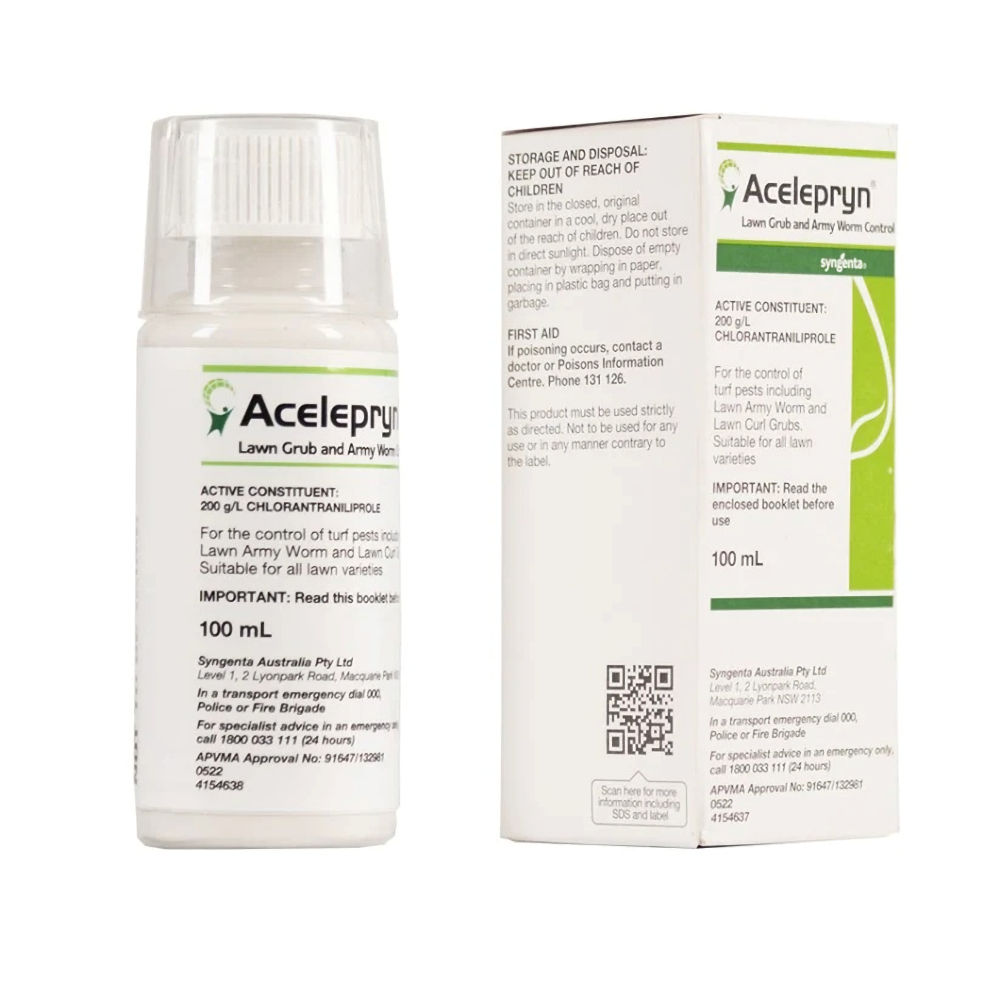
Description
Which pests does Acelepryn Turf Insecticide control?
Acelepryn controls beetle larvae and caterpillars and is widely regarded as an excellent African black beetle treatment.
The following species of pest are susceptible to Acelepryn Turf Insecticide:
- African black beetle (Heteronychus arator)
- Argentinian scarab beetle (Cyclocephala signaticollis)
- Argentine stem weevil (Listronotus bonariensis) larvae
- Billbug (Sphenophorus brunnipennis ) larvae
- Black cutworm (Agrotis ipsilon)
- Lawn armyworm (Spodoptera mauritia)
- Sod webworm (Herpetogramma licarsisalis)
When is the best time to apply Acelepryn for beetle larvae?
For preventative control, application is recommended from mid-September. This timing will target overwintering adults and early instar larvae before they cause visible turf damage. Early application at a rate of 1.5L/ha provides protection across both African black beetle and Argentinian scarab seasons with just one treatment.
Acelepryn Turf Insecticide application rates
At a glance, here are the recommended application rates for Acelepryn by insect type:
| Pest Group | Rate (per ha) | Rate (per 100m2) |
|---|---|---|
| Beetle larvae, Stem Weevil, Billbug | 750 mL to 1.5 L | 7.5 to 15 mL |
| Caterpillars | 750 mL | 7.5 mL |
The maximum annual broadcast rate of Acelepryn Turf Insecticide is 2.8L per ha.
Is Acelepryn resistance common?
Acelepryn activates ryanodine receptors in insect muscle cells, leading to uncontrolled muscle contraction and eventually, paralysis. Because this mode of action is unique to Group 28 insecticides, it carries a low cross-resistance risk with organophosphates and pyrethroids.
To manage resistance, always rotate the insecticide with other products from different mode-of-action groups, and follow the recommended Integrated Resistance Management (IRM) strategy for your state or region.
Is Acelepryn safe around people, pets, and the environment?
With no poison schedule classification, Acelepryn is extremely safe around humans. It requires no Personal Protective Equipment (PPE) and no withholding period for human re-entry. The same goes for pets, which can return to treated areas as soon as the spray has dried.
It is, however, dangerous to aquatic invertebrates. Observe all mandatory buffer zones near natural waterways, and do not apply to food crops. Do not cut or graze turf for stock food.
What’s the difference between Acelepryn liquid and Acelepryn GR?
Both the liquid and granular formulas of Acelepryn contain the same active ingredient and are registered to control the same turf pests as listed above. Their protection periods are also the same — up to 6 months of residual protection when applied at the higher recommended rate.
The key differences between Acelepryn liquid and Acelepryn GR are the formulation and how it is administered:
- Acelepryn liquid is a suspension concentrate formulated with chlorantraniliprole at 200g/L, which must be mixed with water and then applied using spray equipment at 750mL to 1.5L per hectare. Liquid Acelepryn suits broadacre turf setups where spray gear is already in use.
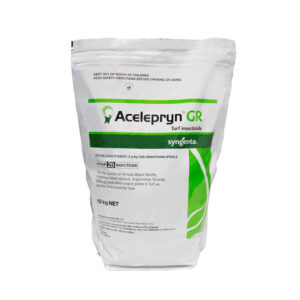
- Acelepryn GR is a dry granular formulation featuring chlorantraniliprole at 2g/kg. It is applied using a calibrated spreader at 75kg to 150kg per hectare, with no spray equipment or tank mixing required. Granular Acelepryn suits tight or hard-to-access areas where spraying is not practical,
Both products should be watered in with irrigation immediately after application for best results (unless treating caterpillars, where it is recommended to delay watering and mowing for 24 hours). Ultimately, your choice of product should hinge on application method, site, and equipment, not on performance, as the pest control delivered is the same.
When should Acelepryn Turf Insecticide be applied for lawn grub control?
For preventative control of lawn grubs, apply this chlorantraniliprole turf insecticide from mid-September, when overwintering beetles appear and before eggs hatch. For curative control of existing grubs, administer the higher rate of Acelepryn from mid-December. Early application targeting young larvae will give the best long-term results.
How long does Acelepryn last?
When applied at the higher recommended rate (1.5L/ha) in early spring, Acelepryn Turf Insecticide provides up to six months of residual protection. This covers both the beetle larvae and caterpillar pest windows with the one application.
For more information about one of the best lawn grub killers in Australia, read our comprehensive guide to Acelepryn.












Mick (verified owner)
This is the best Army Worm insecticide on the market and it stays in the soil profile for up to 6 months. Has just become available in liquid form making it easier to apply than granular form. This was the best price I could find in Australia with postage price included. Arrived very quickly.
Recommended seller.
Upvote if this was helpful (0) Downvote if this was not helpful (0) Watch Unwatch Flag for removal