• Locally Australian Owned
  • Friendly Advice
  • FREE & Fast Shipping
  • Secure Online Shopping
  • Quality Guaranteed

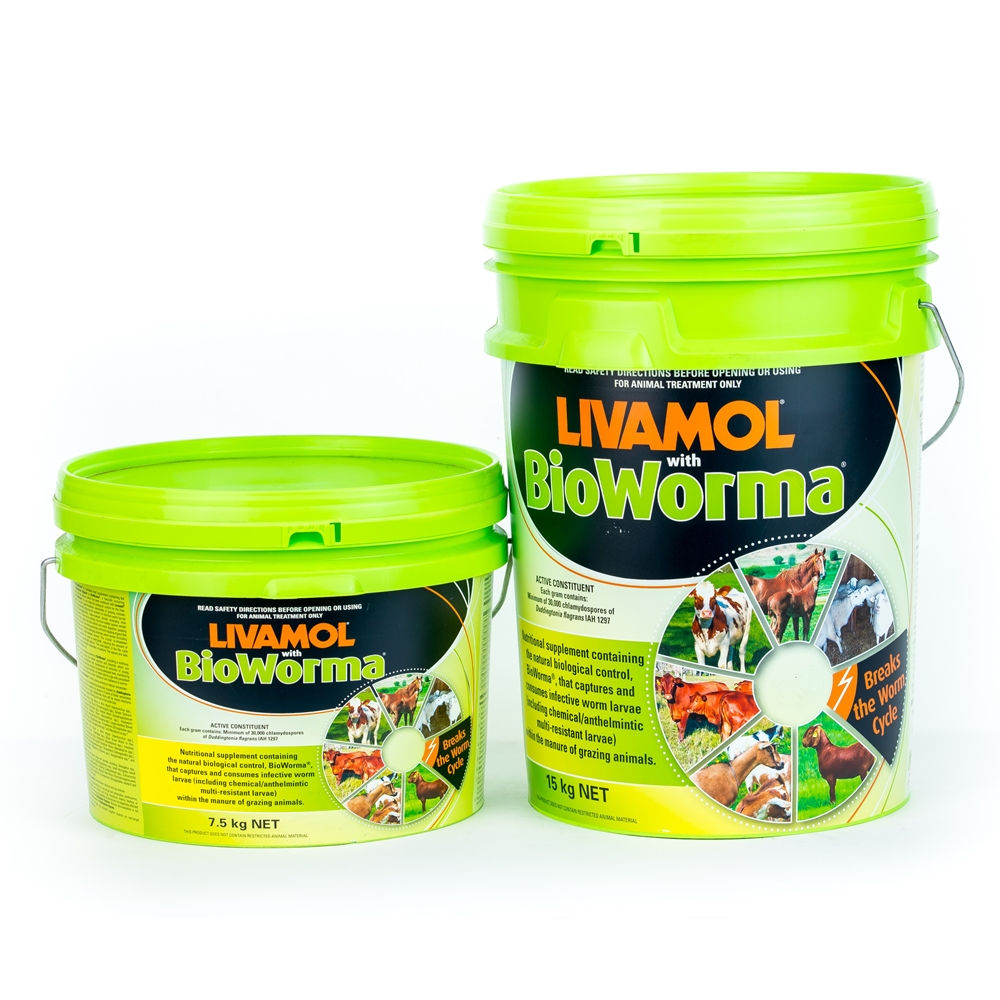
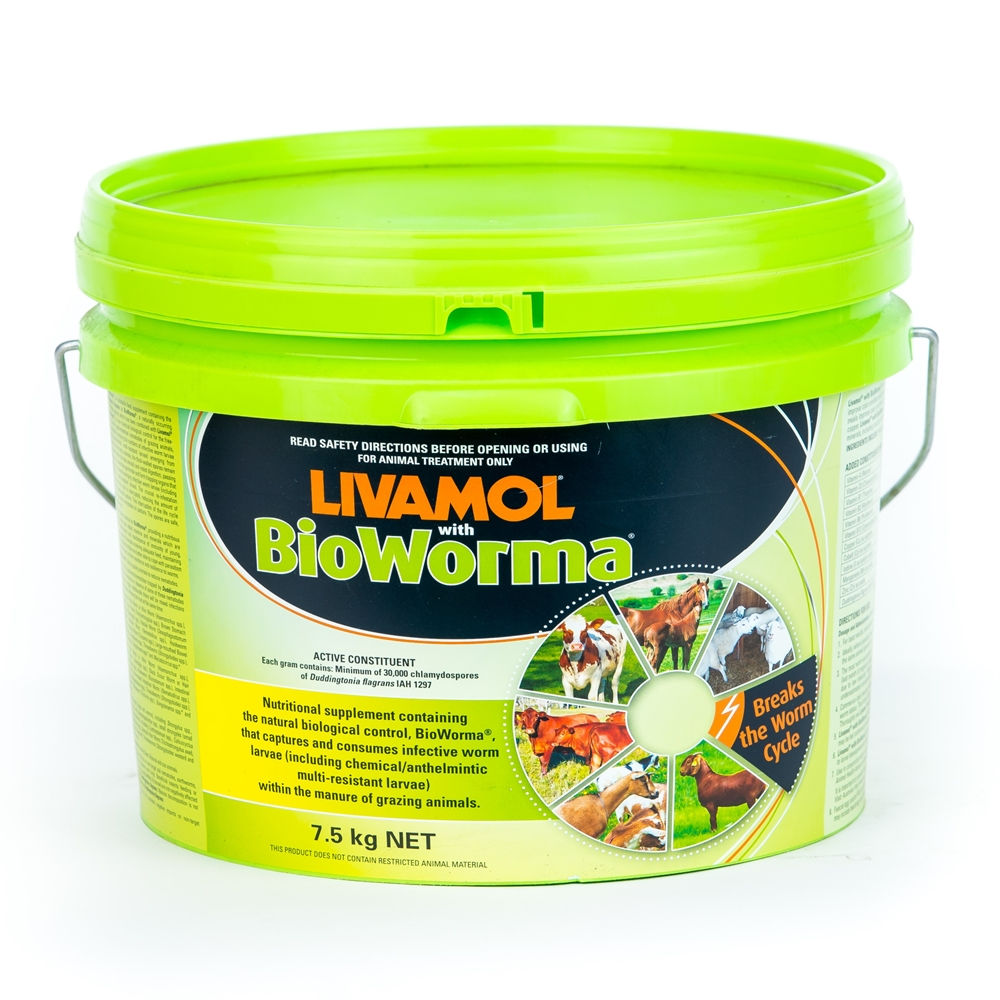
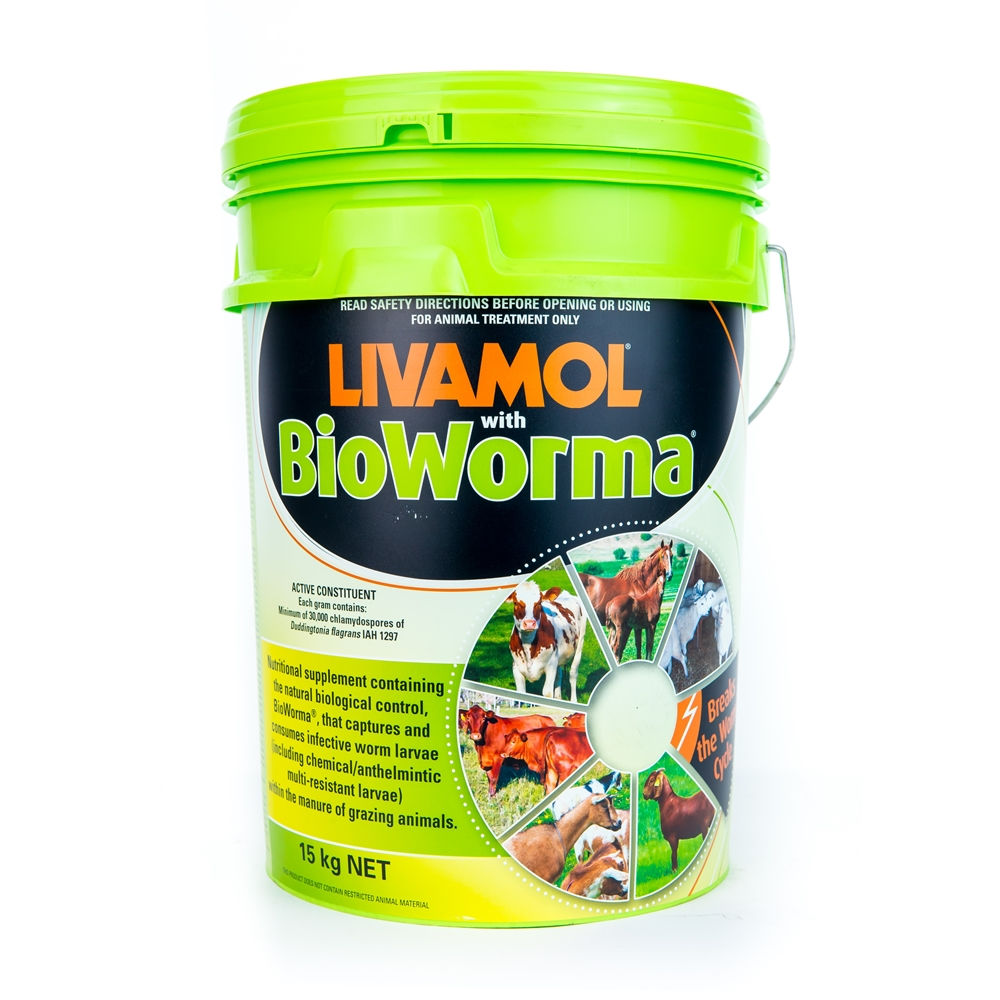
Livamol with BioWorma Biological Worm Control Supplement

Livamol with BioWorma Biological Worm Control Supplement is a palatable feed supplement for grazing animals.

Each gram contains a minimum of 30,000 chlamydospores of Duddingtonia flagrans IAH 1297. These spores pass into the manure, then trap and consume infective worm larvae, including anthelmintic multi-resistant larvae. As a result, fewer larvae emerge onto pasture. The protein, fish oil, vitamin and mineral base also supports young, growing animals. Producers feed it daily alongside a worm management plan, because it does not reduce larvae already on pasture.

Pack Sizes: 7.5 kg and 15 kg. Registrant: International Animal Health Products Pty Ltd (APVMA #: 82646/106348)

Click For Technical Info & Tips For Use
5 out of 5 (5 customers reviews)

QuantityDiscountStatus
2 or more$230.00 eachAvailable
-
+

Free & Fast Shipping

Not able to be delivered to a PO box Live remotely? Please ensure a courier can reach your address. Click here for shipping info or give us a call.

This item is dangerous and requires a courier! Ensure a courier can reach your address.
Don’t worry, shipping is STILL FREE!
Click here for shipping info or give us a call.

Ordering multiple large items? They will be shipped on a skid or pallet to ensure that your items arrive safely and securely. The delivery truck will need to be unloaded with a forklift. If you do not have a forklift, please provide an address where a forklift is present.

This item is large and requires a courier! Ensure a courier can reach your address.
Don’t worry, shipping is STILL FREE!
Click here for shipping info or give us a call.

Ordering multiple large items? They will be shipped on a skid or pallet to ensure that your items arrive safely and securely. The delivery truck will need to be unloaded with a forklift. If you do not have a forklift, please provide an address where a forklift is present.

Livamol with BioWorma Biological Worm Control Supplement LIVAMOL-BIOWORMA International Animal Health

Description

Livamol with BioWorma is a biological worm control supplement for grazing animals. Specifically, each gram contains a minimum of 30,000 chlamydospores of Duddingtonia flagrans IAH 1297, a natural soil fungus. International Animal Health Products Pty Ltd registers this supplement for sheep, goats, cattle, horses and other grazing animals.

The spores pass through the animal unharmed and germinate in the manure. There, the fungus traps and consumes infective worm larvae, including anthelmintic multi-resistant larvae. As a result, fewer larvae emerge onto pasture, while the protein and mineral base supports young, growing animals.

Product highlights

  • Active: minimum 30,000 chlamydospores of Duddingtonia flagrans IAH 1297 per gram
  • Targets worm larvae in the manure, including anthelmintic multi-resistant larvae
  • Suits sheep, goats, cattle, horses, deer and alpacas
  • Zero days for meat withholding, milk withholding and ESI
  • Daily rate of 1 g per kg bodyweight
  • Pack sizes: 7.5 kg and 15 kg

How a biological worm control supplement breaks the worm cycle

The thick-walled spores resist digestion and germinate in the manure. They then form trapping organs that capture, paralyse and consume emerging larvae. This interrupts the re-infestation stage of the parasite life cycle. However, the product does not reduce larvae already on pasture. Therefore, treat animals with a suitable chemical wormer first.

How to feed Livamol with BioWorma

Feed it daily, based on the heaviest animal in the group. Mix it thoroughly with feed or feed supplements. Alternatively, offer it by free access alongside other feed.

Bodyweight (kg) 25 50 100 200 300 400 500
Daily dose (g/head) 25 50 100 200 300 400 500

Frequently asked questions

Q. What does Livamol with BioWorma control?

A. It reduces infective worm larvae in the manure of grazing animals. The label lists roundworms such as barber’s pole worm, black scour worm and brown stomach worm. As a result, fewer infective larvae reach pasture.

Q. Does Livamol with BioWorma replace a chemical wormer?

A. No, it works alongside a chemical wormer. First, treat animals with a suitable chemical wormer. Then, move them to low worm pasture, ideally not grazed by the same species for six weeks.

Q. Which animals should receive Livamol with BioWorma?

A. Feed it to grazing animals, including sheep, goats, cattle and horses. Young animals from three months to 18 to 24 months face the highest worm risk. Likewise, females in the last month of pregnancy and during lactation face higher risk.

Q. Is there a withholding period for Livamol with BioWorma?

A. The meat withholding period is zero days. The milk withholding period is also zero days. Likewise, the export slaughter interval is zero days.

Q. How much Livamol with BioWorma do I feed each day?

A. Feed 1 g per kg of bodyweight each day. For animals over 500 kg, add 100 g for every extra 100 kg. A standard 300 mL coffee mug holds 200 g.

Features & Benefits

  • Biological control: spores of Duddingtonia flagrans IAH 1297 trap and consume infective worm larvae in the manure.
  • Reduces larvae emerging onto pasture, including anthelmintic multi-resistant larvae.
  • Non-chemical control that works alongside a veterinary worm management plan.
  • Thick-walled spores stay inert in the animal and pass through into the manure.
  • Palatable feed base of protein, energy and polyunsaturated oils.
  • Added vitamins A, D3, B1, B2, B6 and B12, plus copper, cobalt, iodine, manganese and zinc.
  • No negative effects on non-target soil nematodes, earthworms or dung beetles, and manure decomposition stays unchanged.
  • Zero days for meat withholding, milk withholding and export slaughter interval.
  • Suits sheep, goats, cattle, horses, deer, alpacas and other grazing animals.

Share your thoughts!

5 out of 5 stars

5 reviews

Let us know what you think...

What others are saying

  1. Lars Larvelle

    Significant different

    Lars Larvelle

    Just like the product describes

    Upvote if this was helpful (0) Downvote if this was not helpful (0) Flag for removal

    Something wrong with this post? Thanks for letting us know. If you can point us in the right direction...

  2. susanprodger

    fantastic!

    susanprodger (verified owner)

    I have been using this since it was release on the market for my goats. It has been a life saver, only drenching occasionally. Worm count is very low and goats are in great condition from this product.

    Upvote if this was helpful (0) Downvote if this was not helpful (0) Flag for removal

    Something wrong with this post? Thanks for letting us know. If you can point us in the right direction...

  3. Michelle

    Great product Fantastic service

    Michelle (verified owner)

    Great product and super fast delivery

    Upvote if this was helpful (0) Downvote if this was not helpful (0) Flag for removal

    Something wrong with this post? Thanks for letting us know. If you can point us in the right direction...

  4. Greg

    Great organic solution

    Greg (verified owner)

    Mixed this up with some chaff and the sheep and alpacas love it. Looking forward to a lower worm count as time progresses

    Upvote if this was helpful (0) Downvote if this was not helpful (0) Flag for removal

    Something wrong with this post? Thanks for letting us know. If you can point us in the right direction...

  5. Lloyd Tomkins

    Bioworma

    Lloyd Tomkins (verified owner)

    Not sure just started using in last month but is promising

    Upvote if this was helpful (0) Downvote if this was not helpful (0) Flag for removal

    Something wrong with this post? Thanks for letting us know. If you can point us in the right direction...

×

Welcome back

Existing account holders please login below via Email or Google Account or Click here to register your NEW FREE ACCOUNT.

Already Registered? Sign in with your email
Register for an account

Secure Checkout

You can shop with Specialist Sales online store with confidence. We have partnered with PayPal, Master and Visa Card which is provided by Braintree. Braintree payment technology accepts credit cards and electronic payments safely and securely for our customers.

Braintree transactions are processed using the 3D Secure framework to ensure your sensitive customer information and credit card processing is safe and secure. Similarly, PayPal also provides comprehensive buyer protection for your peace of mind.

Your information is safe

Specialist Sales adheres to strict industry standards for payment processing, using industry leading security protection measures including 128-bit Secure Sockets Layer (SSL) technology for secure Internet Protocol (IP) transactions, and compliance with the Payment Card Industry Data Security Standard (PCI DSS).

Continue as a Guest

Directions Of Use

Click here for Livamol with BioWorma directions for use

General instructions

  • Livamol with BioWorma is a green, free-flowing fine meal.
  • Dose it according to body weight, based on the heaviest animal in the group.
  • Mix it thoroughly with feed or feed supplements, offer it by free access alongside other feed, or use it in formulated rations.
  • Preferably, use it under the direction of a nutritionist or veterinarian.

Daily feeding rate

Bodyweight (kg) 25 50 100 200 300 400 500
Dosage (g/head/day) 25 50 100 200 300 400 500

For animals heavier than 500 kg, use an additional 100 g for each 100 kg. A standard coffee mug (300 mL) holds 200 g of Livamol with BioWorma.


Doses per pack

Pack 25 g/head 50 g/head 100 g/head 200 g/head 300 g/head 400 g/head 500 g/head
7.5 kg 300 150 75 37 25 18 15
15 kg 600 300 150 75 50 37 30

Critical comments

  1. For best results, treat animals with a suitable chemical wormer or anthelmintic.
  2. Ideally, where possible, move the treated animals onto low worm pasture (that is, pasture that has not been grazed by the same animal species for a minimum of 6 weeks).
  3. The most worm-susceptible are young animals (from 3 months up to 18 to 24 months of age) and periparturient females (last month of pregnancy and while producing milk), as they are the most likely to have less resistance to worm infestation due to low immunity. Pasture contamination by adult stock, even with low faecal egg counts (FEC), should not be underestimated considering the volume of faecal material they place on pasture.
  4. Commence daily feeding of Livamol with BioWorma to minimise pasture infectivity and maintain the animal’s low worm status. The product will not reduce pre-existing larval pasture contamination. Thoroughly mix Livamol with BioWorma with feed or feed supplements.
  5. Livamol with BioWorma will begin to work immediately within the manure of treated animals, and for best results may be fed continuously when climatic conditions are conducive to BioWorma and parasitic nematode activity.
  6. Livamol with BioWorma is recommended for strategic use during periods when weather conditions are conducive to larval development and transmission onto pasture at temperatures above 5 °C (40 °F).
  7. Use in conjunction with a recommended worm management strategy for your area by contacting your veterinarian, animal health adviser or government advisory groups for a strategic Integrated Parasite Management (IPM) plan. It is important to consider the principles of refugia. WormBoss provides further guidance for Australia.
  8. Faecal egg counts (FECs) may be useful to monitor the effectiveness of the worm management strategy. Other options may include faecal egg count reduction test (FECRT) and identifying worm species by using faecal larval cultures (FLC).

Rates are a general guide only. Before opening, carefully read Livamol with BioWorma directions for use, precautionary and protection statements, storage and disposal, safety directions and first aid instructions. The product is designed for the particular purpose indicated on the label. Failure to use the product strictly as directed may be illegal and dangerous, and render the product ineffective.

Questions and answers from customers

    How many sheep will 15kg of Livamol with Bioworma treat?

  1. Q How many sheep will 15kg of Livamol with Bioworma treat?
    Asked by MairiAnne on December 9, 2024 9:16 pm
    A

    Livamol with Bioworma (Duddingtonia Flagrans) is recommended to have a daily feeding rate of 25gm per 25kg. Use an additional 100gm for each 100kg for animals heavier than 500kg, i.e. if your average sheep weight per head is 50kg, the dose per day would be 50gm; at this rate, there would be 300 doses per 15kg. 

  2. How would you feed Livamol with Bioworma to 3500 sheep?

  3. Q How would you feed Livamol with Bioworma to 3500 sheep?
    Asked by MairiAnne on December 9, 2024 9:10 pm
    A

    Livamol with Bioworma (Duddington Flagrans) may be mixed with feed, offered by free access alongside other feed or may be used in formulated rations, preferably under the directions of a nutritionist or veterinarian.

  4. I have 2 miniature belted galloways to help keep down the pasture so I don't feed them every day. Just occasionally. I was told this would be good for pests and parasites. Given that I don't feed them daily, would it be suitable?

  5. Q I have 2 miniature belted galloways to help keep down the pasture so I don't feed them every day....... Read more
    Asked by Kerry on April 16, 2023 11:45 am
    A

    Livamol with BioWorma claims it will begin to work immediately within the manure of treated animals. It may be fed continuously for best results when climatic conditions are conducive to BioWorma and parasitic nematode activity. Livamol with BioWorma recommends daily feeding to minimise pasture infectivity and maintain the animal’s low worm status. The product will not reduce pre-existing larval pasture contamination. Using Livamol BioWorma with a recommended worm management strategy for your area would be best.

  6. Can you mix Livamol with Bioworma with moist feed?

  7. Q Can you mix Livamol with Bioworma with moist feed?
    Asked by Deb on February 22, 2023 10:03 pm
    A

    Livamol with Bioworma can be mixed with dry or wet feed. However, if mixing with wet feed, you must ensure that it is consumed immediately, as the spores of Duddingtonia flagrans may start germinating before passing through into the manure. 

  8. How long should goats be fed Bioworma?  They have a high worm count and it is very wet here in the Southern Highlands NSW. 

  9. Q How long should goats be fed Bioworma?  They have a high worm count and it is very wet here in th...... Read more
    Asked by peter on May 12, 2022 8:27 pm
    Answered by the admin

    The length of time goats need to be treated with Bioworma depends on the parasites affecting the animals.  Barbers Pole Worm, for example, has a life cycle of approx 90days, so treatment for 90 days is recommended (a minimum of 60 days).  Certain climatic conditions (ie frost) will reduce Barbes Pole numbers so that this treatment period may be reduced heading into winter.  Regular worm testing will indicate when egg counts have been reduced.

Send me a notification for each new answer.

Disclaimer: This information and product advice is not intended to be advice or recommendations for any specific use or circumstance. You should seek specialist advice before using any product. Always follow the manufacturer’s guidelines. Specialist Sales liability is limited.

Host & Pest

Host Pest
Host & Pest
Cattle Barber's Pole Worm - Haemonchus Spp., Black Scour Worm - Trichostrongylus Spp., Gongylonema Spp., Hookworm - Bunostomum Spp., Intestinal Threadworm-strongyloides Spp., Large Roundworm - Toxocara Vitulorum, Mecistocirrus Spp., Nodule Worm - Oesophagostomum Spp., Small Brown Stomach Worm-ostertagia Spp., Small Intestinal Worm - C. Curticei, Thin Necked Intestinal Worm, Whipworm - Trichuris Spp.
Sheep and Goat Barber's Pole Worm - Haemonchus Spp., Black Scour Worm - Trichostrongylus Spp., Gongylonema Spp., Hookworm - Bunostomum Spp., Intestinal Threadworm-strongyloides Spp., Large Mouth Bowel Worm - Chabertia Spp., Mecistocirrus Spp., Nodule Worm - Oesophagostomum Spp., Skrjabinema Spp., Small Brown Stomach Worm-ostertagia Spp., Small Intestinal Worm - C. Curticei, Thin Necked Intestinal Worm, Whipworm - Trichuris Spp.
Horse Ascarid - Parasacris Equorium, Gongylonema Spp., Intestinal Threadworm - S. Westeri, Intestinal Threadworm-strongyloides Spp., Large Strongyles, Mecistocirrus Spp., Pinworm - Oxyuris Equi, Small Strongyles, Stomach Hair Worm, Whipworm - Trichuris Spp.

Tips For Use

Mixing and general instructions

  • Thoroughly mix Livamol with BioWorma with feed or feed supplements.
  • Alternatively, offer it by free access alongside other feed.
  • Formulated rations should preferably follow the direction of a nutritionist or veterinarian.
  • Coat colour may be affected by dietary levels of minerals such as zinc and copper.

Nutritional information (guaranteed analysis)

  • Minimum crude protein: 20%
  • Minimum crude fat: 5%
  • Minimum crude fibre: 9%
  • Calcium (Ca): minimum 4%, maximum 6%
  • Phosphorus (P): minimum 1.5%, maximum 2.5%
  • Salt: nil
  • Maximum fluorine (F): 0.025%
  • Average digestible energy: 11 MJ/kg

Added constituents per kg

  • Vitamin A (retinol): 60,000 IU
  • Vitamin D3 (cholecalciferol): 12,000 IU
  • Vitamin B1 (thiamine): 1 mg
  • Vitamin B2 (riboflavin): 2 mg
  • Vitamin B6 (pyridoxine): 1 mg
  • Vitamin B12 (cyanocobalamin): 32 µg
  • Copper (Cu) as sulphate: 15.7 mg
  • Cobalt (Co) as sulphate: 80 µg
  • Iodine (I) as sodium iodide: 87 µg
  • Manganese (Mn) as oxide: 104 mg
  • Zinc (Zn) as oxide: 25 mg
  • Duddingtonia flagrans IAH 1297: 30 million chlamydospores

Storage

  • Store below 30 °C (room temperature).
  • Keep out of reach of children.
  • Keep the container tightly closed in a moisture-free environment.
  • Store under cover, away from sources of heat or ignition.

Handling

  • Use in a well-ventilated area.
  • Avoid generating dust, particularly dust clouds in a confined or unventilated space.
  • Avoid contact with oxidising agents such as nitrates, oxidising acids and chlorine bleaches.

Safety Directions

  • May irritate the eyes, nose and throat.
  • Avoid inhaling dust.
  • When preparing feed, wear disposable gloves and a disposable dust mask covering the mouth and nose.
  • Wash hands after use.

Additional User Safety

  • The SDS classifies the product as causing skin irritation and serious eye damage.
  • Wear protective gloves, protective clothing and eye protection when handling.
  • Take off contaminated clothing and wash it before reuse.

Disposal (plastic containers)

  • Triple-rinse the container into the medicated feed.
  • Do not dispose of undiluted chemicals on-site.
  • If recycling, replace the cap and return the clean container to a recycler or designated collection point.
  • If not recycling, break, crush or puncture the container and deliver it to an approved waste management facility.
  • If no approved facility is available, bury the broken, crushed or punctured container 500 mm below the surface in a marked disposal pit, clear of waterways, vegetation and tree roots, in line with local, state or territory regulations.
  • Do not burn empty containers or product.

First Aid

  • Eyes: wash out immediately with water. If irritation continues, seek medical attention.
  • Skin or hair: flush with running water and soap if available. Seek medical attention if irritation occurs.
  • Inhalation: if dust is inhaled, remove the person from the contaminated area. If irritation or discomfort persists, seek medical attention.
  • Ingestion: give a glass of water immediately. First aid is not generally required, but if in doubt, contact a Poisons Information Centre or a doctor.
  • If poisoning occurs, contact a doctor or the Poisons Information Centre. Phone Australia 131 126.
  • For further information, refer to the Safety Data Sheet (SDS).

This information and product advice are not intended as advice or recommendations for any specific use or circumstance. You should seek specialist advice before using any product. Always follow the manufacturer’s guidelines. Specialist Sales liability is limited.

Withholding Period

Withholding Period Details (WHP):

  • Meat: zero (0) days
  • Milk: zero (0) days
  • Export slaughter interval (ESI): zero (0) days

SDS & Technical

Livamol with Bioworma Label (APVMA) Download Pdf
Livamol with Bioworma SDS Download Pdf
Livamol with Bioworma DataSheet Download Pdf

Related Products