
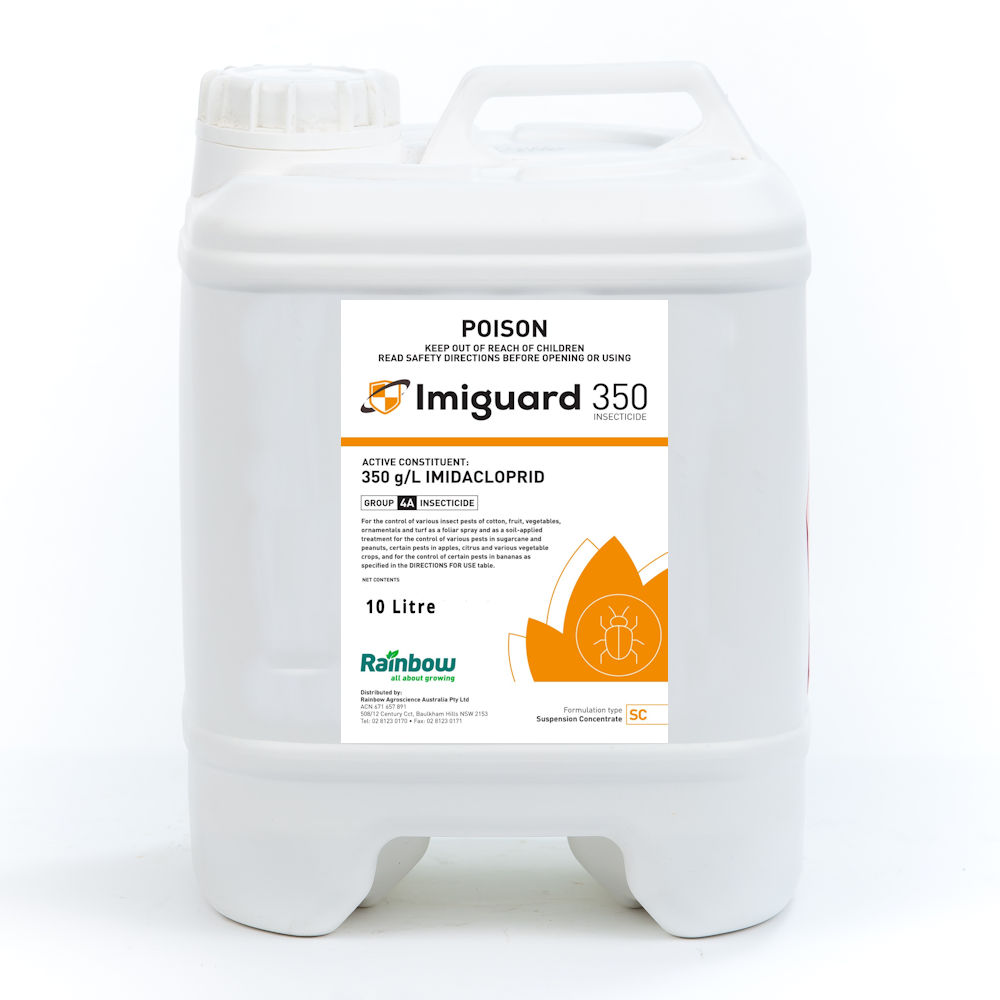
Imiguard 350 Insecticide

Imiguard 350 Insecticide provides versatile management of various insect pests across a broad array of crops such as cotton, fruit, vegetables, ornamentals, and turf. It is suitable for application as a foliar spray or as a soil treatment, targeting specific pests in crops including sugarcane, peanuts, apples, citrus, and bananas.

Featuring the proven active ingredient Imidacloprid (350 g/L), Imiguard 350 Insecticide delivers broad-spectrum control against key economic pests.

Active Ingredient: Imidacloprid @ 350g/L

Similar or comparable to Impressor 350 Soil Insecticide (Axichem) & Confidor Guard Soil Insecticide (Bayer CropScience)

Click For Technical Info & Tips For Use
0 out of 5 (0 customers reviews)

QuantityDiscountStatus
2 or more$210.00 eachAvailable
-
+

Free & Fast Shipping

Not able to be delivered to a PO box Live remotely? Please ensure a courier can reach your address. Click here for shipping info or give us a call.

This item is dangerous and requires a courier! Ensure a courier can reach your address.
Don’t worry, shipping is STILL FREE!
Click here for shipping info or give us a call.

Ordering multiple large items? They will be shipped on a skid or pallet to ensure that your items arrive safely and securely. The delivery truck will need to be unloaded with a forklift. If you do not have a forklift, please provide an address where a forklift is present.

This item is large and requires a courier! Ensure a courier can reach your address.
Don’t worry, shipping is STILL FREE!
Click here for shipping info or give us a call.

Ordering multiple large items? They will be shipped on a skid or pallet to ensure that your items arrive safely and securely. The delivery truck will need to be unloaded with a forklift. If you do not have a forklift, please provide an address where a forklift is present.

Imiguard 350 Insecticide IMIGUARD-350 Rainbow Agro

Description

Imiguard 350 Insecticide

Active Ingredient: Imidacloprid @ 350g/L

Similar or comparable to Impressor 350 Soil Insecticide (Axichem) & Confidor Guard Soil Insecticide (Bayer CropScience)

Imiguard 350 Insecticide is for the control of various insect pests of cotton, fruit, vegetables, ornamentals and turf as a foliar spray and as a soil-applied treatment for the control of various pests in sugarcane and peanuts, certain pests in apples, citrus and various vegetable crops, and for the control of certain pests in bananas

Why choose Imiguard 350 Insecticide

  • Proven Active Ingredient: Contains 350 g/L Imidacloprid, a widely used insecticide.
  • Broad-Spectrum Control: Effective against a variety of insect pests in numerous crops, including cotton, fruit, vegetables, ornamentals, and turf.
  • Versatile Application: Can be applied as a foliar spray for many crops or as a soil treatment for pests in sugarcane, peanuts, apples, citrus, and various vegetable crops.
  • Specific Mode of Action: Classified as a Group 4A Insecticide, working by disrupting nerve function in insects.
  • Resistance Management Guidance: The label includes important insecticide resistance management strategies, particularly for cotton and vegetables, to help maintain long-term effectiveness.
  • Ornamental Plant Compatibility: Tested on a wide array of ornamental species with generally good safety, though a preliminary test on a small number of plants is advised due to potential sensitivities.
  • Detailed Use Directions: Provides comprehensive, crop-specific instructions for application, including rates and critical comments to ensure effective pest control and crop safety.
  • Targets Key Economic Pests: Controls problematic insects such as various types of cane grubs in sugarcane, aphids and whiteflies in fruit and vegetables, and scarabs and billbugs in turf

Imidacloprid, the active constituent in Imiguard 350 Insecticide, is a widely utilised insecticide due to several key characteristics evident in this product’s usage. Its versatility is a significant factor, as it can be applied effectively through various methods, including foliar sprays and different soil application techniques like drenching, furrow sprays, and irrigation systems. This adaptability protects a broad spectrum of crops, such as fruits, vegetables, cotton, sugarcane, turf, and ornamentals, from numerous insect pests. 

The systemic nature of Imidacloprid, particularly evident in soil applications, means the product can be absorbed by the plant and distributed internally, offering extended protection against pests like canegrubs, aphids, and whiteflies. This can result in long residual activity, as suggested by extended withholding periods for certain soil treatments achieving longer-term pest control

Pack Size: 10-Litre

Registrant: Rainbow International Co Ltd (APVMA #: 66688)

Farm Chemical Insecticide Range

Features & Benefits

  • Proven Active Ingredient: Contains 350 g/L Imidacloprid, a widely used insecticide.
  • Broad-Spectrum Control: Effective against a variety of insect pests in numerous crops, including cotton, fruit, vegetables, ornamentals, and turf.
  • Versatile Application: Can be applied as a foliar spray for many crops or as a soil treatment for pests in sugarcane, peanuts, apples, citrus, and various vegetable crops.
  • Specific Mode of Action: Classified as a Group 4A Insecticide, working by disrupting nerve function in insects.
  • Resistance Management Guidance: The label includes important insecticide resistance management strategies, particularly for cotton and vegetables, to help maintain long-term effectiveness.
  • Ornamental Plant Compatibility: Tested on a wide array of ornamental species with generally good safety, though a preliminary test on a small number of plants is advised due to potential sensitivities.
  • Detailed Use Directions: Provides comprehensive, crop-specific instructions for application, including rates and critical comments to ensure effective pest control and crop safety.
  • Targets Key Economic Pests: Controls problematic insects such as various types of cane grubs in sugarcane, aphids and whiteflies in fruit and vegetables, and scarabs and billbugs in turf

Share your thoughts!

0 out of 5 stars

0 reviews

Let us know what you think...

What others are saying

There are no contributions yet.

×

Welcome back

Existing account holders please login below via Email or Google Account or Click here to register your NEW FREE ACCOUNT.

Already Registered? Sign in with your email
Register for an account

Secure Checkout

You can shop with Specialist Sales online store with confidence. We have partnered with PayPal, Master and Visa Card which is provided by Braintree. Braintree payment technology accepts credit cards and electronic payments safely and securely for our customers.

Braintree transactions are processed using the 3D Secure framework to ensure your sensitive customer information and credit card processing is safe and secure. Similarly, PayPal also provides comprehensive buyer protection for your peace of mind.

Your information is safe

Specialist Sales adheres to strict industry standards for payment processing, using industry leading security protection measures including 128-bit Secure Sockets Layer (SSL) technology for secure Internet Protocol (IP) transactions, and compliance with the Payment Card Industry Data Security Standard (PCI DSS).

Continue as a Guest

Directions Of Use

For Imiguard 350 Insecticide directions for use, click here

General Directions For Use (summary only)


Field Crops:

  • Crop: Sugarcane (plant cane, ratoon cane), Peanuts 
  • Pest: Greyback canegrub, Childers canegrub, Negatoria canegrub, Plectris canegrub, Rhopaea canegrub, Southern one-year canegrub, French’s canegrub, Peanut white grub (Heteronyx piceus) 
  • Rate: The general application rates for field crops are specified as follows:
    • For Sugarcane (plant and ratoon cane), per 100 metres of cane row: Rates range from 11 mL per 100 metres of cane row to 22 mL per 100 metres of cane row. This is equivalent to rates ranging from 720 mL/ha to 1.44 L/ha for single row cane with 1.52 m spacing between rows.
    • For Peanuts, per 100 metres of peanut row: Rates range from 6.5 mL per 100 metres of peanut row to 13 mL per 100 metres of peanut row. This is equivalent to rates ranging from 0.71L/ha to 1.43L/ha for a single peanut row with 0.91 m spacing between rows.

Fruit Crops:

  • Crop: Apples, Bananas – Cavendish, Bananas – Lady Finger, Citrus, Citrus (non-bearing only), Stone fruit 
  • Pest: Woolly aphid, Banana rust thrips (Chaetanaphothrips signipennis), Banana weevil borer (Cosmopolites sordidus), Black citrus aphid, Citrus leafminer, Pink wax scale, Red scale, Green peach aphid, Black peach aphid 
  • Rate: The general application rates for fruit crops vary depending on the specific crop, target pest, and application method:
    • Per tree application (soil drench, water mix, or via irrigation): Rates range from 3.5mL per 1L of water per tree (e.g., for Apples) to 9mL per tree (e.g., for Citrus). 
    • Per stool application (injection for Bananas): Rates range from 2.5mL to 3.5mL per stool; this can be injected undiluted or diluted 50:50 with water. 
    • Dilute Spraying application (e.g., for Stone fruit): The specified rate is 15 mL per 100 L of water. 
    • Concentrate Spraying application (e.g., for Stone fruit): The rate is calculated based on the chosen concentrate spray volume relative to the dilute spray volume. For example, a 3x concentration of a 15mL/100L dilute rate results in 45mL per 100L of concentrate. The concentration factor should not exceed 5x, meaning a rate up to 75mL per 100L of water if the dilute rate is 15mL/100L.

Vegetables:

  • Crop: Brassicas (including broccoli, Brussels sprouts, cabbage, cauliflower, kohlrabi), Capsicum, Cucurbits, Eggplant, Sweet Potato, Tomatoes, Cucumber, Dubosia, Potatoes
  • Pest: Grey Cabbage Aphid, Turnip Aphid, Silverleaf whitefly (including type B), Green peach aphid, onion thrips, Melon thrips
  • Rate: The general application rates for vegetables vary by crop, pest, and application method:
    • As a foliar or dilute spray (mL per 100L of water): The rate is 15mL per 100L of water.
    • As a foliar or dilute spray (mL per hectare): Rates range from 145mL per hectare  to 170mL per hectare.
    • For plant hole drench or furrow spray in Brassicas (mL per 1000 seedlings): The rate is 35 mL per 1000 seedlings.
    • For soil applications such as sub-surface trickle irrigation, furrow spray, or plant hole drench (mL per 100 metres of row): Rates range from 9 mL per 100 metres of row  to 14 mL per 100 metres of row

Ornamentals & Trees:

  • Crop: Azaleas in pots, Elm, Ornamentals in pots, Ornamental Plants, Pandanus trees, Roses, Seedling eucalypts (to 1m high) in pots 
  • Pest: Azalea lace bug, Elm leaf beetle, Scarab beetle larvae, Aphids, Bronze orange bug, Harlequin bug, Citrus mealybug, Greenhouse thrips, Fuller’s rose weevil, Hibiscus flower beetle, Longtailed mealy bug, Psyllids, Soft scales, Flatid (Jamella australiae), Chrysomelid beetle larvae 
  • Rate: The general application rates for ornamentals vary significantly based on the plant, pest, and application method:
    • Soil Drench/Application per Plant or Pot:
      • For Azaleas in pots (Azalea lace bug): 2mL of product in 250mL of water per pot.
      • For Scarab beetle larvae in Ornamentals in pots: A mixture of 2mL of product in 5L of water is used to treat twenty 6L pots (this is equivalent to 0.1mL of product per pot).
    • For Roses (Aphids, soil drench):
      • 2mL of product in 2L of water per plant (for plants up to 1m high), with an additional 1.2mL of product in 2L of water for each additional metre of plant height.
      • For Seedling eucalypts (to 1m high) in pots (Chrysomelid beetle larvae, Psyllids): 1.5mL of product per plant, mixed in water up to 0.5L per 3L pot.
    • Tree Trunk/Stem Application:
      • For Elm (Elm leaf beetle, soil injection): 4mL of product per 25mm of tree diameter at breast height, mixed in sufficient water (e.g., at least 50L per tree up to 400-500mm diameter).
      • For Pandanus trees (Flatid, stem injection): A mixture is made using 1 L of product per 1 L of water. Then, 5 mL of this mixture is applied per drilled hole.
      • Foliar Spray or Spot Spray Application (Rates of product per 100L of water): Rates range from 15mL to 500mL per 100L of water, depending on the pest and plant.
    • Specific rates include:
      • 15mL per 100L of water for pests such as Aphids, Azalea lace bugs, Psyllids, and Soft scales on Ornamental Plants, and for Aphids on Roses (foliar application).
      • 30mL per 100L of water for Hibiscus flower beetle or Longtailed mealy bug (plus surfactant for mealybug) on Ornamental Plants.
      • 500 mL per 100 L of water for Flatid (Jamella australiae) on Pandanus trees (Spot Spray).

Cotton:

  • Crop: Cotton 
  • Pest: Aphids, Mirids, Brown Flea Beetle 
  • Rate: The general application rate for the listed pests in cotton is:
    • 145mL per hectare. This application requires the addition of an organosilicone adjuvant at the recommended rate.

  • Turf:
  • Situation: Turf 
  • Pest: First instar larvae of African Black Beetle, Argentinian scarab, Pruinose scarab, Larvae of billbug 
  • Rate: The general application rates for the listed pests in turf are:
    • 1.5L per hectare, or 15mL per 100m²

Rates are a general guide only.  Before opening, carefully read Imiguard 350 Insecticide directions for use, precautionary and protection statements, storage and disposal, safety directions and first aid instructions.  The product is designed for the particular purpose indicated on the label. Failure to use the product strictly as directed may be illegal and dangerous and render the product ineffective.

Questions and answers from customers

    What is the mixing rate of Imiguard 350 Insecticide with water for stem injection in sugarcane stalks for cane grub control?

  1. Q What is the mixing rate of Imiguard 350 Insecticide with water for stem injection in sugarcane st...... Read more
    Asked by Brett on December 9, 2025 3:16 pm
    Answered by the admin

    When using Imiguard 350 Insecticide in Sugar Cane crops, the label specifies a soil-applied treatment, not a stem injection. The rate of Imiguard 350 Insecticide to water is 16-22ml per 100 metres of cane row, or 11ml per 100ml of cane row, dependent on the pest pressure, diluted in no less than 1.5 litres of water per 100 metres of cane row (therefore, depending on your situation, the rate should be 11 - 22 ml of Imiguard 350 Insecticide mixed with 1.5L or more of water). We do not recommend applying Imiguard 350 Insecticide in any manner other than the application method specified on the label. Please ensure you read the SDS and Label before purchase and use & follow all manufacturers' guidelines, as the label does include several application directions that will vary depending on your situation. These are available under 'SDS and Technical' on the product page on our website. 

  2. Should Imiguard 350 Insecticide be irrigated after application? If so, how much water should be applied? Also, can I mix Imiguard 350 with an instant knockdown like Bifenthrin?

  3. Q Should Imiguard 350 Insecticide be irrigated after application? If so, how much water should be a...... Read more
    Asked by Ricky on September 2, 2025 8:48 am
    A

    The irrigation requirements for Imiguard 350 depend on the specific situation, such as the crop and the application method being used, so it is important to read the product label for these details and recommendations. These are available under 'SDS and Technical' on the product page on our website. Regarding tank mixing with Bifenthrin, the label does not specify compatibility with other insecticides. We recommend performing a 'jar test' first to ensure the products are compatible before mixing a whole batch, or seeking further advice from the manufacturer, Rainbow International Co. Ltd. at [email protected]

Send me a notification for each new answer.

Disclaimer: This information and product advice is not intended to be advice or recommendations for any specific use or circumstance. You should seek specialist advice before using any product. Always follow the manufacturer’s guidelines. Specialist Sales liability is limited.

Host & Pest

Host Pest
Host & Pest
Apple Woolly Aphid
Azalea - In Pot Azalea Lace Bug
Banana - Cavendish Banana Rust Thrip
Brassica Spp. Or Cole Crop & Cucumber Silverleaf Whitefly
Brassicas Cabbage Aphid, Turnip Aphid
Capsicum Or Pepper Green Peach Aphid - Suppression
Citrus Black Citrus Aphid, Citrus Leafminer, Pinkwax Scale, Red Scale
Cotton Aphids - Rhopalosiphum Spp., Brown Flea Beetle, Mirids
Duboisia Or Corkwood & Tomato Green Peach Aphid
Eggplant Green Peach Aphid, Melon Thrips
Elm Tree Elm Leaf Beetle
Eucalyptus Seedling Chrysomelid Beetle - Larvae, Psyllid Or Lerp Insect
Lady Finger Banana Banana Weevil Borer
Non-Bearing Citrus Tree Citrus Leafminer
Ornamental Plant Aphids - Rhopalosiphum Spp., Azalea Lace Bug, Bronze Orange Bug, Citrus Mealy Bug, Fuller's Rose Weevil, Greenhouse Thrip, Harlequin Bug, Hibiscus Flower Beetle, Longtailed Mealy Bug, Psyllid Or Lerp Insect, Soft Scale
Ornamentals In Pots Scarab Beetle - Larva
Pandanus Tree Flatid
Peanut Banana Weevil Borer, Canegrub - Lepidiota Negatoria, Childers Canegrub, French's Canegrub, Greyback Canegrub, Peanut White Grub , Southern One-Year Canegrub
Potato Green Peach Aphid, Silverleaf Whitefly
Rose Aphids - Rhopalosiphum Spp.
Stone Fruit Black Peach Aphid, Green Peach Aphid
Sugar Cane Canegrub - Lepidiota Negatoria, Childers Canegrub, French's Canegrub, Plectris Cane Grub, Rhopaea Canegrub, Southern One-Year Canegrub
Sugar Cane - Plant Crop Canegrub - Lepidiota Negatoria, Childers Canegrub, Greyback Canegrub, Plectris Cane Grub, Rhopaea Canegrub, Southern One-Year Canegrub
Turf African Black Beetle - 1st Instar Larvae, Argentinian Scarab, Bill Bug - Larvae, Pruinose Scarab

Tips For Use

General Instructions:

Ornamentals: 

  • Imiguard 350 Insecticide has been used on a wide range of ornamental plant species without damage. 
  • Some species and varieties however are particularly sensitive to chemical sprays and as this sensitivity is often related to local conditions it is advisable to treat only a small number of plants first, in order to ascertain their reaction before treating the whole crop.

Restraints: 

  • Do not use on crops produced hydroponically or in glasshouses and other covered situations.
  • Do not apply Imiguard 350 Insecticide or any other Group 4A Insecticide as a foliar spray after soil application of Imiguard 350 Insecticide in that crop.
  • Do not apply more than one soil application of Imiguard 350 Insecticide or any other
  • Group 4A Insecticide per crop for vegetables, sugarcane, or peanuts per season for citrus or per two years for apples.
  • Do not apply more than one application of Imiguard 350 INSECTICIDE or any other Group 4A insecticide per crop for bananas.

Spray Drift Restraints

  • Specific definitions for terms used in this section of the label can be found at apvma.gov.au/spraydrift
  • Do not allow bystanders to come into contact with the spray cloud.
  • Do not apply in a manner that may cause an unacceptable impact to native vegetation, agricultural crops, landscaped gardens and aquaculture production, or cause contamination of plant or livestock commodities, outside the application site from spray drift. 
  • Wherever possible, correctly use application equipment designed to reduce spray drift and apply when the wind direction is away from these sensitive areas.
  • Do not apply unless the wind speed is between 3 and 20 kilometres per hour at the application site during the time of application.
  • Do not apply if there are hazardous surface temperature inversion conditions present at the application site during the time of application. Surface temperature inversion conditions exist most evenings one to two hours before sunset and persist until one to two hours after sunrise.

Precautions: 

Application in bananas: 

  • Ensure the application equipment does not leak. 
  • To reduce the risk of exposure from accidental leakage, wear gloves during application.

Protection Of Wildlife, Fish, Crustaceans And the Environment:

  • Do not contaminate streams, rivers or watercourses with chemical or used containers.
  • Imidacloprid is toxic to certain aquatic species.
  • The application should be planned to avoid run-off within 48 hours of application. 
  • Do not apply to wet/waterlogged soils.
  • Do not apply if heavy rains are expected to occur within 48 hours.
  • Irrigation run-off from treated areas should be prevented from entering drains and waterways.
  • Do not over irrigate or cause run-off. Irrigation should only occur when soil moisture measurements indicate the need for addition of water.
  • Citrus: For the first 48 hours after application, irrigation should be restricted to only that which is recommended immediately after application (refer to the Application section on the product’s label).
  • Sugarcane: Irrigation should not occur within 48 hours of application.
  • Vegetables (furrow spray pre-plant and plant hole drench applications): Irrigation within 48 hours of application should be minimal and sufficient to reduce seedling stress only.
  • Potatoes: Irrigation within 48 hours of application should be minimal. If necessary, a light irrigation, avoiding run-off, may be performed.
  • Run-off management: Do not apply within 3 metres of aquatic areas. The growth of a vegetative filter strip between the application site and any water body would also assist.
  • A spray drift minimisation strategy should be employed at all times when aerially applying sprays. The strategy envisaged is exemplified by the cotton industry’s Best Management Practices Manual.

Protection Of Livestock

  • Dangerous to bees. 
  • Do not spray any plants in flower while bees are foraging. 
  • Avoid application by surface drippers or micro sprinklers while bees are foraging in the orchard, especially on hot days, as bees can use these devices as sources of water for the hive.

Storage:

  • Store in the closed, original container in a cool, well-ventilated area. 
  • Do not store for prolonged periods in direct sunlight.

Safety Directions:

  • Harmful if swallowed. 
  • Repeated exposure may cause allergic disorders. 
  • When preparing product for use, wear cotton overalls buttoned to the neck and wrist, a washable hat, elbow-length chemical resistant gloves and a face shield. 
  • Wash your hands after use. 
  • After each day’s use, wash gloves, face shield and contaminated clothing.

First Aid:

  • If poisoning occurs, contact a doctor or the Poisons Information Centre. Phone Australia 131 126.
  • For further information, refer to the Safety Data Sheet (SDS). 

This information and product advice is not intended as advice or recommendations for any specific use or circumstance. You should seek specialist advice before using any product. Always follow the manufacturer’s guidelines. Specialist Sales liability is limited.​

Withholding Period

Withholding Period Details (WHP):

Harvest (H):

  • Brassicas, Capsicum, Eggplant, Potatoes, Sweet Potatoes (Foliar): do not harvest for 7 days after application.
  • Citrus: Do not harvest for 20 weeks after application.
  • Cotton: Do not harvest for 13 weeks after application.
  • Cucurbits (Foliar): Do not harvest for 1 day after application.
  • Stone Fruit (Foliar): Do not harvest for 21 days after application 
  • Sugarcane: Do not harvest for 21 weeks after application
  • Tomatoes (Foliar): Do Not Harvest For 3 Days After Application.
  • All other crops: Not required when used as directed

Grazing (G):

  • Peanuts: Do not graze or cut treated areas for stock food for 12 weeks after application.
  • Sugarcane: Do not graze or cut for stockfeed for 21 weeks after application.
  • All other crops: Do not graze any treated area or cut for stock food.
  • Do not feed produce harvested from treated areas to animals, including poultry.

Trade Advice: 

  • Export of Treated Product: Growers should note that MRLs or import tolerances do not exist in all markets for edible produce treated with Imiguard 350 Insecticide.
  • If you are growing edible produce for export, please check with Shandong Rainbow International Co Ltd for the latest information on MRLs and import tolerances before using Imiguard 350 Insecticide.

SDS & Technical

Imiguard 350 Insecticide Label (APVMA) Download Pdf
Imiguard 350 Insecticide Label Download Pdf
Imiguard 350 Insecticide SDS Download Pdf

Related Products