



Spring Is Here: Tackle Weeds, Woody Regrowth, and Cattle Health Now
Table of Contents

What jobs to tackle this Spring
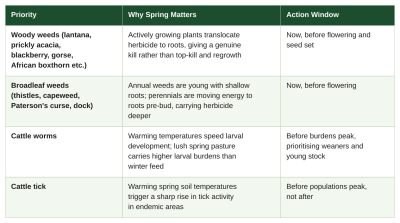
Spring is the busiest window of the farming year, because three things peak at once: woody and broadleaf weeds hit their fastest growth stage, internal worm burdens climb as pasture greens up, and cattle tick populations build with the warming soil. All three respond best to treatment right now, before they get ahead of you.
This guide covers what to spray, what to drench, and when; woody weed control; broadleaf weed management; and cattle worm and tick programs with the products and application windows that matter for Australian grazing and cropping properties this spring.
Woody Weeds – hit them hard now
At the beginning of spring, think about dealing with woody weeds now.
Lantana, prickly acacia, camphor laurel, rubber vine, mesquite, wild tobacco, and parthenium are among the woody and shrubby weed species that can take over a Queensland, New South Wales, or northern Australian grazing property. All of them share one trait that works in your favour this time of year: when soil moisture is adequate and the plant is pushing new growth, it’s translocating carbohydrates and water through its vascular system at high rates. Systemic herbicides move with that flow, reaching roots and growing points in concentrations high enough to cause genuine plant death, not just the top-kill and regrowth you’d get from treating a stressed, semi-dormant plant in summer.
To help identify Australia’s top 10 woody weeds, refer to our guide on identifying the top 10 woody weeds in Australia.
Which herbicides and methods to use
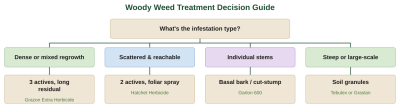
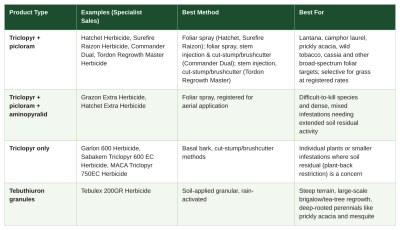
The right product depends on the species, infestation density, and terrain. Three active ingredients, triclopyr, picloram, and aminopyralid, form the backbone of woody weed control in Australia, used alone or in combination via foliar spraying, basal bark treatment, cut-stump, or drill-and-fill.
The three-active combination (Grazon Extra, Hatchet Extra) is the broadest-spectrum foliar option on the market and has a longer soil residual than the two-active products, which is why it’s often the pick for dense or mixed infestations that need a single-pass result.
Garlon 600 sits at the other end; no aminopyralid means less soil residual, useful where you plan to plant back to sensitive species.
Tebuthiuron granules work differently: they’re absorbed through the root zone after rainfall, making them the practical option on large-scale regrowth where foliar spraying isn’t feasible. It is not recommended for steep country as the pellets can move in the soil and harm non targeted species.
Application Tips for Spring Woody Weed Foliar Spray Treatments
- Spray to wet, not to runoff. Full leaf coverage without dripping gets the dose where it needs to go; runoff wastes product and reduces uptake.
- Target plants before flowering. Seed set can be rapid once flowering begins; treating before this stops the next generation before it starts.
- Avoid spraying in wind or ahead of rain. Drift onto sensitive non-target plants, cotton, fruit trees, vegetables, and eucalypts in particular, can cause serious off-target damage. Allow several hours after application before rainfall.
- Observe plant-back periods. Picloram- and aminopyralid-containing products have soil residual activity; check the label plant-back period before replanting treated areas to legumes or sensitive crops.
- Don’t forget to add a penetrant. Spray additives like penetrants, surfactants & adjuvants help breakdown the surface tension of the plant and spreads the herbicide evenly across the leaf surface. They assist in penetrating’ the waxy cuticle which improves herbicide uptake and absorption, improving control and allowing more consistent results, especially on hard-to-wet or waxy-leaved weeds.
Broadleaf weeds – Your Best Window Is Now
Capeweed smothering a paddock, nodding thistles bolting to stem, Paterson’s curse spreading across a hillside, dock sitting in a ryegrass pasture- these are the situations that cost Australian graziers and grain growers productive area year after year, and spring is when the spray program either gets ahead of the problem or falls behind it.
Annual weeds are best targeted young, before they develop extensive root systems. Perennials like thistles and horehound are most susceptible just before the bud stage, when they’re actively moving energy into their roots and will carry the herbicide deeper into the plant.
For more information on controlling broadleaf weeds, explore this guide.
Which Herbicides and Methods to Use
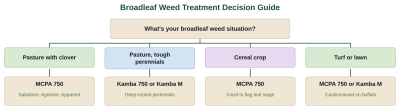
The right product depends on the weed spectrum, whether legumes are present, and the situation: pasture, cereal crop, or turf. Two active ingredients, MCPA and dicamba, form the backbone of broadleaf weed control in Australia, used alone, in combination, or tank-mixed with a partner product to broaden the spectrum.
Pastures – Thistles, Capeweed, Fireweed and Broadleaf Problem Weeds
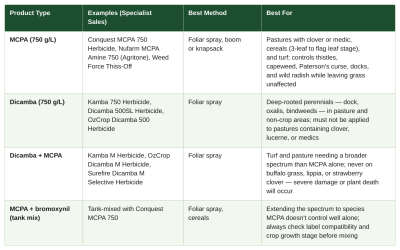
MCPA 750 remains one of the most widely used and cost-effective options for broadleaf weed control in established grass-based pastures, controlling more than 80 broadleaf weed species, thistles (nodding, variegated, Scotch, spear, saffron, artichoke and more), capeweed, Paterson’s curse, Bathurst burr, docks, horehound, wild turnip, and wild radish, while leaving grass essentially unaffected when applied correctly. It’s generally the preferred choice over 2,4-D amine where legumes are present, as it’s somewhat more tolerant of clovers and medics, though damage can still occur at higher rates.
Where tougher perennials need more firepower, or a broader weed spectrum is needed, dicamba excels on deep-rooted perennials that MCPA alone can struggle with – see the table above for method and restrictions.
Cereals – Broadleaf Weed Control in Growing Crops
In winter cereal crops emerging from the cooler months, broadleaf pressure from wild radish, wild turnip, charlock, capeweed, and doublegee is often most visible and most manageable in spring. MCPA 750 is registered for use in wheat, barley, oats, triticale, and cereal rye from the 3-leaf stage through to flag leaf emergence, giving a meaningful spray window before weeds compete significantly with the crop or set seed.
Tank mixing MCPA with bromoxynil extends the weed spectrum to include species MCPA doesn’t control well on its own and can improve efficacy on mixed broadleaf populations. Always check label compatibility and critical growth stage comments for your specific crop and region before mixing.
Turf – Broadleaf Weeds in Lawns and Sports Turf
Spring flushes of bindii, capeweed, clover, dandelion, and flatweed in lawns and playing fields are best treated now, while weeds are young and actively growing. MCPA 750 is registered for established turf, with a caution around buffalo grass; this species is more sensitive than couch, kikuyu, or ryegrass, so use the lower registered rate and monitor for temporary yellowing.
For broader-spectrum turf control that handles both fast-growing annuals and tough deep-rooted perennials, Kamba M controls over 50 weed species in turf, including bindii, capeweed, oxalis, dandelion, dock, and thistle, while preserving couch, kikuyu, fescue, ryegrass, and bentgrass. It is safe on common couch, couch hybrids, and kikuyu (with some transient yellowing possible on kikuyu that resolves without permanent damage), but must never be applied to buffalo grass, lippia, or strawberry clover turf.
Key Spray Tips for Spring Broadleaf Weed Control
- Spray when weeds are actively growing. Moderate temperatures, adequate soil moisture, and settled weather give the best results; cold or drought-stressed plants take up herbicide slowly and inconsistently.
- Allow 2 hours after application before rain. MCPA 750 and related products are rainfast within 2 hours, but earlier rain significantly reduces efficacy.
- Observe the 7-day withholding period before grazing or cutting for stock food after applying MCPA or related products to pastures.
- Watch stock after spray-grazing. Dying weeds, particularly capeweed, Paterson’s curse, and variegated thistle, can become more palatable after spraying and may be toxic in large quantities. Introduce stock carefully and monitor grazing behaviour.
Cattle Health – Worm Burdens and Ticks Are Building
The same spring conditions that drive pasture and weed growth also accelerate the life cycles of internal parasites and cattle ticks. Warming temperatures speed larval development on pasture, and fresh spring pasture, while highly nutritious, carries higher larval burdens than the harder, drier feed of winter. Cattle grazing that pasture ingest more larvae than they did a few weeks ago, and burdens can climb quickly, particularly in younger cattle and weaners.
Cattle tick populations build the same way. In tick-endemic areas of Queensland, the Northern Territory, and northern New South Wales, warming spring soil temperatures trigger a significant rise in tick activity. A well-timed treatment now, before tick and worm populations peak, is considerably more cost-effective than treating a heavily burdened mob later in the season.
Internal Parasites – Getting on Top of Worms in Spring
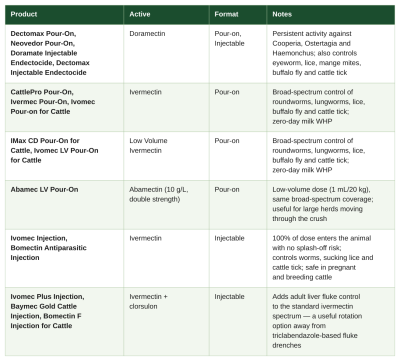
The macrocyclic lactone (ML) group: ivermectin, doramectin, abamectin, and moxidectin, remains the most widely used drench class for internal and external parasite control in Australian cattle, offering broad-spectrum activity as pour-ons and injectables.
Cattle Tick – Knocking Numbers Back Before They Peak
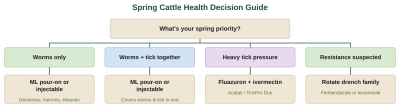
ML pour-ons and injectables provide effective knockdown of cattle tick (Boophilus microplus) for 21 to 28 days, addressing internal parasites and other external pests in a single treatment. For heavier tick pressure or declared tick areas, fluazuron-based tick development inhibitors, Acatak Duostar and TickPro Duo (fluazuron + ivermectin), or fluazuron-only options like TickPro Pour-On or Oztik Pour-On, offer long-term tick suppression by interfering with chitin synthesis in larval tick stages. Alternate these with conventional pour-ons or dips when repeat treatments are required to slow resistance development. Always check state tick area requirements for your region, as treatment intervals and product registration vary by jurisdiction.
A Note on Drench Resistance
Resistance to macrocyclic lactone drenches is documented in Australian cattle parasite populations, particularly in Cooperia species. Industry guidance from WormBoss and Meat & Livestock Australia is consistent: the ML group has been the dominant drench class in cattle for around 30 years, and heavy reliance on it without rotation is a major driver of the resistance now being seen, especially in Cooperia. Agriculture Victoria notes that benzimidazole (BZ) drenches remain a cheaper, useful option in rotation, while levamisole-based drenches are mainly used in Australia’s northern regions.
Rotating drench families, using fenbendazole (a benzimidazole) or levamisole in rotation with ML products, is one of the most effective ways to slow resistance and protect the long-term efficacy of the ML group. Specialist Sales stocks oral and injectable drench options across multiple active ingredient families to support a proper rotation program.
When planning a spring drench program, prioritise by stock class: weaners and young stock generally carry the heaviest worm burdens and should be treated first. Breeding cows approaching calving and bulls prior to joining are other key intervention points.
Frequently Asked Questions
Why does spring matter more than other seasons for woody weed spraying?
Because the plant is actively growing. Herbicide moves with the plant’s carbohydrate and water flow, so a treatment applied to actively growing tissue in spring reaches the roots and growing points, delivering a genuine kill rather than the top-kill and regrowth you’d get from spraying a stressed or semi-dormant plant.
Can I use MCPA 750 on a pasture with clover?
Yes, MCPA 750 is generally more tolerant of clovers and medics than 2,4-D amine, making it the preferred choice where legumes are present in the pasture. That said, damage can still occur at higher rates, so check the label rate for your situation.
Is Kamba M or Kamba 750 safe on buffalo grass?
No. Both products will severely damage or kill buffalo grass, and neither should be used on Lippia or strawberry clover. For buffalo lawns needing broadleaf control, look at a product specifically registered for buffalo turf instead.
How soon after spraying broadleaf weeds in a pasture can I graze it?
Observe the 7-day withholding period before grazing or cutting for stock food after applying MCPA or related products. Also watch stock closely in the days after spraying. Dying weeds like Capeweed and Paterson’s Curse can become more palatable and potentially toxic in large quantities as they die off.
Which cattle drench should I use if I’m worried about resistance?
There’s no single answer; resistance management is about rotation, not a single “best” product. Alternating macrocyclic lactone drenches with a benzimidazole (fenbendazole)- or levamisole-based product in a planned rotation is the approach recommended by WormBoss and MLA to slow resistance development in worm populations such as Cooperia.
Do tick treatments also control worms? ML-based pour-ons and injectables (ivermectin, doramectin, abamectin) control worms and cattle tick in the same treatment. Fluazuron-only products like Oztik are tick-specific and don’t control internal parasites; fluazuron-ivermectin combinations like Acatak Duostar or TickPro Duo cover both.
Make Spring Work for You
The three-week window either side of peak spring growth is one of the most productive intervention points of the farming year. Herbicides are most effective when weeds are actively growing. Parasite treatments have the most impact when applied before populations peak, not after. Getting ahead of these pressures, rather than chasing them, is what separates a productive season from a stressful one.
If you’re working through your spring spray list or planning a drench program and aren’t sure which product is right for your situation, the team at Specialist Sales is here to help. Browse the full range at specialistsales.com.au or call 1800 780 317 for personalised advice.
Always read and follow product labels before use. Ensure all products are registered for your specific situation, crop, weed, or animal class. Withholding periods, plant-back requirements, and regional restrictions vary by product and state; check the label before purchase and application. The information in this article is general in nature and does not constitute specific agronomic or veterinary advice. Consult your agronomist or veterinarian for guidance tailored to your property and herd. Specialist Sales’ liability is limited; please review our Terms and Conditions.
About the author