
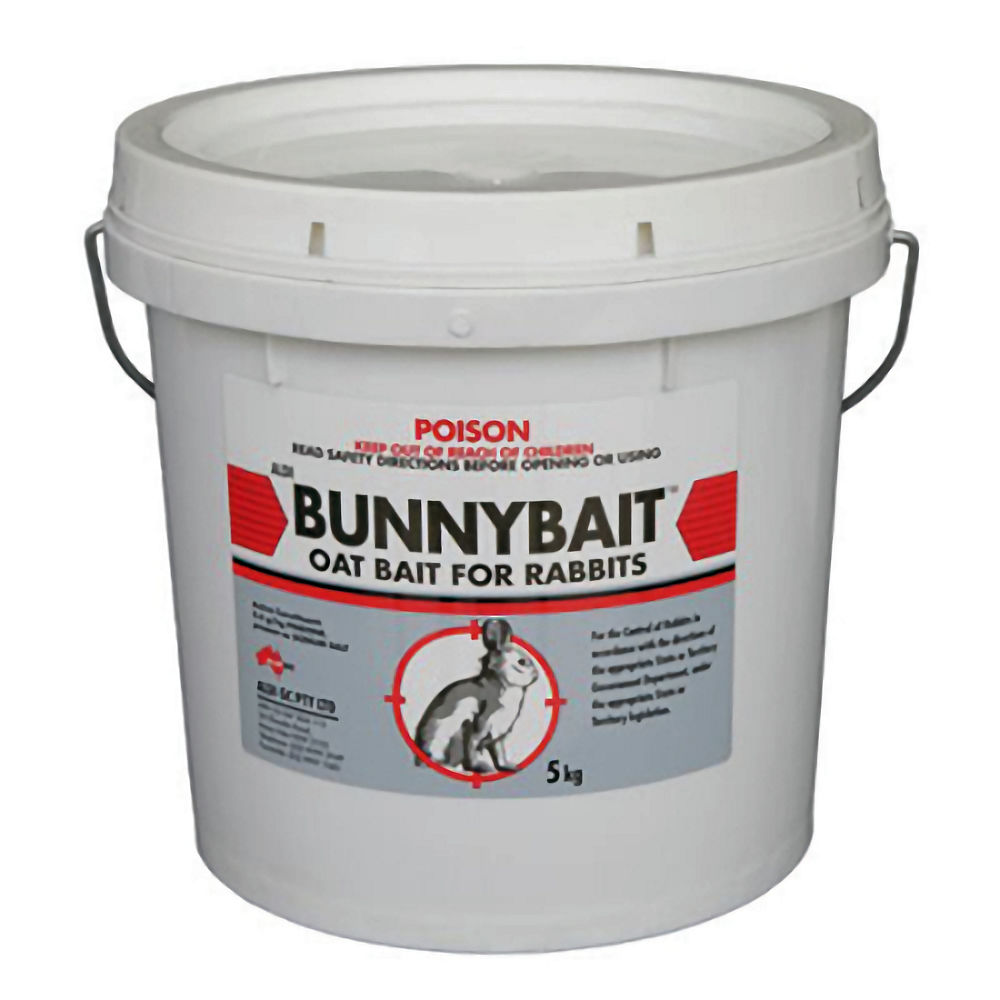
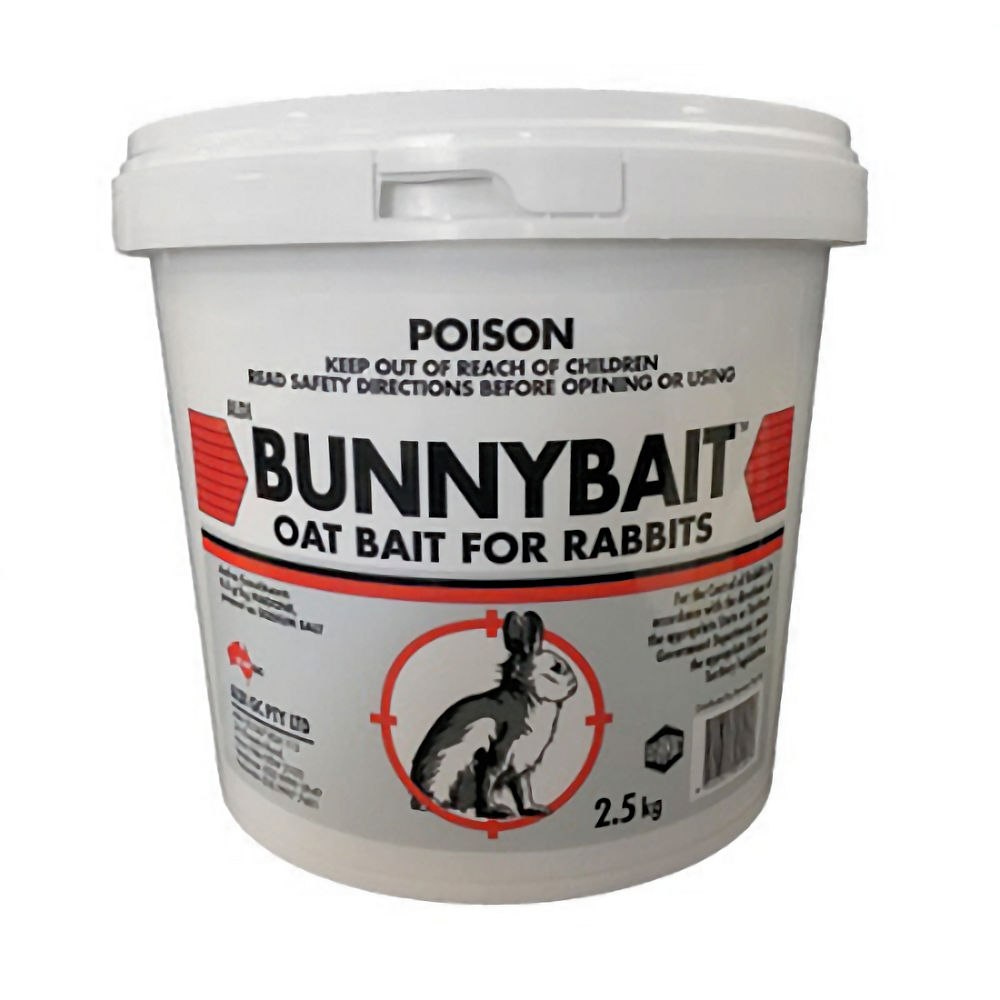
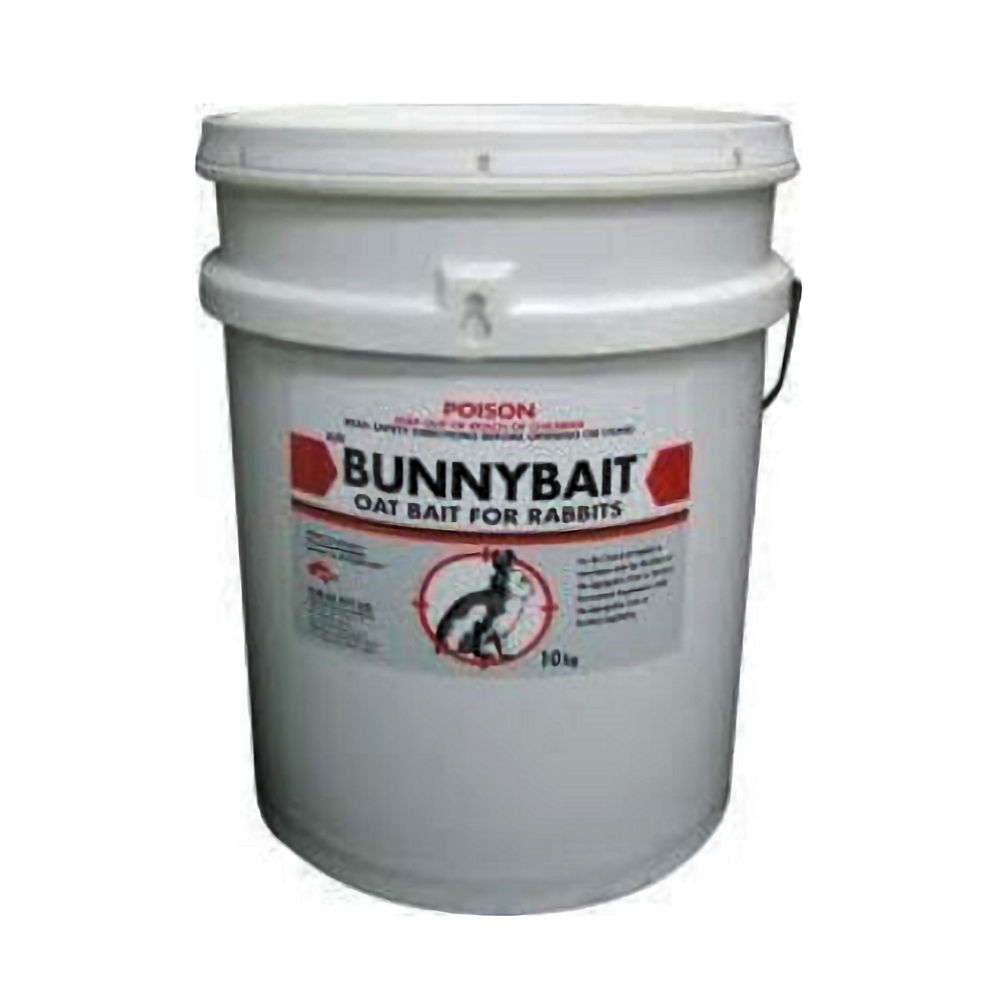
Bunnybait Oat Bait For Rabbits

Bunnybait Oat Bait for Rabbits, with Pindone, offers a strategic and safer solution for rabbit control in both urban and rural settings. This chronic anticoagulant poison requires multiple feeds, reducing risk to non-target animals.

It’s designed for use around farms, farm buildings, and in closely settled areas. Bunnybait does not build up in the food chain and is a sterilised, green-dyed oat bait to further minimise risks. Always use in accordance with State or Territory regulations for effective and responsible rabbit management.

Active Ingredient: Pindone @ 0.5g/kg

Similar or comparable to Shotgun Pindone Oat Rabbit Bait (Freezone)

Click For Technical Info & Tips For Use
0 out of 5 (0 customers reviews)

QuantityDiscountStatus
2 or more$205.00 eachAvailable
-
+

Free & Fast Shipping

Not able to be delivered to a PO box Live remotely? Please ensure a courier can reach your address. Click here for shipping info or give us a call.

This item is dangerous and requires a courier! Ensure a courier can reach your address.
Don’t worry, shipping is STILL FREE!
Click here for shipping info or give us a call.

Ordering multiple large items? They will be shipped on a skid or pallet to ensure that your items arrive safely and securely. The delivery truck will need to be unloaded with a forklift. If you do not have a forklift, please provide an address where a forklift is present.

This item is large and requires a courier! Ensure a courier can reach your address.
Don’t worry, shipping is STILL FREE!
Click here for shipping info or give us a call.

Ordering multiple large items? They will be shipped on a skid or pallet to ensure that your items arrive safely and securely. The delivery truck will need to be unloaded with a forklift. If you do not have a forklift, please provide an address where a forklift is present.

Bunnybait Oat Bait For Rabbits BUNNYBAIT Amgrow

Description

Bunnybait Oat Bait For Rabbits

Active Ingredient: Pindone @ 0.5g/kg

Similar or comparable to Shotgun Pindone Oat Rabbit Bait (Freezone)

Bunnybait Oat Bait for Rabbits offers a strategic solution for rabbit control, particularly in areas where traditional methods are insufficient or too costly. Bunnybait utilises pindone, a chronic anticoagulant poison, which requires multiple feeds for lethality, making it safer for non-target animals and humans due to its slow action and minimal buildup in the food chain. An effective control program involves understanding rabbit behaviour, identifying active areas, and employing free-feeding before poison bait application. Monitoring and adapting the program based on observed results are essential for optimising control efforts.

Using Bunnybait Oat Bait For Rabbits for the Control of Rabbits must be done in accordance with the directions of the appropriate State or Territory Government Department, under the appropriate State or Territory legislation. It can be used for the control of rabbits in and around farms and farm buildings, and in urban and closely settled areas. Pindone is one of two poisons registered for rabbit control in Australia. The other poison is sodium fluoroacetate or “1080”, which is normally used in rural areas only. 1080 cannot be used in built-up areas because of the dangers of secondary poisoning of dogs and cats (which may eat rabbit carcasses).

Bunny Bait contains 0.5g/kg of Pindone, present as a sodium salt. It is a first-generation anti-coagulant poison that blocks the process in the liver that recycles vitamin K, which prevents the blood from clotting, resulting in death. This may take several days to occur. Designed in accordance with the directions of the appropriate state or territory government department and legislation. 

Pindone interferes with the routine synthesis of vitamin K-dependent blood clotting factors in the liver. Without these factors, the normal daily damage to blood vessels can no longer be repaired. Poisoned animals usually die from multiple causes associated with anaemia or hypovolemic shock. A large single dose (18 mg/kg for rabbits) or repeated smaller doses (0.52 mg/kg/day over 7 days) are generally needed to induce death. After ingestion of anticoagulants, there is usually a lag period of 3-5 days before the onset of clinical signs. This delayed onset reflects the time required to deplete existing stores of vitamin K and blood-clotting factors.I

Why choose Bunnybait Oat Bait for Rabbits

  • It can be used in and around farms and farm buildings, and in urban and closely settled areas.
  • A first-generation anti-coagulant poison.
  • As a chronic poisoner, domestic animals/wildlife would need to have several feeds before sufficient toxic action is caused to induce death.
  • Does not build up in the food chain.
  • A sterilised oat bait, dyed green to reduce risk to birds and sterilised to prevent seed germination.

Bunnybait Oat Bait For Rabbits is a sterilised oat bait, dyed green to reduce risk to birds and sterilised to prevent seed germination.

Pack Sizes: 2.5kg, 5kg and 10kg

Registrant: Aldi GC Pty Ltd (APVMA #: 53850)

Pest Control Product Range

Features & Benefits

  • It can be used in and around farms and farm buildings, and in urban and closely settled areas.
  • Contains Pindone, a first-generation anti-coagulant poison.
  • As a chronic poisoner, domestic animals/wildlife would need to have several feeds before sufficient toxic action is caused to induce death.
  • Does not build up in the food chain.
  • A sterilised oat bait, dyed green to reduce risk to birds and sterilised to prevent seed germination.

Share your thoughts!

0 out of 5 stars

0 reviews

Let us know what you think...

What others are saying

There are no contributions yet.

×

Welcome back

Existing account holders please login below via Email or Google Account or Click here to register your NEW FREE ACCOUNT.

Already Registered? Sign in with your email
Register for an account

Secure Checkout

You can shop with Specialist Sales online store with confidence. We have partnered with PayPal, Master and Visa Card which is provided by Braintree. Braintree payment technology accepts credit cards and electronic payments safely and securely for our customers.

Braintree transactions are processed using the 3D Secure framework to ensure your sensitive customer information and credit card processing is safe and secure. Similarly, PayPal also provides comprehensive buyer protection for your peace of mind.

Your information is safe

Specialist Sales adheres to strict industry standards for payment processing, using industry leading security protection measures including 128-bit Secure Sockets Layer (SSL) technology for secure Internet Protocol (IP) transactions, and compliance with the Payment Card Industry Data Security Standard (PCI DSS).

Continue as a Guest

Directions Of Use

For Bunnybait Oat Bait For Rabbits directions for use, click here.


  • Situation: Farms and farm buildings, urban and closely settled areas.
  • Pest: Rabbits
  • Rate: 
    • Low density of rabbits: 3 kg per km bait trail
    • Medium density of rabbits: 6 kg per km bait trail
    • High density of rabbits: 9 kg per km bait trail
  • Critical Comments:
    • For more details and information on the use of Bunnybait, see General Instructions.
    • De-stock all paddocks or isolate the bait stations before baiting.
    • Baits must be laid in the evening through rabbit feeding areas at a low enough rate to ensure overnight consumption of most bait by rabbits.
    • Free feeding before the application of poison baits to encourage rabbits onto bait trail is optional, but may assist in determining the amount of bait required. 
    • Apply un-poisoned baits to the area where rabbits are feeding and adjust quantities so that no more than 20% of the bait remains on the following morning.
      • First Poison Feed: 3-5 days after the last free feed (if used).
      • Second Poison Feed: 3-5 days after first poison feed.
      • Monitor uptake after the 1st and 2nd poison feeds and adjust the quantity laid to account for take.
      • Third Poison Feed: 3-5 days after second poison feed.
    • Collect all uneaten bait/cover trail within a period of 4 days after the last baits are laid.
    • Collect all carcasses for up to 12 days after the last poison feed.
  • Where there is a significant risk of exposure to non-target animals, measures must be taken to reduce this risk, or bait should not be laid.
  • If uncertain, users should seek advice regarding risk reduction measures from the Department of Agriculture/Primary Industries, Parks and Wildlife Service, Local Land Services or similar Authority in their respective State/Territory.

Poisoning Program:

  • Monitor Site and Assess Infestation:
    • Locate warrens, rabbit harbour, and feeding areas.
    • Map paddocks, identify rabbit-prone soils, wildlife congregation areas, rocky areas, warrens, and rabbit-free zones.
    • Conduct spotlight counts for three consecutive nights to identify high, medium, or low rabbit infestation areas.
    • Use warren monitoring and rabbit counts to assess burrow activity and rabbit age.
  • Notify Neighbours
    • In NSW, give at least three days’ notice to adjoining neighbours before laying Bunnybaits baits.
    • Post notices specifying the target animal and application date at all property entrances, poisoning site entrances, and boundaries fronting public thoroughfares for at least four weeks.
  • Laying Bait
    • Lay bait in trails (furrows or mown swathes) through feeding areas of high rabbit activity.
    • Recommended trail locations: one near rabbit living areas (not closer than 30m) and another 40m further out.
    • Furrow baiting: Cut continuous furrows 10cm wide and 2cm deep (max 10cm) between feeding areas and harbour, and through feeding areas. For large-scale programs, use 16km of trail per 100ha with trails 40m apart.
    • Scatter (broadcast) baiting: Thinly broadcast bait in a 5m wide swathe using a vehicle-mounted machine, primarily for areas where furrowing is impractical.
    • Aerial Baiting: Effective for steep, rocky, and hilly areas; requires discussion with the appropriate State/Territory authority in advance due to restrictions and legal requirements.
  • Amount of Bait Required:
    • Low density ( \<20 rabbits/km): 3 kg bait per km trail
    • Medium density (21-50 rabbits/km): 6 kg bait per km trail
    • High density ( \>50 rabbits/km): 9 kg bait per km trail
  • Ensure sufficient bait for each rabbit to consume approximately 15-30g per application.

Rates are a general guide only.  Before opening, carefully read Bunnybait Oat Bait For Rabbits directions for use, precautionary and protection statements, storage and disposal, safety directions and first aid instructions.  The product is designed for the particular purpose indicated on the label. Failure to use the product strictly as directed may be illegal and dangerous, and render the product ineffective.

Questions and answers from customers

There are no questions yet. Be the first to ask a question about this product.

Send me a notification for each new answer.

Disclaimer: This information and product advice is not intended to be advice or recommendations for any specific use or circumstance. You should seek specialist advice before using any product. Always follow the manufacturer’s guidelines. Specialist Sales liability is limited.

Host & Pest

Host Pest
Host & Pest
Agricultural/Farm Buildings, Closely Settled Areas, Farms And Urban Areas Rabbit

Tips For Use

General Instructions:

  • The most cost-efficient method to control rabbits and prevent reinfestation is to work cooperatively with neighbours.
  • The use of pindone baits is only the first step in the control of rabbits. 
  • Follow-up action consisting of harbourage destructions, both above-ground surface harbour and warren destruction, is required if control is to be achieved.
  • Consult your local authority for more information on how to complete a full control program.
  • Rabbits poisoned with pindone usually die after a delay while body stores of clotting factors and vitamin K are exhausted. 
  • Overall, rabbit numbers are expected to progressively decline, commencing about 10 days after the first application.
  • Although rabbit poisoning programs can be carried out year-round, baiting is most effective when alternative food for rabbits is scarce (eg, end of summer or early autumn). 
  • Baiting may be less effective during the breeding season.
  • Check rabbit-prone areas at least 4 times a year. 
  • Spotlight counts are the most common method used.

Restraints: 

  • Do not lay bait trails in the vicinity of kangaroo, bandicoot and native rodent refuge areas.
  • Do not lay baits if heavy rain is expected in the next 24 hours.
  • Do not heap baits.
  • Do not use in urban areas on residential blocks less than 1000 square metres in size.

Precautions:

  • Do not place baits in locations that are accessible to children.
  • Do not allow bait to contaminate foodstuffs or feed intended for human or animal consumption.

Protection Of Livestock:

  • Do not allow stock to graze in any treated area.
  • Do not place baits in locations that are accessible to domestic animals or livestock.

Storage and Disposal:

  • Store in the closed, original container at or below 25°C (room temperature). 
  • Do not store for prolonged periods in direct sunlight. 
  • At the end of the control program, collect or bury the residual bait before allowing stock onto the baited area. 
  • Both during and at the end of the program, recover any rabbit carcasses and destroy them by incineration (where permitted) or deep burial, as some species of birds are susceptible to poisoning from rabbit carcasses.
  • Triple rinse containers before disposal. 
  • Dispose of rinsings in a disposal pit marked and set up for this purpose, clear of waterways, desirable vegetation and tree roots.
  • Break, crush, or puncture and deliver empty packaging for appropriate disposal to an approved waste management facility. 
  • If an approved waste management facility is not available, bury the empty packaging 500 mm below the surface in a disposal pit specifically marked and set up for this purpose, clear of waterways, desirable vegetation and tree roots, in compliance with relevant Local, State or Territory government regulations. 
  • Do not burn empty containers.

Safety Directions: 

  • Poisonous if swallowed. 
  • Do not touch bait.
  • Do not inhale dust. 
  • When preparing and distributing the bait, wear elbow-length PVC gloves. 
  • If the product is on the skin and after baiting, wash thoroughly with soap and water. 
  • Wash your hands and gloves after use. 
  • Vitamin K1 (phytomenadione) is antidotal.

First Aid Instructions: 

This information and product advice is not intended as advice or recommendations for any specific use or circumstance. You should seek specialist advice before using any product. Always follow the manufacturer’s guidelines. Specialist Sales liability is limited.​

Withholding Period

Withholding Period Details: (WHP)

  • Not applicable when used as directed.

SDS & Technical

Specialist Sales Bunnybait Oat Bait For Rabbits Label (APVMA) Download Pdf
Specialist Sales Bunnybait Oat Bait For Rabbits SDS Download Pdf

Related Products